


What materials work best for 2K injection molding
In 2K injection molding, a successful part is born long before the machine starts. It begins with a single, critical decision: the materials. While the advanced process and precision tooling are essential, it is the fundamental science of polymer compatibility that dictates the strength, durability, and performance of the final component. Choosing the right combination is the difference between a product that fails under stress and one that lasts a lifetime.
The best materials for 2K injection molding are compatible pairs of a rigid substrate (like ABS, PC, or PP) and a flexible or second rigid overmold (like TPE or TPU) that are chosen specifically for their ability to form a strong, permanent chemical or mechanical bond. This selection is a careful balance of physical properties, chemical compatibility, application requirements, and budget.
As a material science expert with a global manufacturing footprint in both China and the USA, SunOn Mould has a deep understanding of polymer interaction. We source, test, and process a vast range of engineering-grade plastics to meet the complex demands of our international clientele. This guide is a deep dive into the materials that make 2K molding possible, providing the expert knowledge you need to make the right choice for your project.
The Foundation of Success: Chemical vs. Mechanical Bonding Explained
The entire principle of 2K injection molding rests on the ability to make two distinct materials stick together permanently. This is achieved through one of two methods: a powerful chemical fusion or a clever mechanical interlock. Understanding the difference is the first step in material selection.
Chemical Bonding
A chemical bond is the gold standard in 2K molding. It occurs when the two selected plastics are from compatible polymer families. During the second injection shot, the intense heat of the molten overmold material melts the surface layer of the solid substrate. This allows the polymer chains from both materials to physically entangle and cross-link at a molecular level as they cool.
Think of it like welding two pieces of steel. The process fuses them into a single, continuous piece with no discernible seam. A successful chemical bond is often as strong as the materials themselves, creating a part that is virtually impossible to separate without destroying it. This method is preferred for its strength, seamless appearance, and ability to create watertight seals.
Mechanical Bonding
A mechanical bond is an engineering solution used when two chemically incompatible materials must be joined. In this case, there is no molecular fusion. Instead, the bond relies entirely on the physical geometry of the part. The substrate is designed with features like undercuts, holes, grooves, or textured channels.
During the second injection shot, the overmold material flows into and around these features. As it solidifies, it becomes physically locked in place. Think of it like pouring concrete into a mold with rebar inside; the concrete holds onto the rebar, creating a strong composite structure. While not as seamless as a chemical bond, a well-designed mechanical interlock can produce an incredibly robust and reliable part. This method is essential for joining materials like Acetal (POM) with soft elastomers.
The Ultimate 2K Material Compatibility Chart
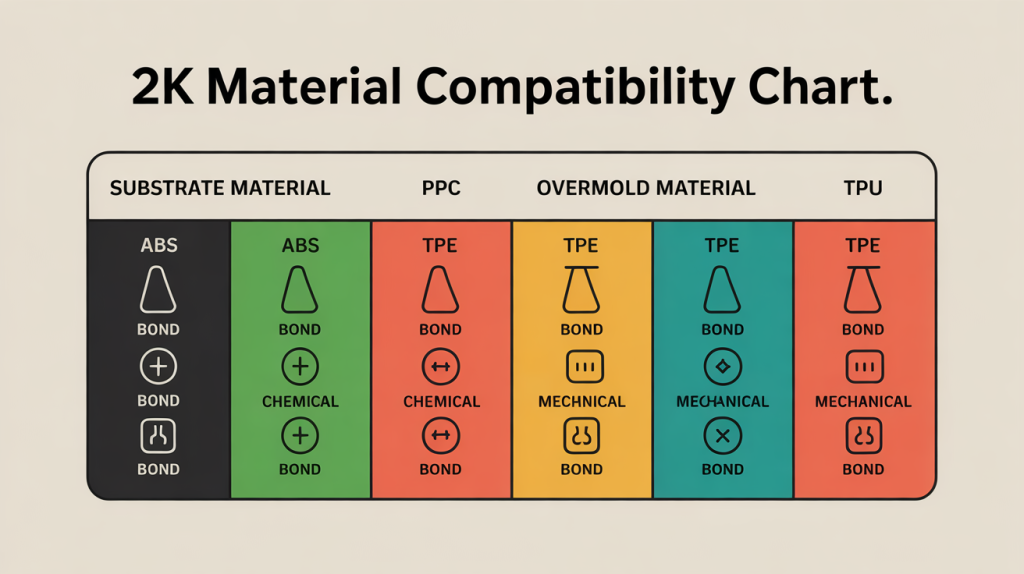
Choosing the right material pair is the most critical decision an engineer will make in a 2K molding project. This chart serves as a comprehensive guide to common pairings, their bond type, and their ideal applications. It’s the starting point for any serious design discussion.
| Substrate Material (Rigid) | Common Overmold Material(s) | Bond Type | Key Characteristics & Common Applications |
| PP (Polypropylene) | TPE-S, TPV (Bondable Grades) | Chemical | Cost-effective, excellent chemical resistance. Used for consumer goods, packaging (caps/closures), and automotive components. |
| ABS | TPE-S, TPU | Chemical | Great aesthetics, good impact strength and stiffness. Used for electronic housings, handheld devices, and appliance panels. |
| PC (Polycarbonate) | TPE-S, TPU, LSR | Chemical | Excellent toughness, clarity, and heat resistance. Used for rugged electronics, power tool handles, and medical devices. |
| PC/ABS Alloy | TPE-S, TPU | Chemical | Combines the heat resistance of PC with the processability of ABS. Ideal for demanding automotive interiors and electronics. |
| PA (Nylon) | TPE-S, TPE-V, TPU (Bondable Grades) | Chemical | High strength, temperature resistance, and excellent wear properties. Used for industrial components, gears, and under-hood auto parts. |
| POM (Acetal) | Most TPEs/TPUs | Mechanical | Extremely low friction (slippery), high stiffness. Requires mechanical interlocks for bonding. Used for gears and high-wear moving parts. |
| PBT | TPE-S | Chemical | Good electrical insulator, dimensionally stable. Used for electronic connectors, sensors, and automotive lighting bezels. |
| PMMA (Acrylic) | TPE-S, TPU | Chemical | Excellent optical clarity and scratch resistance. Used for creating "windows" with integrated soft seals or light pipes. |
A Deep Dive into Common 2K Materials
While the chart provides pairings, understanding the individual characteristics of the most common substrates and overmolds is essential for nuanced decision-making.
Part 1: The Substrates (The Rigid Core)
The substrate forms the structural foundation of the part. Its properties define the component's strength, temperature resistance, and overall durability.
- Polypropylene (PP): As one of the most widely used commodity plastics, PP is valued for its low cost, light weight, and excellent resistance to chemicals and moisture. It's a versatile choice for a huge range of consumer products, from container lids with integrated seals to automotive interior trim.
- ABS (Acrylonitrile Butadiene Styrene): ABS is a popular engineering thermoplastic known for its impact resistance, rigidity, and high-quality surface finish. It’s easy to process and readily accepts color, making it a favorite for consumer electronics housings, kitchen appliances, and decorative automotive parts.
- Polycarbonate (PC) & PC/ABS: When exceptional toughness is required, PC is the answer. It has incredible impact strength (it's used for bullet-resistant glass) and maintains its properties over a wide temperature range. A PC/ABS alloy blends the best of both worlds, offering a fantastic balance of strength, heat resistance, and processability.
- Polyamide (PA / Nylon): Known for its high mechanical strength, stiffness, and excellent resistance to wear and abrasion, Nylon is a workhorse for demanding industrial applications. It's used in gears, bearings, and structural components that require long-term durability under load.
Part 2: The Overmolds (The Second Layer)
The overmold material is what defines the part's tactile feel, color contrast, or sealing capability.
- TPE (Thermoplastic Elastomer): This is a broad family of rubber-like materials, with TPE-S (styrenic block copolymers) being the most common for overmolding. TPEs are incredibly versatile, available in a vast range of hardness levels (from gel-soft to firm rubber), and are easily colored. They provide the signature "soft-touch" feel on ergonomic products. This is the key material used in creating high-quality soft touch grips.
- TPU (Thermoplastic Polyurethane): When durability is paramount, TPU is the preferred choice. It offers superior resistance to abrasion, tearing, and exposure to oils and greases. While often firmer than TPEs, its toughness makes it ideal for caster wheels, industrial tool grips, and protective cases for electronic devices.
- LSR (Liquid Silicone Rubber): LSR is a thermosetting material that is processed in a specialized 2K molding process. It offers outstanding thermal stability (withstanding very high and low temperatures), is inherently biocompatible and hypoallergenic, and has excellent compression set (it returns to its original shape after being squeezed). This makes it the premier choice for medical device seals, infant care products, and baking molds.
How Do You Choose the Right Material Pair for Your Project?
With so many options, how do you narrow down the choices? A systematic approach is key. For any project, your engineering team should answer these five critical questions:
1. What is the Operating Environment? The single most important factor. Will the part live outdoors, requiring UV resistance? Will it be exposed to harsh chemicals, oils, or cleaning agents? Will it need to function in extreme heat or cold? The answers will immediately eliminate many material candidates.
2. What is the Required Hardness and Tactile Feel? For ergonomic applications, the "feel" is everything. This is defined by Shore Hardness. Do you need a soft, gel-like cushion (Shore 20A) or a firm, high-friction grip (Shore 70A)? Prototyping different hardness levels is often a crucial step.
3. Are there Regulatory Needs? If the part is for a medical device, it may need to be made from USP Class VI certified materials. If it will contact food, it must be FDA compliant. These regulatory requirements severely restrict material options but are non-negotiable for market access.
4. What is the Project Budget? Material costs can vary dramatically. While a standard PP+TPE combination is highly cost-effective, a high-temperature Nylon paired with a medical-grade LSR will be significantly more expensive. Performance must be balanced against the target cost per part.
5. What is the Desired Aesthetic Finish? Will the part have a high-gloss, textured, or matte finish? Some materials, like ABS, are excellent for achieving a premium cosmetic look, while others, like glass-filled Nylon, have a more industrial appearance. The material choice must align with the product's brand identity.
How Material Choice Directly Impacts Part Design
The material selection decision cannot be made in a vacuum; it has direct and immediate consequences for the physical design of the part. The principles of Design for Manufacturing (DFM) require that the material and geometry be developed in tandem.
- Scenario 1: You Choose a Chemically Compatible Pair (e.g., PC + TPU) Because these materials form a strong molecular bond, the designer has immense freedom. They can focus on smooth, flowing transitions between the hard and soft materials. The design can be sleek, minimalist, and driven purely by ergonomics and aesthetics, as the bond is guaranteed by the material science.
- Scenario 2: You Require a Chemically Incompatible Pair (e.g., POM + TPE) Because these materials will not fuse together, the designer’s primary task is to create a robust mechanical bond. The part must be designed with physical interlocks. This could include through-holes, wrap-around features, or a series of grooves and ribs that allow the TPE to physically anchor itself to the POM substrate. Here, the material limitation dictates the part's geometry. Ignoring this will lead to catastrophic delamination and product failure.
A Global Supply Chain Advantage: Sourcing Materials from China & the USA
Material availability, cost, and lead times can be a major logistical hurdle. Partnering with a manufacturer with a strategic global footprint provides a significant competitive advantage. SunOn Mould's dual presence in China and the USA creates a resilient and flexible supply chain for our clients.
- The China Advantage: Our facility in China gives us direct access to the world's largest and most diverse polymer production market. This allows us to source a vast array of materials, from commodity plastics to specialized engineering resins, often at a significant cost advantage. This is ideal for high-volume projects where optimizing the supply chain is key to profitability.
- The USA Advantage: Our US-based facility is perfectly positioned for projects requiring specialized, domestically sourced materials, such as those for medical or defense applications (ITAR). It also provides North American clients with a localized supply chain, faster material validation, and reduced shipping times.
This unified approach allows us to recommend and source the absolute best material for a project, regardless of origin, ensuring optimal performance, price, and logistics for our clients worldwide. Understanding the entire 2k injection molding process and its benefits is tied to this global material strategy.
Conclusion
In 2K injection molding, material selection is not just a step in the process; it is the process. It is a science that balances the complex interplay of chemical compatibility, physical performance, design requirements, and economic realities. The right choice leads to an innovative product that is stronger, more functional, and more valuable. The wrong choice leads to failure.
Navigating this complex landscape requires more than just a datasheet; it requires decades of hands-on experience and a deep understanding of how materials behave in the real world.
Choosing the right materials is complex. Partnering with an expert is simple. Contact our global engineering teams in the USA and China today to analyze your project and recommend the perfect material combination for success.
Frequently Asked Questions
Absolutely. 2K molding is often used to combine two different rigid materials to achieve a specific outcome, such as creating a chassis with a different colored, high-gloss outer shell, or molding a rigid part with an integrated clear window made of PC or PMMA.
The parts will fail to bond. The overmold layer will likely peel off the substrate easily, sometimes even falling off as the part is ejected from the machine. The product will have zero structural integrity.
Yes, they can. The carrier resins and pigments used in color concentrates can sometimes interfere with the chemical bonding process. For applications requiring a critical bond strength, it is essential to test the specific colored materials together before committing to mass production.
Before creating expensive production tooling, compatibility is often tested using prototype molds. A series of sample parts are molded and then subjected to destructive testing, such as peel tests and tensile tests, to quantitatively measure the bond strength and ensure it meets the project's specifications.
