


2K Injection Molding vs. Overmolding: Which Is Right for Your Product?
Choosing the right manufacturing process is one of the most critical decisions in product development. When your component requires multiple materials—like a hard plastic body with a soft, flexible grip—both 2K injection molding and overmolding are top contenders. The best choice hinges on your specific needs for durability, production volume, and cost.
Directly put, 2K injection molding is a single-machine process that creates a robust molecular bond between two materials, making it ideal for high-volume, complex parts. Overmolding is a two-step process that places one material over another, offering greater material flexibility and lower initial tooling costs, which is better suited for lower-volume production.
Key Takeaways for a Quick Decision
- Process: 2K molding uses one integrated, automated process; overmolding uses two separate steps, often with manual handling.
- Bonding: 2K creates a permanent chemical bond; overmolding typically relies on a mechanical or weaker chemical interlock.
- Cost & Volume: 2K has higher upfront tooling costs but lower per-part costs, making it perfect for high volumes. Overmolding is the reverse.
- Best Use: Choose 2K for superior durability and precision. Choose overmolding for prototyping and broader material variety.
What Is 2K Injection Molding?
2K injection molding, also known as two-shot or multi-shot molding, is a highly automated manufacturing process that creates a single, multi-material component during one machine cycle. It works by injecting a second polymer onto or around an initial substrate while it's still in the original mold. Because the first shot is at an optimal temperature, the two materials fuse together, forming a powerful and permanent chemical bond.
This integration is achieved using a specialized injection molding machine with two injection units. The mold is engineered to rotate or shift after the first material (the substrate) is injected, repositioning it for the second injection. The result is a seamless, two-material part created in seconds, without manual assembly or secondary processing. The primary advantage of this method is its incredible production efficiency and the superior bond strength between materials. To learn more, see our comprehensive guide to 2K injection molding.
What Is Overmolding?
Overmolding is a multi-step injection molding process where one material (the overmold) is molded onto a second, pre-existing part (the substrate). This process begins by creating the rigid substrate component through standard injection molding. Once cooled and solidified, that part is physically placed into a second, slightly larger mold cavity. The second material, often a softer thermoplastic elastomer (TPE), is then injected into, onto, or around the substrate.
This "pick and place" step can be performed by a machine operator or a robotic arm, introducing additional time and labor into the cycle. The bond created in overmolding is typically mechanical—the overmold material flows into holes or wraps around features in the substrate. While a chemical bond is possible if the materials are compatible, the bond is generally less robust than what is achieved with 2K molding. Its main advantage is the flexibility in material combinations and a lower initial investment in tooling.
Key Differences: 2K Molding vs. Overmolding Head-to-Head
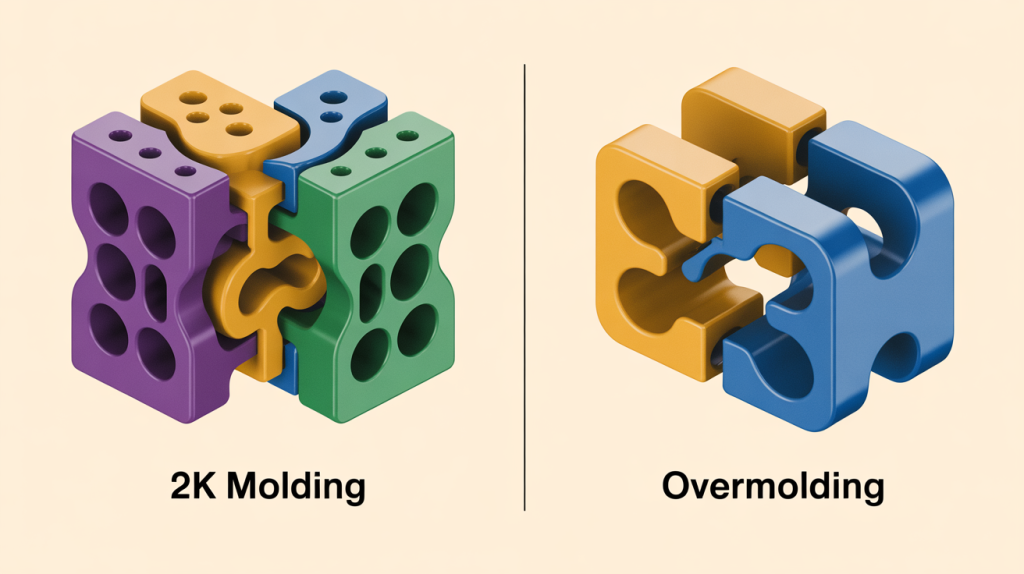
While both processes produce multi-material parts, their core mechanics create significant differences. The primary distinctions lie in the process efficiency, bond type, cost structure, and the design complexity each method can accommodate. Understanding these is key to making the most effective and profitable choice for your product line.
Process and Cycle Time
The most fundamental difference is in the manufacturing workflow. 2K injection molding is a highly efficient, single-machine process. Since the substrate is never removed from the mold and is immediately ready for the second shot, cycle times are incredibly fast—often just 30-60 seconds per finished part. This automation minimizes labor and the risk of contamination between shots, making it ideal for large-scale, continuous production.
Overmolding, by contrast, is a two-step operation. It requires the substrate to be molded, fully cooled, and then transferred to a different mold for the second shot. This adds significant time for cooling and handling, resulting in longer overall cycle times. The added labor for transferring parts also increases the potential for surface contamination (like dust or oils), which can compromise the bond between materials.
Material Bonding and Durability
The quality of the bond is a critical performance factor. 2K molding creates a permanent chemical bond. Because the second material is injected onto the first while it is still hot and in a receptive state within the mold, the two resins fuse together on a molecular level. This results in a superior, seamless bond that is incredibly strong and will not peel, separate, or delaminate over the product's lifespan.
Overmolding primarily relies on a mechanical interlock for its bond. Designers must incorporate features like holes, grooves, or rough surfaces into the substrate so the overmold material can physically grip it. While a chemical bond can be achieved if the materials are compatible, the conditions are less ideal than in 2K molding, often resulting in a weaker connection. For applications requiring maximum durability and longevity, the 2K bond is unmatched.
Production Volume and Cost Economics
Your budget and production volume will heavily influence your decision. 2K molding has a high initial investment due to the complex and expensive custom 2K injection mould required. However, its fast cycle times and low labor requirements lead to a very low per-part cost. This makes it the most economical choice for high-volume production runs, where the initial tooling cost can be amortized over hundreds of thousands or millions of units.
Overmolding offers a lower barrier to entry. The tooling is simpler and therefore less expensive to produce. However, the per-part cost is higher due to longer cycle times and the need for manual labor. This cost structure makes overmolding a more financially viable option for prototyping, low-volume production, or when the initial capital budget is a primary constraint.
Design Complexity and Precision
Both methods are highly capable, but 2K molding excels at creating complex and intricate designs. The automated process allows for extremely tight tolerances and seamless, clean transitions between materials. This is essential for sophisticated products like watertight electronic enclosures, medical devices, or automotive components where precision is non-negotiable.
Overmolding is better suited for less complex geometries, such as adding a soft-touch grip to a power tool or a protective bumper to a device casing. While still precise, the two-step nature can introduce slight variations in part placement, making it less ideal for designs that demand the absolute highest level of integration and tolerance control.
Comparison Table: Which Process Fits Your Needs?
This table breaks down the critical factors to help you decide between 2K injection molding and overmolding at a glance.
| Feature | 2K Injection Molding | Overmolding |
| Process Steps | Single, integrated machine cycle | Two separate molding steps |
| Bond Type | Strong chemical (molecular) bond | Primarily mechanical interlock; weaker chemical bond |
| Cycle Time | Very fast (typically 30-60 seconds) | Slower (requires cooling and part transfer) |
| Tooling Cost | High | Low to moderate |
| Per-Part Cost | Low | High (due to labor and longer cycle time) |
| Ideal Volume | High volume (100,000+ units) | Low to medium volume, prototyping |
| Material Compatibility | Requires chemically compatible polymers | More flexible; can bond incompatible materials mechanically |
| Common Applications | Medical devices, automotive buttons, electronics with seals | Power tool handles, toothbrush grips, kitchen utensils |
How to Choose the Right Process for Your Project
Your choice ultimately depends on balancing four key factors: your expected production volume, product performance requirements, budget constraints, and design complexity. Making the right decision upfront will save significant time and money over your product's lifecycle. To simplify the choice, use the following scenarios as a guide.
When to Choose 2K Injection Molding
Opt for 2K injection molding when performance, precision, and long-term cost efficiency are your primary drivers. It is the superior choice for:
- High-Volume Production: If you anticipate manufacturing runs exceeding 100,000 units, the high initial tooling cost is quickly offset by the low per-part cost and rapid cycle times.
- Mission-Critical Durability: For products where the bond cannot fail—such as medical devices, automotive sensors, or electronic enclosures requiring a permanent waterproof seal—the molecular bond from 2K molding is non-negotiable.
- Complex, Integrated Designs: When your part has intricate geometry or requires a seamless, barely-visible transition between materials, the precision of the 2K process is unmatched.
- Long-Term Cost Reduction: For established product lines, investing in 2K tooling is a strategic decision that minimizes labor costs and maximizes output, leading to greater profitability over time.
Understanding the 2K molding process and its benefits in detail can help solidify this decision for performance-critical applications.
When to Choose Overmolding
Choose overmolding when you need more flexibility, are working with smaller volumes, or have a tighter initial budget. It is the ideal solution for:
- Prototyping and Low-Volume Runs: The lower tooling costs make overmolding the perfect choice for testing designs, market validation, or for products with a smaller production forecast.
- Adding Simple Ergonomic Features: It is highly effective and cost-efficient for adding soft-touch grips, handles, or protective bumpers to existing hard plastic or metal components.
- Wide Material Combinations: If your chosen materials are not chemically compatible, overmolding’s reliance on mechanical bonding provides a reliable way to join them.
- Strict Initial Budget Constraints: When capital for tooling is limited, overmolding allows you to get your product to market with a much lower upfront investment.
Mini-FAQ
No. While the initial tooling for 2K is significantly more expensive, its lower cycle time and automated nature make it more cost-effective for large production runs. Overmolding starts cheaper but becomes more expensive on a per-part basis as volume increases due to labor and slower cycles.
Often, yes, but material selection is more critical for 2K molding. It requires chemically compatible polymers to form a strong molecular bond. Overmolding provides more freedom, allowing for a wider range of material combinations, including incompatible plastics that can be joined with a mechanical interlock. For more information, check our compatible materials for 2K molding guide.
The main advantage is its strength and permanence. Because the bond is chemical (molecular), it creates a single, unified part that is far less likely to peel, separate, or delaminate over the product's lifespan. This is especially critical in harsh environments or for products subjected to frequent use and stress.
Conclusion
Choosing between 2K injection molding and overmolding is a strategic decision that directly impacts your product's quality, cost, and scalability. The core trade-off is clear: 2K molding offers unparalleled bond strength, precision, and high-volume efficiency in exchange for a higher upfront investment. Overmolding provides greater flexibility, a lower entry cost, and is ideal for smaller runs or simpler applications.
By evaluating your project's specific needs against the strengths of each process, you can ensure you're not only creating a high-quality product but also optimizing your manufacturing investment. At Sunon Mould, our engineering team has extensive experience guiding clients to the optimal choice based on their unique product goals and budget.
