


What Are Heat Sinks, and How Are They Made? A Practical Manufacturing Guide
Electronic products keep getting smaller, faster, and more power-dense. That creates one predictable challenge: heat. When heat builds up inside a device, performance drops, component life shortens, and reliability risks rise. A heat sink solves this problem by pulling heat away from a hot component and releasing it into the surrounding air (or a cooling liquid) through a larger surface area.
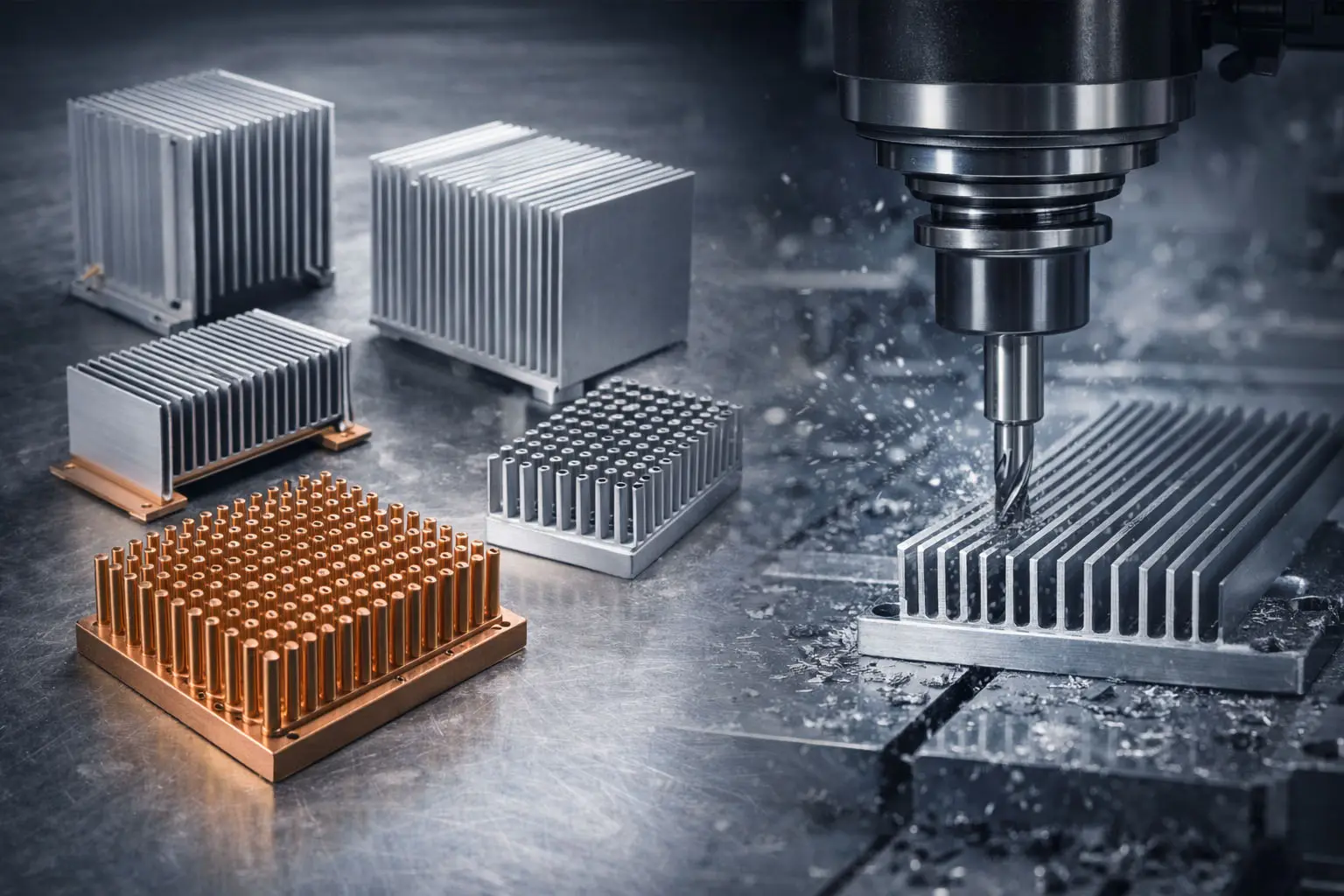
At SunOn, we support customers who need heat sinks and thermal components produced with consistent quality—often as part of a broader build that includes CNC machining, sheet metal, plastics, and assembly. This article explains what heat sinks do, the common types, and the main manufacturing processes used to make them—so you can choose a design that fits performance targets, budget, and production scale.
What a Heat Sink Does
A heat sink is a passive heat exchanger. It transfers heat from a hot surface (like a CPU, power module, LED, or motor controller) into a fluid medium—most often air—so the device can run within a safe temperature range.
Most heat sinks have two core features:
-
A flat base that contacts the heat source
-
Fins (or pins) that increase surface area, helping heat disperse faster
Even with a well-designed heat sink, the connection between the device and the heat sink matters. Thermal interface materials (TIMs)—such as thermal paste, pads, or adhesive—help fill micro-gaps and improve heat transfer.
Why Heat Sinks Are Usually Aluminum or Copper
Material choice drives thermal performance, weight, and cost. Most heat sinks use aluminum or copper because both conduct heat well.
Aluminum heat sinks
Aluminum is popular because it’s lightweight, cost-effective, and easy to manufacture at scale. Many heat sinks use aluminum alloys such as 1050 and 6060/6061/6063 depending on strength, formability, and conductivity needs.
Copper heat sinks
Copper offers higher thermal conductivity than aluminum, which can help in high-heat-flux designs, yet it is heavier and usually more expensive.
In real projects, it’s common to see hybrid designs (for example, an aluminum fin structure with a copper base or core) when performance needs exceed what an all-aluminum part can deliver.
Common Heat Sink Types (and When They Fit)
Heat sink geometry is selected around airflow, available space, and required cooling capacity:
-
Straight-fin heat sinks: classic parallel fins; simple, widely used
-
Pin-fin heat sinks: better when airflow direction is variable; good for compact designs
-
Skived-fin / high-fin-density designs: higher surface area for stronger cooling in forced-air systems (fans)
If your system includes a fan, higher fin density can often help—so long as airflow can pass through the fin channels without excessive pressure loss.
How Heat Sinks Are Made: Main Manufacturing Methods
Different production routes exist because heat sinks vary widely: from low-cost extruded profiles to precision-machined cold plates. Below are the most common methods manufacturers use.
1) Aluminum extrusion
Extrusion is one of the most common ways to make aluminum heat sinks. A heated aluminum billet is pushed through a die to form a continuous profile with fins, then cut to length. Extrusion is cost-efficient for medium-to-high volumes, especially when the heat sink can use a consistent cross-section.
Best fit:
-
Standard fin profiles
-
Good cost control in volume
-
Designs that don’t require complex 3D fin shapes
Typical next steps after extrusion:
-
CNC machining for holes, pockets, mounting features
-
Surface finishing (often anodizing)
2) CNC machining (milling/turning)
CNC machining is ideal for heat sinks that require tight tolerances, complex geometry, precise mounting surfaces, or custom features that extrusion cannot deliver. It’s also common for prototypes and lower-volume builds where tooling investment must stay low.
Best fit:
-
Custom, low-to-mid volume
-
Prototypes, engineering changes
-
Heat sinks that integrate mounting bosses, threaded holes, alignment features
3) Die casting
Die casting forms heat sinks by injecting molten metal into a mold. It can create complex shapes and integrated features in a single process. This method is widely used in consumer electronics and lighting when the design benefits from a net-shape part and production volumes justify tooling.
Best fit:
-
High-volume projects
-
Complex shapes that reduce secondary machining
-
Cost-sensitive programs at scale
4) Bonded-fin heat sinks
Bonded heat sinks attach fins to a base using a conductive adhesive or similar bonding method, enabling higher fin density than many extruded designs. They can be made from aluminum, copper, or mixed materials.
Best fit:
-
High fin density requirements
-
Forced-air cooling systems
-
Designs that need more surface area in a fixed footprint
5) Skiving (skived-fin heat sinks)
Skiving mechanically slices thin fins from a solid metal block, creating very dense fins while keeping excellent thermal contact between base and fins. This approach is often chosen for performance-focused heat sinks where fin density matters.
Best fit:
-
Higher performance designs
-
Compact spaces with forced airflow
-
Projects that can accept higher unit cost
6) Cold plates and liquid-cooled solutions (when air isn’t enough)
When airflow is limited or power density is high, a heat sink may shift toward a liquid-cooled cold plate. In that case, heat moves from the device into a plate with internal flow paths, then into the coolant.
Surface Treatments and Finishing Options
Finishing is not only cosmetic. It can improve corrosion resistance and help consistency in harsh environments.
Common finishing routes:
-
Anodizing (aluminum): corrosion protection and appearance control
-
Plating (copper or hybrid): oxidation control and surface stability
-
Bead blasting / brushing: appearance and light surface uniformity
-
Flatness finishing on the base: improves contact quality for TIM and mounting
Design Factors That Decide Performance
A heat sink’s real-world performance depends on more than “more fins.”
Key factors include:
-
Thermal resistance (°C/W) from device to ambient air
-
Airflow speed and direction (natural convection vs forced air with a fan)
-
Base contact quality (flatness, mounting pressure, TIM selection)
-
Fin spacing (too dense can choke airflow; too open can waste surface area)
In manufacturing, we also look at:
-
Can the design be extruded, or does it require machining/casting?
-
Are there thin fins that raise scrap risk?
-
Do mounting features require tight positional tolerances?
How SunOn Supports Heat Sink Manufacturing
For customers building electronics, lighting, and industrial assemblies, we typically help with:
-
DFM review to match heat sink geometry to the right process (extrusion, CNC, die casting, bonded, skiving)
-
Material suggestions (aluminum alloy vs copper vs hybrid) based on heat load and environment
-
Secondary machining for mounting features, threads, and assembly interfaces
-
Finishing coordination (anodizing, plating, surface prep) for consistent appearance and protection
If you share your power dissipation, space constraints, airflow conditions, and mounting approach, we can recommend a manufacturing route that balances performance, cost, and lead time.
