


What Is a Lathe? Definition, Key Parts, Types, and Real-World Uses
When individuals hear the word machining, they tend to imagine a milling machine that is being used to cut elaborate figures. However, round objects, such as shafts, bushings, pulleys, rings, threaded fittings, valve bodies, tend to be the first machine that engineers consider using the lathe. A rotating machine, or lathe, spins the piece of work about the axis of the piece and a cutting tool is used to cut away the piece in a manner that forms a symmetric shape around the axis.
Lathe-based operations (namely, CNC turning) are an everyday occurrence at SunOn, in which correct metal and plastic parts are built to utilize in industrial, automotive, electronic, and medical need. This guide discusses what is a lathe, how it operates, its key parts, the most used types of lathes, and the best strategy to use in deciding the turning method to use on your parts.
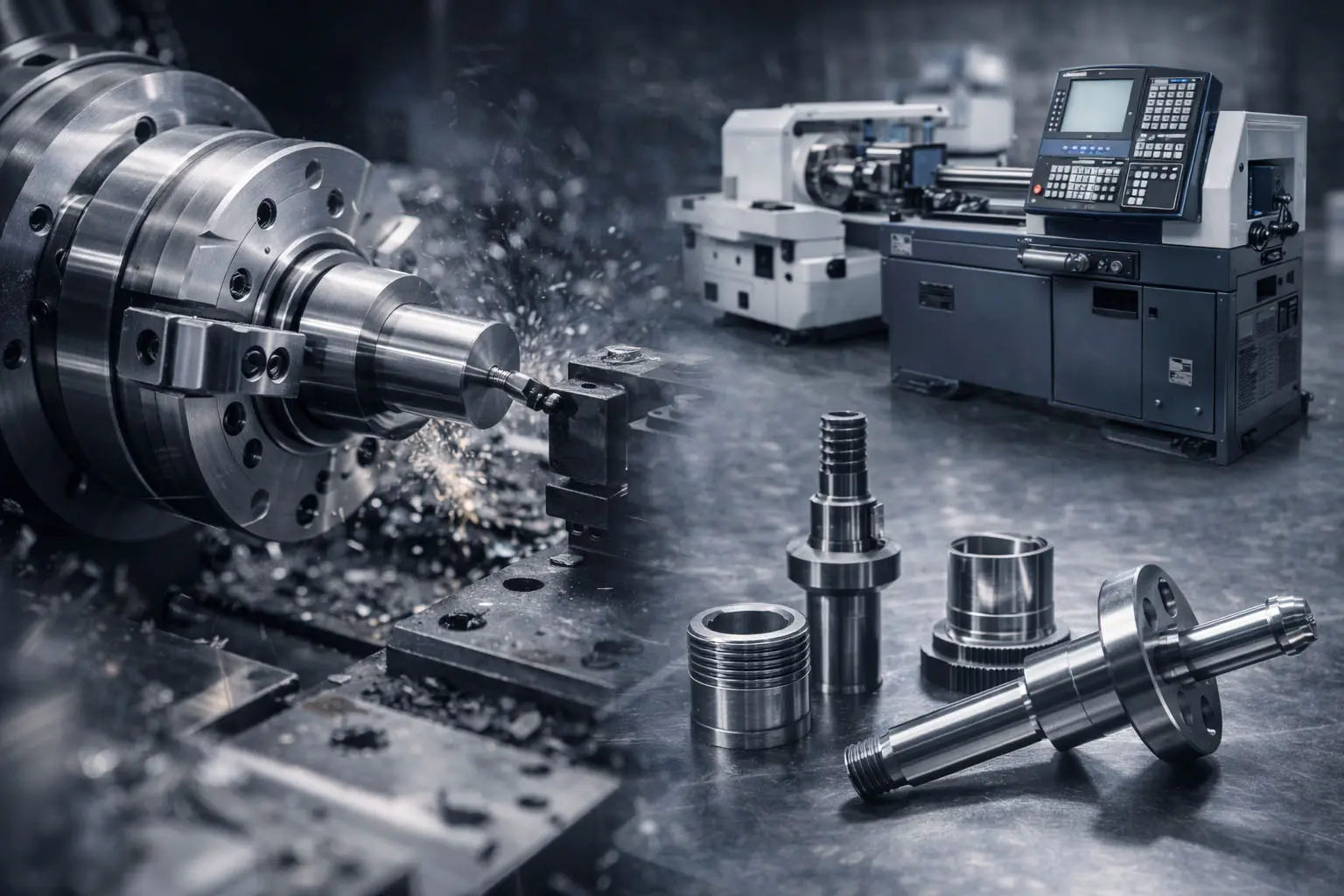
What Is a Lathe?
A lathe is a machine tool that spins a workpiece with a cutting tool defining it by cutting such operations as turning, facing, drilling, grooving, knurling and threading. The outcome is a rotational symmetrical part - any of a simple cylinder, through a multi-step shaft with fine threads and grooves.
In contemporary production, CNC lathes (also referred to as CNC turning centers) are computer-controlled and are capable of providing consistent precision, repeatability and efficiency during prototyping and manufacturing.
A Quick Look at Lathe History (Why It Still Matters)
The lathe has evolved from early manual wood-turning setups into today’s CNC platforms. One milestone often referenced is Henry Maudslay’s refinement of the screw-cutting lathe in the early 19th century, which helped enable more consistent thread cutting and contributed to standardization in precision engineering.
Why this matters today: thread accuracy, repeatability, and interchangeability—key expectations in modern supply chains—are closely tied to the lathe’s development and the machining standards that followed.
How a Lathe Works (The Core Motion)
A lathe works on a simple principle:
-
The workpiece spins (held by a chuck, collet, or between centers)
-
A cutting tool moves along controlled axes (commonly X and Z) to remove material
-
The combination of rotation + tool motion creates the final geometry
A typical turning workflow includes setup, tool selection, spindle speed selection, feed engagement, cutting passes, measurement/adjustment, and finishing/inspection.
Key Components of a Lathe (And What Each Does)
Understanding the major assemblies helps when you’re designing parts or reviewing manufacturability.
Headstock and spindle
The headstock houses the spindle and drive system. The spindle rotates the chuck/collet and ultimately the workpiece. Speed control at the spindle is critical for cutting performance.
Tailstock
The tailstock supports the far end of long workpieces (improving rigidity) and can also hold drilling/reaming tools.
Bed
The bed is the rigid foundation that keeps the machine aligned and stable. A stiff bed reduces vibration and helps maintain accuracy.
Carriage, cross slide, and compound
These assemblies position the cutting tool and control movement along the machine axes (longitudinal and radial).
Tool post / turret
This holds the cutting tools. CNC lathes often use a turret so the machine can switch tools automatically for multi-step parts.
Lead screw and feed rod
These support controlled tool motion—especially important for consistent feed during turning and for threading operations.
Chuck or collet
Workholding matters as much as the machine itself. 3-jaw chucks self-center quickly; 4-jaw chucks allow independent adjustment; collets are excellent for speed and concentricity in bar work.
Common Lathe Operations (What You Can Make)
Most “turning” projects combine several operations:
-
Turning: reduce diameter, create steps/shoulders
-
Facing: flatten the end of a part
-
Boring: enlarge or true an internal diameter
-
Drilling/reaming: create accurate holes
-
Grooving: cut snap-ring grooves, O-ring grooves, reliefs
-
Threading: external or internal threads
-
Parting: cut off a finished part from stock
-
Knurling: create grip texture on knobs/handles
Types of Lathes (Which One Fits Which Job)
Different lathe designs exist because parts vary so much in size, shape, and volume.
Engine (center) lathe
The classic manual lathe used for general-purpose turning. It’s flexible for single parts, repairs, and simple machining tasks.
CNC lathe / CNC turning center
Computer control provides repeatability, automation, and faster cycle times—ideal for production and complex turning. Many CNC turning centers also support live tooling for milling features (like flats or cross holes) in the same setup.
Turret lathe
Designed for faster multi-tool work. The turret holds multiple tools, enabling quicker transitions between operations.
Swiss-type lathe (sliding headstock)
Swiss lathes excel at small, slender, high-precision parts. The key difference is the use of a guide bushing near the cutting zone, which supports the material and reduces deflection—making it possible to machine long, thin features with better stability.
Vertical lathe (VTL)
A vertical lathe mounts the spindle vertically and is well-suited for large, heavy, or wide-diameter parts. Gravity helps with workholding, and loading/clamping can be safer for heavy workpieces.
Wood lathe
Optimized for woodturning—commonly used for bowls, furniture components, and craft work. While different from metal lathes, the underlying principle is similar: rotating workpiece + shaping tool.
Where Lathes Are Used in Manufacturing
Because rotational parts are everywhere, lathes show up across industries:
-
Automotive: shafts, hubs, bushings, threaded fittings
-
Aerospace: precision sleeves, spacers, bearing seats
-
Industrial equipment: rollers, couplings, valve parts
-
Electronics: housings, heat-sink interfaces, small precision connectors
-
Medical devices: small turned components (often Swiss machined)
This aligns with why lathes are considered among the most fundamental and versatile machine tools in manufacturing.
Lathe vs Milling: Which Process Should You Choose?
A practical rule:
-
If the part is mostly round, start with turning.
-
If the part has complex prismatic geometry, milling may lead.
-
If the part is round but also needs flats/holes/slots, a CNC turning center with live tooling (or a mill-turn setup) can reduce setups.
Turning typically produces excellent concentricity and roundness when the workholding and toolpath strategy are correct—because the geometry naturally references the axis of rotation.
Design Tips That Make Turning Easier (and Cheaper)
If you’re designing a turned part, a few choices can reduce cost and improve yield:
Avoid ultra-thin walls on long parts
Thin walls can chatter and deform, especially on longer stick-out lengths.
Use sensible corner radii and reliefs
A tiny internal corner may force a tiny tool. Adding relief grooves and practical radii helps tool access and finish.
Control thread requirements
If you need high-performance threads, specify the standard clearly and consider adding a relief at thread ends for clean tool exit.
Think in setups
Every time a part must be flipped or moved, variation risk increases. Designs that allow more features in one setup are generally more stable and efficient.
How SunOn Supports Lathe and CNC Turning Projects
For customers using SunOn for turning work, we focus on two things: repeatable quality and practical manufacturability.
Typical support includes:
-
DFM review for turned geometry (critical diameters, thread callouts, groove placement, tool access)
-
Workholding strategy selection (chuck vs collet vs between centers)
-
Matching lathe type to part needs (standard CNC turning vs Swiss for small slender parts; VTL approach for large/heavy rotors or housings)
-
Inspection planning for concentricity, runout, thread gauges, and functional fit
If you share your drawing and application details (loads, mating parts, tolerances, surface finish targets), we can recommend a turning approach that balances precision, lead time, and cost.
Conclusion
The lathe has continued to be one of the most significant machine tools in the manufacturing industry since it is used to make rotating components in an efficient and repeatable manner. Since ancient engine lathes were built up to the modern CNC turning center, Swiss machine, and vertical turner, there are reasons why each platform exists: stability, automation, part size, or precision.
