


Metal Casting in Manufacturing: Processes, Types, Materials, and Design Tips
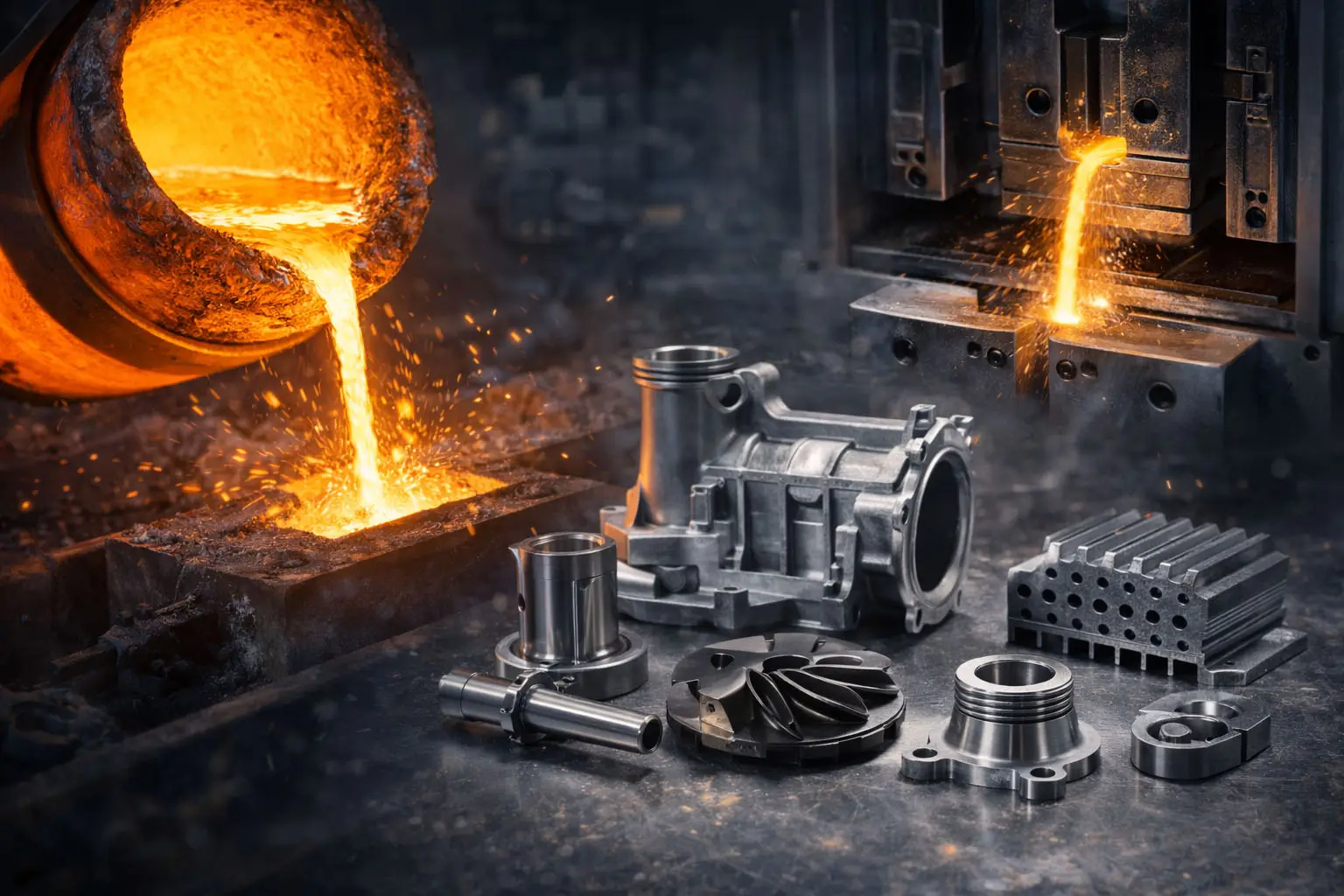
Metal casting is one of the oldest and most flexible manufacturing methods. It works by melting metal, pouring (or injecting) it into a mold cavity, letting it solidify, and then removing the formed part. Because the mold defines the shape, casting can produce complex geometries that may be slow or costly to machine from solid stock.
At SunOn, casting is often paired with CNC machining and surface finishing to deliver near-net-shape parts with controlled critical dimensions—especially when customers need complex forms, internal features, or volume scalability.
What Is Metal Casting?
In simple terms, casting delivers molten metal into a mold (through channels such as a sprue/gating system) and lets it cool into the mold’s negative impression. Once the part solidifies, it is removed and may be trimmed, machined, and finished.
Why Manufacturers Use Casting
Casting remains popular because it can:
-
Create complex shapes (including internal passages with cores) that would require extensive machining otherwise
-
Reduce material waste compared with machining from billet in many designs (near-net shaping)
-
Scale efficiently for medium to high volumes (especially die casting)
-
Support a wide range of metals: aluminum, zinc, magnesium, steels, stainless steels, copper alloys, and more (process-dependent)
The Basic Casting Workflow
Most casting projects follow a similar structure:
-
Design + DFM review: confirm draft angles, wall thickness, radii, parting line strategy, and machining allowances
-
Mold/pattern preparation: build sand molds, dies, or investment shells depending on process
-
Melting + pouring/injection: deliver molten metal into the cavity under gravity or pressure
-
Solidification + cooling: controlled cooling reduces defects and distortion
-
Shakeout/ejection + trimming: remove gates/risers/flash
-
Secondary ops: CNC machining, heat treatment (if required), and surface finishing to meet specs
Major Casting Types and When to Use Each
1) Sand Casting
Sand casting uses sand as the mold material. It’s widely used because molds are economical and can handle many alloys, including steel, and it scales well for larger parts.
Best for: larger components, lower-to-medium volumes, cost-sensitive tooling, broad material choices.
2) Investment Casting (Lost-Wax Casting)
Investment casting “invests” a pattern in refractory material to create a precise mold. It’s known for excellent detail, good surface finish, and strong dimensional control, often reducing machining.
Best for: complex geometry, fine detail, small-to-medium parts, and a broad metal range.
3) Die Casting (High-Pressure)
Die casting forces molten metal into hardened steel dies under high pressure. It’s highly efficient for high-volume production of non-ferrous parts (commonly aluminum, zinc, magnesium).
Best for: high volumes, thin-wall parts, strong repeatability, good surface finish.
4) Gravity / Permanent Mold Casting
A reusable metal mold (permanent mold) is filled by gravity. It often sits between sand casting and die casting in tooling cost and part quality. (Common in aluminum castings.)
Best for: medium volumes, improved consistency vs sand casting, stable properties.
5) Centrifugal Casting
Molten metal is poured into a rotating mold, using centrifugal force to distribute metal—often used for cylindrical parts.
Best for: pipes, rings, bushings, sleeves, and rotational components.
In real production, the “best” casting method depends on alloy, geometry complexity, tolerance/finish targets, and quantity.
Casting Metals: Common Choices
-
Aluminum: lightweight, good strength-to-weight, widely used in die casting and gravity casting
-
Zinc: excellent castability for fine details; common in die casting
-
Magnesium: very lightweight; used in die casting where weight matters
-
Steel / stainless steel: often cast via investment casting or sand casting for strength and heat resistance
-
Copper alloys (bronze/brass): used for wear/corrosion needs; commonly investment cast for complex shapes
Common Casting Defects (and How to Reduce Risk)
Casting is powerful, but it’s sensitive to process control. Typical defect families include:
-
Porosity (gas or shrinkage): can reduce strength and leak-tightness
-
Cold shuts / misruns: metal streams fail to fuse or fill completely, often linked to temperature, flow, or venting
-
Inclusions/contamination: impurities can weaken the part and damage molds
Practical ways to reduce these risks include sound gating/risering design, proper melt handling, controlled pouring/injection parameters, and process simulation where appropriate.
Design Tips for Better Cast Parts
If you’re planning a casting, these design habits usually improve quality and cost:
-
Keep wall thickness as uniform as possible to control shrinkage and solidification behavior
-
Add fillets/radii instead of sharp corners to reduce hot spots and stress concentration
-
Plan draft angles and parting lines early (especially for die casting and permanent molds)
-
Identify which features must be as-cast and which will be machined (critical bores, sealing faces, threads)
-
Specify surface finish requirements realistically—many cast surfaces still need secondary finishing for cosmetic or sealing needs
Casting vs CNC Machining: A Practical Rule
-
Choose casting when geometry is complex, internal cavities are needed, or volumes make tooling worthwhile.
-
Choose CNC machining when tolerances are tight everywhere, volumes are low, or design changes are frequent.
-
Combine casting + CNC machining when you want near-net cost efficiency but still need precision on select features (very common in industrial parts).
How SunOn Supports Casting Projects
For customers using SunOn for cast components, we typically focus on a smooth path from design intent to production stability:
-
DFM guidance to match the right casting process to your geometry and volume
-
Post-machining capability to hold tight tolerances where needed (mounting surfaces, bearing fits, threads)
-
Finish coordination (blasting, polishing, coating, plating) for functional or cosmetic targets
-
Inspection planning around the features that matter most to assembly and performance
If you share your drawing, target quantity, alloy preference, and critical dimensions, we can recommend a casting route and a secondary-machining plan that balances cost, lead time, and quality.
