


Types of Fasteners in Manufacturing: A Comprehensive Guide for Precision Assembly
In contemporary manufacturing, fasteners can be considered one of the most vital and yet pre-inconspicuous elements in the design of parts, assembly, and functionality of the product. In the aerospace, automotive, consumer electronics, and the heavy machinery industries, the fasteners are used to hold parts together with high precision and reliability. These parts are small but they play an immense role, in terms of product quality, assembly efficiency, and service life.
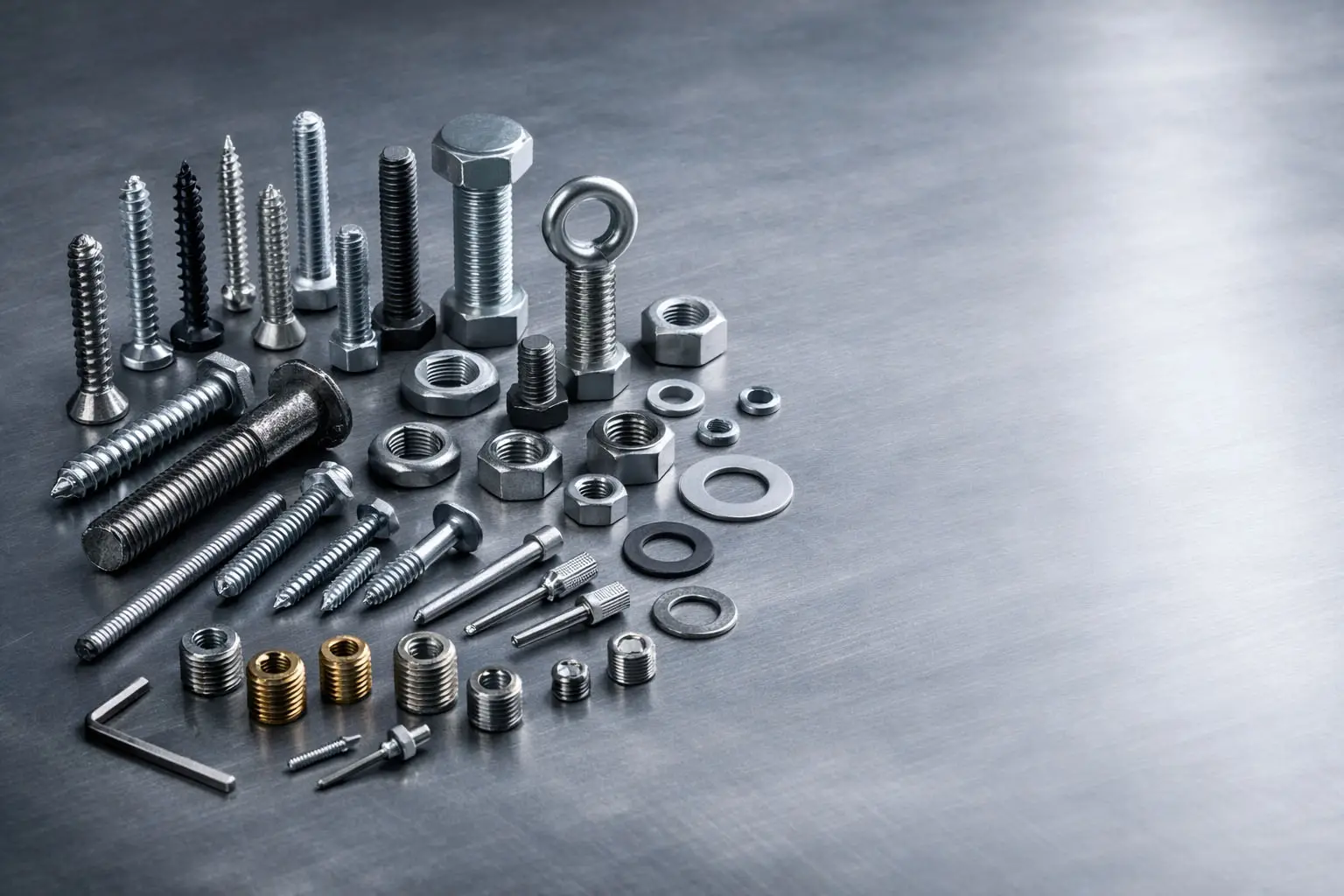
In SunOn Industrial Group Limited, we focus on knowing the role of fasteners and their selection, as most of our products are designed and produced either by injection molding, CNC machining or sheet metal fabrication, but eventually depends on correct fastening approaches to facilitate assembly integrity. This guide will discuss the most common types of fasteners employed in industry, their purpose and the way they are selected by engineers to be used in certain applications.
What Is a Fastener and Why It Matters
A fastener is a mechanical hardware item, which holds two or more things together. Most fasteners form non-permanent joints, that is to say that they can be disassembled without creating defects on the components to be joined. Unlike permanent joining processes such as welding or adhesive bonding, most fasteners form non-permanent joints. This is an essential property in terms of repairability, maintenance, and re-assembling it during production.
The fasteners are in a variety of shapes, sizes and performance grades. Although small, they should be strong, durable and resistant to environmental forces, such as vibration, temperature, or corrosion, and particularly in industrial areas with high demands.
1. Screws — Versatile Threaded Fasteners
Screws are among the most widely used fasteners in manufacturing due to their flexibility and ease of use. A screw typically has a head at one end and external threads along the shaft. Screws are designed to engage with internal threads in components or to cut their own threads as they are driven, depending on the type.
Common Screw Types
-
Machine Screws: Used in machinery and electronics. These require a pre‑threaded hole or a nut.
-
Self‑Tapping Screws: Designed to cut their own mating threads in soft materials like plastics or metal sheets.
-
Wood Screws: Typically have coarse threads and a sharp point for joining wood components.
-
Lag Screws: Heavy‑duty screws used in wood, structural framing, or large fixtures.
Each head type (flat, pan, hex, Phillips, Torx, etc.) corresponds to tooling requirements and assembly conditions. Screws can also be made from a range of materials such as stainless steel, carbon steel, or alloy steel to match performance needs.
2. Bolts — Strong & Reliable Fasteners
Bolts are similar to screws in that they feature male external threads, but they usually require a nut to secure the joint. Bolts are ideal for joining materials with unthreaded holes, creating highly secure clamped assemblies when used with a matching nut and, often, a washer.
Common Bolt Varieties
-
Hex Bolts: Characterized by a hexagonal head; widely used in structural and mechanical assemblies.
-
Carriage Bolts: Have a smooth, rounded head often used in wood or metal framing.
-
U‑Bolts: Shaped like a “U”, used to clamp pipes or cylindrical objects.
-
Eye Bolts: Feature a looped head, ideal for lifting or suspension applications.
Materials play a key role in bolt performance: high‑strength alloy steel bolts are common in automotive or heavy machinery, while stainless steel or brass may be preferred for corrosion resistance.
3. Nuts — The Complement to Bolts
Nuts are female threaded fasteners that mate with bolts to complete a secure joint. The internal threads of a nut correspond to the bolt’s diameter and thread pitch, forming a robust mechanical connection that can be tightened and loosened as needed.
Notable Nut Types
-
Hex Nuts: The most common form with six sides for wrenching.
-
Lock Nuts: Designed to resist loosening under vibration via nylon inserts or distorted threads.
-
Wing Nuts: Feature tabs for hand tightening without tools.
-
Weld Nuts: Designed to be welded onto components for captive fastening.
Choosing the right nut is as critical as selecting the right bolt — especially in contexts where vibration or thermal cycling could loosen joints. Locking mechanisms or secondary locking features are often incorporated to enhance reliability.
4. Washers — Load Distributors & Protectors
While washers are not fasteners in themselves, they are indispensable in many assemblies. A washer is typically a thin plate with a hole, placed between a bolt head or nut and the surface of the component. They serve multiple functions:
-
Distribute Load: Prevent surface damage and reduce stress concentration.
-
Protect Surfaces: Minimize abrasion or indentation from tightening.
-
Enhance Locking: In specialized forms (e.g., split lock washers), they help resist loosening.
Washers are used in virtually every bolted or screwed assembly — from small electronics to large machinery.
5. Rivets — Permanent Fastening Solutions
Unlike screws and bolts, rivets create permanent joints. A rivet typically consists of a smooth shaft with a head at one end. When installed, the tail end is deformed (or “upset”) to hold components securely. Once set, rivets cannot be easily removed without damaging the joint.
Typical Rivet Types
-
Solid Rivets: Traditional rivets used in structural applications.
-
Blind Rivets: Installed from one side, ideal where access is limited.
-
Semi‑Tubular Rivets: Require less force to deform, used in medium‑strength applications.
Riveted joints are common in aircraft structures, metal fabrication, and where permanent, vibration‑resistant fastening is necessary.
6. Specialized Fasteners: Threaded Inserts & Studs
In addition to the major categories above, there are specialized fasteners designed for particular materials or assembly needs:
Threaded Inserts
Threaded inserts are installed into softer materials (like plastic or aluminum) to provide durable internal threads that won’t strip over repeated use. Insert molding or press‑fit techniques embed inserts directly into components, improving assembly reliability.
Threaded Rods / Studs
Threaded rods or studs are long threaded fasteners without heads. Often used when tension or adjustment is required over wide ranges, studs accept nuts on both ends and are common in heavy equipment or structural fixtures.
7. Other Components: Pins & Anchors
Beyond threaded fasteners, pins, anchors, and other hardware play auxiliary roles in assembly:
-
Pins: Dowel pins, taper pins, and clevis pins help locate parts precisely before or during fastening.
-
Anchors: Expansion anchors secure components into masonry or concrete.
Fastener Materials and Selection Criteria
Most industrial fasteners are metal, with steel being the most widely used. Choices include carbon steel, alloy steel, and stainless steel for corrosion resistance. Other materials such as brass, aluminum, or titanium are selected based on specific performance needs — corrosion resistance, weight, conductivity, and strength.
Selecting the right fastener also depends on:
-
Joint strength requirements
-
Vibration or shock exposure
-
Assembly and disassembly frequency
-
Environmental conditions (corrosion, temperature)
Engineers often consult standards such as ASME B18 series for thread dimensions, tolerances, and mechanical properties to ensure compatibility and performance.
Conclusion: Fasteners as Critical Components in Precision Manufacturing
Although small in size, mechanical assemblies in practically all manufactured products rely on small, fasteners. By being aware of their types, functionality, materials, and requirements in the selection, engineers and manufacturers can create more reliable, serviceable, and more efficient products. Whether the metal components are machined using CNC machines, or the plastic housings are injection-molded with threaded inserts, the correct fastening strategy puts a measurable difference in terms of performance and life cycle, which we believe in at SunOn Industrial Group in any of our precision manufacturing services.
