


Acetal vs. Delrin: Are They Really Different Materials?
In the world of engineering plastics, Acetal and Delrin are often mentioned together—especially when durability, low friction, and wear resistance are critical. Many people assume they are two completely different materials. In reality, both belong to the same polymer family: POM (Polyoxymethylene).
The real difference lies not in the base chemistry, but in material structure, performance balance, and application priorities. Understanding this distinction can help engineers and product designers choose the right material for long-term reliability.
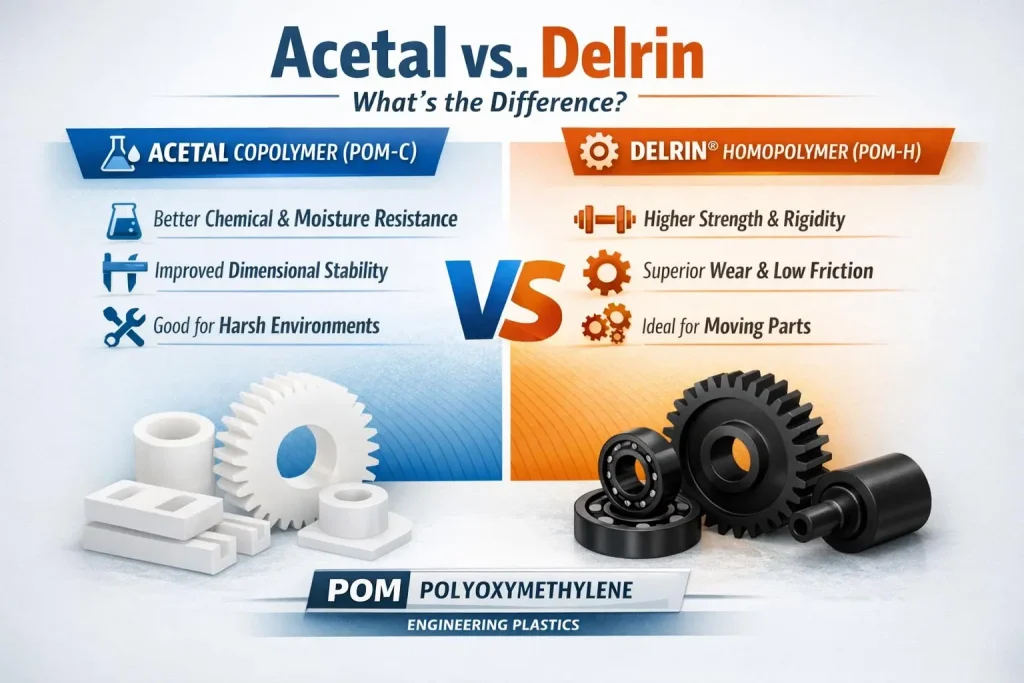
Acetal Is a Material Family, Not a Single Plastic
The term Acetal is a general name that refers to POM materials as a whole. In industrial use, Acetal is typically divided into two structural types:
- Acetal Copolymer (POM-C)
- Acetal Homopolymer (POM-H)
Copolymer Acetal is known for its lower internal stress and improved resistance to chemicals and hot water. These characteristics make it a dependable choice for parts exposed to moisture, cleaning agents, or fluctuating environments. It is often selected when long-term dimensional stability is a top priority.
What Is Delrin? A Brand Name with a Specific Structure
Delrin® is not a different plastic—it is a brand name for Acetal Homopolymer, originally introduced by DuPont.
Because of its homopolymer structure, Delrin typically offers:
- Slightly higher mechanical strength and stiffness
- Excellent wear resistance and fatigue performance
- A smoother surface finish and lower friction behavior
These properties explain why Delrin is widely used for precision components and moving parts that must maintain performance under repeated mechanical stress.
Key Differences Between Acetal and Delrin
Although Acetal Copolymer and Delrin are closely related, small performance differences can matter a lot in real-world applications.
Strength and Rigidity
Delrin generally provides higher stiffness and tensile strength, making it suitable for load-bearing and high-precision components.
Chemical and Hot-Water Resistance
Acetal Copolymer typically performs better in chemically aggressive or hot, wet environments, where long-term material stability is critical.
Dimensional Stability
Because copolymer Acetal has lower internal stress, it is often more resistant to warping and deformation, especially in larger or complex molded parts.
Friction and Wear Performance
Delrin excels in low-friction and sliding applications, making it a preferred choice for gears, bushings, rollers, and guide components.
When to Choose Delrin vs. Acetal Copolymer
Choose Delrin When:
- The part is a moving or wear component
- High stiffness and mechanical strength are required
- Tight tolerances and smooth sliding behavior matter
- The application involves repeated load cycles
Choose Acetal Copolymer When:
- The part is exposed to chemicals, moisture, or hot water
- Long-term dimensional stability is more important than peak strength
- Internal stress or warping could affect performance
- Reliability in harsh environments is a priority
Common Applications for Both Materials
Both Acetal and Delrin are widely used in:
- Gears, bushings, bearings, and rollers
- Automotive and industrial mechanical parts
- Precision components in consumer and industrial products
In many cases, the two materials can substitute for each other. However, selecting the right one based on environment and function can significantly extend part lifespan and reduce maintenance risk.
Quick Summary
- Delrin is best suited for high-strength, low-friction, wear-resistant moving parts
- Acetal Copolymer is better for chemical resistance, hot-water exposure, and long-term dimensional stability
