


Aerospace CNC Machining Services — Precision Components for Global OEM Buyers
SunOn provides precision aerospace CNC machining services for OEM/ODM product companies, engineering teams, procurement managers, hardware startups, and industrial manufacturers that need custom aerospace-grade components. Our CNC machining support covers structural brackets, equipment housings, enclosures, adapter plates, sensor housings, mounting hardware, and mechanical sub-assemblies — machined from aerospace-relevant materials including aluminum alloys, titanium, stainless steel, and high-performance plastics.
Buyers working on UAV systems, avionics enclosures, ground support equipment, new energy aviation platforms, or aerospace-adjacent industrial products can work with SunOn from prototype validation through low-volume production. Before requesting a quote, confirm your material grade, critical tolerances, surface finish requirements, inspection documentation needs, and whether your project is at prototype, small-batch, or production stage.
Aerospace Parts SunOn Can CNC Machine
Aerospace applications demand consistent dimensional accuracy, stable material properties, and verified surface quality across every part. SunOn supports CNC machining for a range of aerospace-relevant components, including:
- Structural brackets and mounting frames
- Avionics and electronics enclosures
- Sensor housings and adapter plates
- UAV/drone structural frames and sub-frames
- Manifold bodies and fluid system components
- Fixture and tooling components for ground support equipment
- Custom mechanical assemblies and connector housings
For prismatic components, CNC milling is the primary process. For cylindrical and rotational parts such as shafts, bushings, and connectors, CNC turning is applied. Complex geometry — parts with undercuts, compound angles, thin walls, or deep internal features — typically requires multi-axis or 5-axis CNC machining to maintain dimensional control without multiple setups.
Materials Used in Aerospace CNC Machining
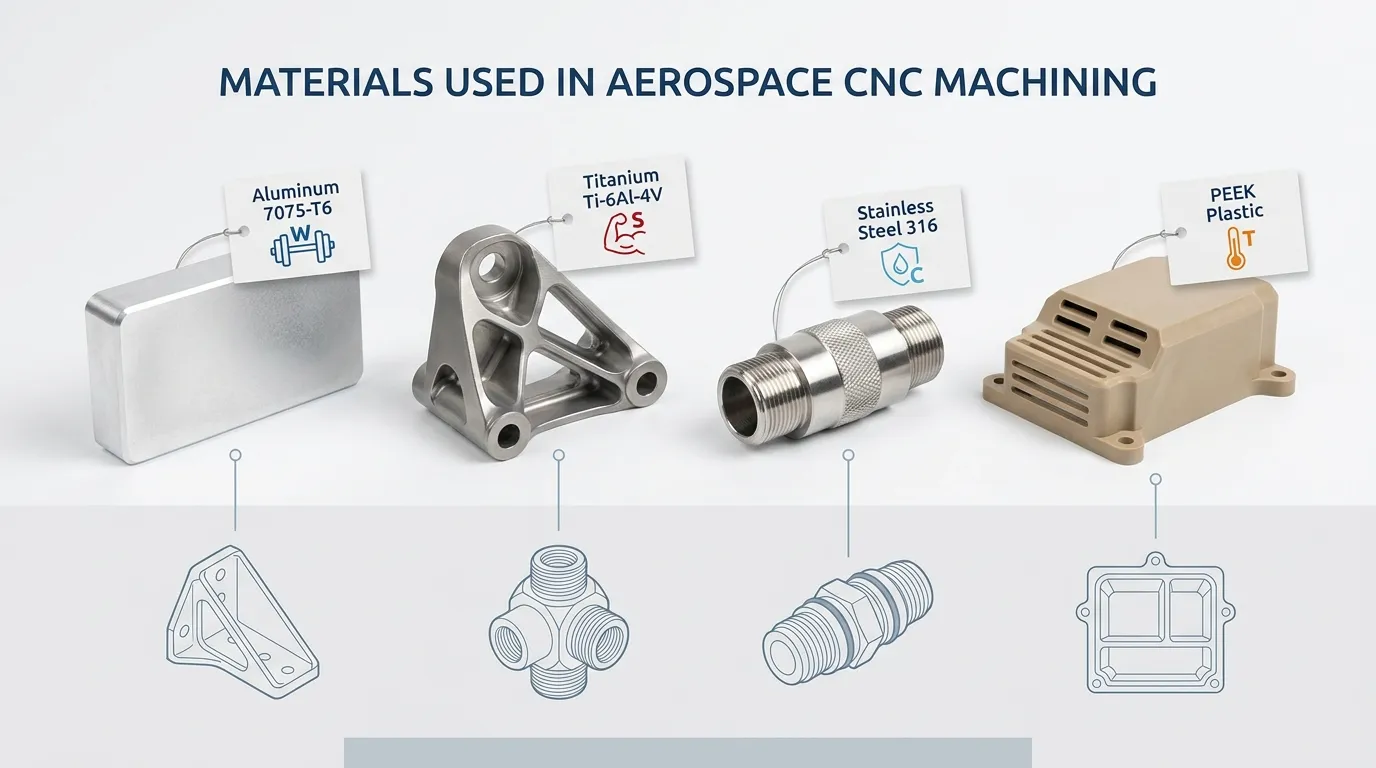
Material selection is one of the most critical decisions in aerospace component sourcing. Each material carries different trade-offs across weight, strength, machinability, and operating environment performance.
| Material | Common Grades | Key Properties | Typical Application |
|---|---|---|---|
| Aluminum | 7075-T6, 6061-T6 | High strength-to-weight ratio, lightweight, machinable | Structural brackets, frames, housings, enclosures |
| Titanium | Ti-6Al-4V | High strength, low weight, corrosion resistant | High-stress structural parts, fastener systems |
| Stainless Steel | 304, 316 | Corrosion resistant, durable, thermally stable | Fluid connectors, fasteners, fixtures |
| High-Performance Plastics | PEEK, Nylon PA66 | Lightweight, chemically resistant, electrically insulating | Insulators, ducts, interior components, sensor housings |
Buyers should confirm both material type and specific grade when preparing drawings. Aluminum 7075-T6 and 6061-T6 behave differently under tight tolerance conditions, and titanium Ti-6Al-4V requires careful toolpath and cooling control compared to standard aluminum machining. Providing material grade on the 2D drawing reduces quoting delays and DFM review time.
CNC Machining Capabilities for Aerospace Components
SunOn supports 3-axis, 4-axis, and 5-axis CNC milling alongside CNC turning for aerospace component production. Multi-setup machining is available for complex geometry requiring access from multiple orientations.
5-axis CNC machining is particularly relevant for aerospace parts with compound angles, contoured surfaces, internal pockets, or features that would otherwise require multiple fixtures and risk accumulating positional error. Buyers with complex prismatic or sculptured parts should note this when discussing machining strategy during DFM review.
Surface roughness requirements should be specified on drawings using Ra values. Standard machined surfaces typically achieve Ra 1.6–3.2 µm. Finer finishes for sealing surfaces, mating faces, or optical-adjacent components require additional operations and should be flagged in the RFQ.
Surface Finishing for Aerospace CNC Parts
Post-machining surface treatment affects corrosion resistance, surface hardness, appearance, and dimensional tolerance. Available finishing options for aerospace-machined components include:
- Anodizing (Type II) — standard anodizing for aluminum, improves corrosion resistance and surface hardness
- Hard anodizing (Type III) — thicker oxide layer for wear-critical aluminum components
- Bead blasting — uniform matte surface finish, commonly used before anodizing or as a standalone finish
- Passivation — removes free iron from stainless steel surface to improve corrosion resistance
- Polishing — for sealing surfaces, fluid-contact areas, or appearance-critical faces
- Powder coating — for enclosures and housings requiring color and environmental protection
Finishing adds dimensional change — hard anodizing, for example, adds approximately 25–50% of the oxide layer thickness per side. Buyers with tight-tolerance features should discuss finish allowances during DFM review before machining begins.
Inspection and Quality Verification
Aerospace component buyers typically require more than visual inspection at delivery. SunOn supports dimensional verification using CMM (coordinate measuring machine) inspection, surface roughness measurement, and first article dimensional reporting where specified in the order requirements.
Material certification documentation can be provided upon request for aerospace-grade aluminum, titanium, and stainless steel materials. Buyers should specify inspection requirements — including dimensional report format, critical dimension callouts, and certificate of conformance needs — in the drawing or RFQ at the quoting stage.
If your program requires a full First Article Inspection Report (FAIR) or specific documentation standards, discuss this during the initial engineering review so it can be scoped into the project correctly.
Prototype, Small Batch, and Low-Volume Production
Many aerospace product programs begin with engineering prototype validation before committing to production tooling or volume procurement. SunOn supports this development workflow — buyers can order prototype quantities to validate fit, function, and assembly before scaling.
There is no fixed minimum order quantity for CNC prototype work. Buyers can start with small prototype runs, iterate with design changes, and scale to low-volume or small-batch production using the same supplier relationship and machining setup knowledge.
DFM review is available before machining begins. Our engineering team can flag geometry concerns, tolerance conflicts, surface finish questions, or material considerations before cutting starts — reducing rework and revision cycles, particularly for first-time aerospace parts or complex multi-feature components.
For related manufacturing services across the product development cycle, visit SunOn's CNC machining services page.
What to Prepare Before Requesting an Aerospace CNC Quote
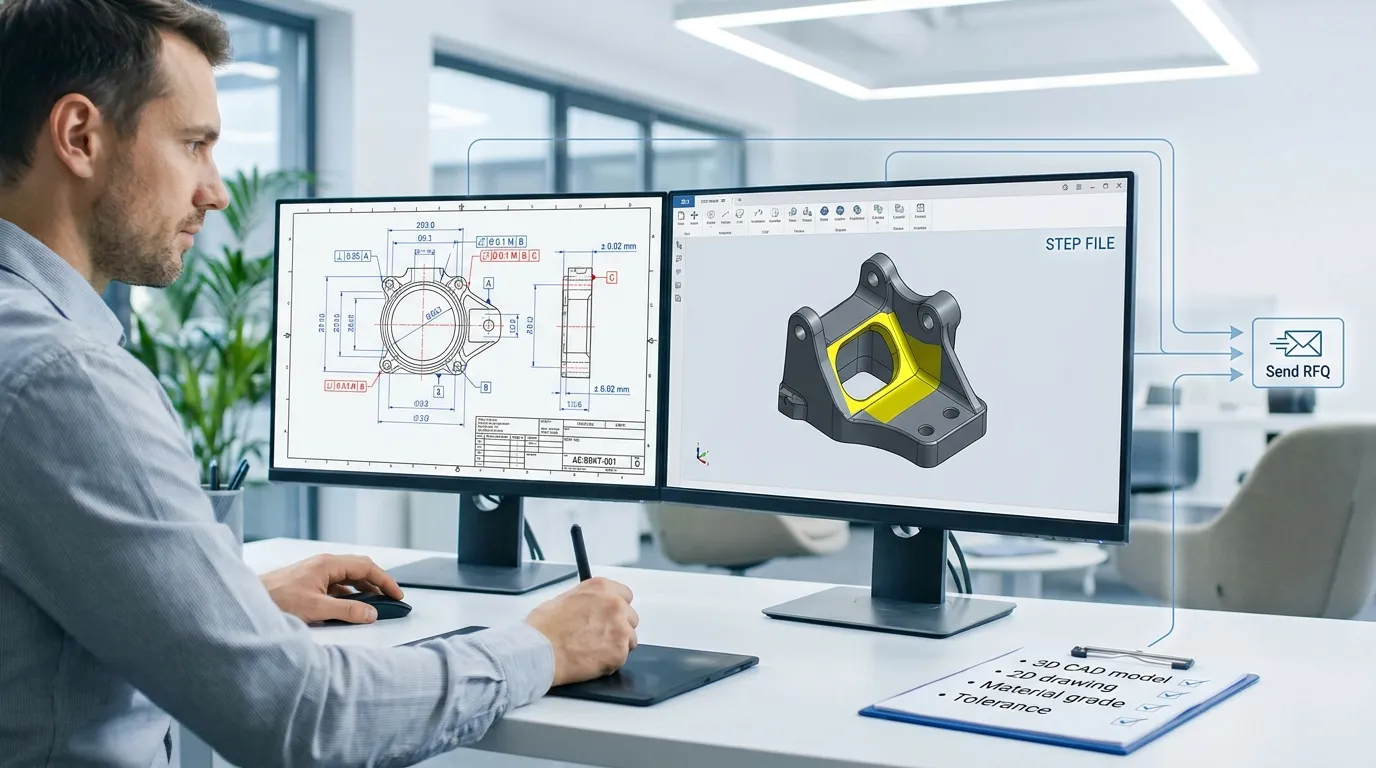
To receive an accurate and complete quote, prepare the following before contacting SunOn:
- Part type and function — what the part does and how it fits into the assembly
- 3D CAD model — STEP or IGES format preferred
- 2D engineering drawing — with all critical tolerances, GD&T callouts, surface roughness, and material specification
- Material and grade — e.g., Aluminum 7075-T6, Titanium Ti-6Al-4V, SS316
- Quantity — prototype count, small batch, or production volume
- Surface finish requirements — anodizing type, bead blast, passivation, polishing, or as-machined
- Inspection requirements — dimensional report, CMM inspection, material certificate, FAIR
- Threading, inserts, tapped holes, or assembly requirements — note in drawing or RFQ comments
- Application or operating environment — helps the team understand fit, load, and finish logic
- Delivery destination and target schedule
- NDA — if project details are confidential, request an NDA before sharing drawings
Incomplete drawings are one of the most common causes of quoting delays and DFM revision requests. Providing a fully annotated 2D drawing alongside the 3D model significantly speeds up review and quotation.
Frequently Asked Questions
What materials does SunOn machine for aerospace applications?
SunOn machines aluminum alloys (7075-T6, 6061-T6), titanium Ti-6Al-4V, stainless steel 304 and 316, and high-performance plastics including PEEK and Nylon PA66. Buyers should confirm the specific grade on their 2D drawing when requesting a quote.
What tolerances are achievable for aerospace CNC parts?
Achievable tolerance depends on part geometry, material, and feature type. Buyers should specify critical tolerances and GD&T requirements on the engineering drawing. Our team reviews tolerance feasibility during DFM and flags any concerns before machining begins.
Does SunOn provide inspection reports and material certificates?
Yes. CMM dimensional inspection reports and material certification documents are available upon request. Buyers should specify inspection requirements — including report format and certificate of conformance — at the quoting or order stage.
Can SunOn support both aerospace prototypes and production runs?
Yes. SunOn supports engineering prototype builds with no fixed minimum quantity, as well as small-batch and low-volume production runs. DFM review is available at the prototype stage to reduce design revision risk before production scale-up.
What files should I send to get an accurate aerospace CNC machining quote?
Send a STEP or IGES 3D CAD file and a fully annotated 2D drawing with tolerances, material grade, surface finish callouts, and any inspection requirements. Including application context and quantity helps the team provide a more complete quotation.
Does SunOn offer DFM review before aerospace CNC machining starts?
Yes. Our engineering team reviews drawings for machinability concerns — including tolerance conflicts, thin-wall risks, surface finish feasibility, and material considerations — before quoting or production begins. This is particularly useful for complex or first-time aerospace components.
Request a Quote for Aerospace CNC Machined Parts
If you are sourcing precision CNC machined components for an aerospace application, UAV program, avionics enclosure, ground support equipment, or aerospace-adjacent industrial project, contact SunOn to discuss your requirements.
Send the following when reaching out:
- Part name and application context
- 3D CAD model (STEP or IGES)
- 2D drawing with tolerances, GD&T, material specification, and finish callouts
- Material grade required
- Quantity (prototype / small batch / production)
- Surface finish and coating requirements
- Inspection documentation requirements (dimensional report, material cert, FAIR)
- Threading, insert, or assembly requirements
- Delivery destination and target schedule
- NDA if required before sharing drawings
Our team reviews drawings and provides quotation and DFM feedback. For urgent prototype requirements or complex geometry reviews, note your timeline and inspection requirements clearly when submitting your RFQ.
Contact SunOn for Aerospace CNC Machining Quote and DFM Review →
