


Aluminum Alloy Die Casting Mold Design: Gates, Vents, and Cooling Channels
In Aluminum Alloy Die Casting, a mold must do more than reproduce part geometry. It must fill thin sections before freezing, evacuate displaced gas, and maintain a repeatable thermal cycle. Weakness in one system often appears elsewhere: restricted venting can limit filling, while excessive local cooling can interrupt pressure transmission.
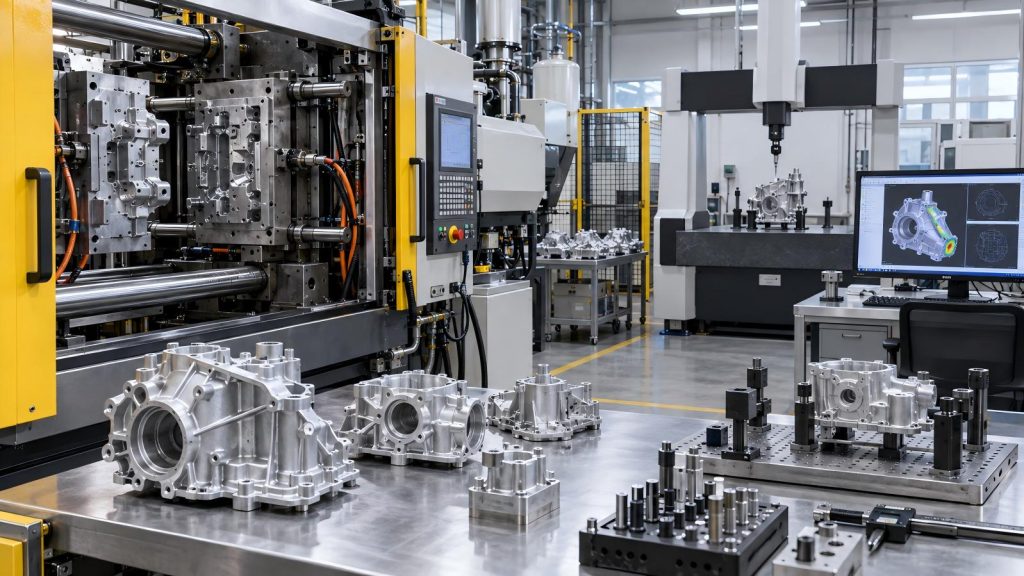
At SunOn, our development process includes DFM, mold-flow analysis, mold manufacturing, T1 inspection, and subsequent tuning. The engineering objective is to connect design decisions with measurable casting performance. SunOn Manufacturing Process
Diagnose Defects Before Changing the Mold
An Aluminum Alloy Die Casting defect should be investigated by location, morphology, and production history.
| Symptom | Design Questions | Verification |
| Cold shuts at thin-wall ends | Is the flow path excessive? Do fronts meet after cooling? | Short-shot study and filling analysis |
| Leakage after machining | Does machining expose porosity near a sealing surface? | Sectioning or CT, followed by defined leak testing |
| Porosity around thick bosses | Is the region a hot spot? Does the gate freeze before effective pressure transmission? | Thermal analysis and pressure-timing review |
| Dimensions drifting across production | Are die temperatures or ejection conditions changing? | Consecutive-shot dimensions and temperature trends |
A pore near a hot spot is not automatically shrinkage. Combine imaging, process records, and defect distribution before selecting corrective action.
Design Gates Around Flow and Pressure Transmission
Gate Area, Velocity, and Filling Time
For preliminary sizing:
Q ≈ Aᵍ × vᵍ; filling time ≈ V ÷ Q
Here, Aᵍ is total effective gate area, vᵍ is gate velocity, and V is the defined filling volume. Use consistent units and account for the actual filling sequence.
Gate velocity is distinct from plunger velocity. The machine has to be able to generate the desired pressure-flow combination and address the runner losses.
In evaluating Aluminum Alloy Die Casting molds:
•Feed Direction: The length of the flow should be reduced as much as possible by avoiding cores.
•Front Convergence: For problem areas, displace them as far away as possible from the critical sealing or loaded areas.
•Gate Thickness: Filling, pressure transmission, gate trimming, and gate mark leaving should be considered.
•Intensification Timing: Higher pressure cannot melt the already frozen gate.
NADCA likewise connects gating calculations with casting geometry, die configuration, and machine performance. NADCA Technical Education
Position Vents Where Gas Actually Collects
Overflows and Vents Have Different Jobs
Overflows receive advancing metal and help establish the filling pattern. Vents provide gas escape paths. Neither should be sized by simply copying a previous mold.
Last-to-Fill regions are identified with filling analysis. Analyze if metal inflow can block evacuation paths. Look at depth and width of vents, length of passages, cleanliness, and connection to the evacuation system.
More Than Pump Capacity
Vacuum-Assisted Aluminum Alloy Die Casting will require:
•All region gaps sealed and moving contacts sealed.
•Adequate pathways for evacuation.
•Valves functioning, opening and closing as intended.
•An indication of pressure for measurement at a specific location.
•Consistent measurement of shot time.
A low reservoir pressure does not establish the pressure achieved in the cavity. Vacuum addresses gas evacuation; it does not eliminate shrinkage caused by unsuitable thermal conditions.
Compare Cooling and Filling Alternatives
| Design Decision | Option A | Option B | Selection Basis |
| Feed arrangement | Single principal feed | Multiple gates | Flow length versus front convergence and trimming complexity |
| Gas evacuation | Conventional vents | Vacuum assistance | Internal-quality requirements versus sealing and maintenance demands |
| Cooling geometry | Drilled channels | Conformal inserts | Hot-spot accessibility versus manufacturing, cleaning, and repair costs |
| Temperature control | Shared circuits | Independent zones | Connection simplicity versus unequal regional heat loads |
These alternatives require trial validation rather than an assumption that greater complexity improves quality.
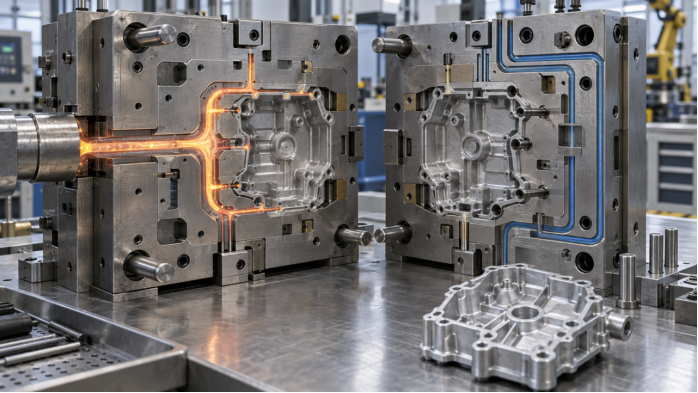
When selecting cooling channels, think about diameter, spacing, diameter of a cavity, and if the shape of blank will interfere with placement of screws, ejectors, and slides. Placing a channel closer together increases thermal access. However, it decreases the amount of remaining steel.
Measure flow of the circuit, pressure loss, and temperatures of the inlet and outlet simultaneously. Cooling effectiveness cannot be determined by a temperature difference. It is necessary to design a thermal cycle that prevents overcooling and does not increase the temperature differentials to a damaging extent.
Pair Aluminum Alloy Die Casting Mold with Production Equipment
Clamping Tonnage is just one aspect to be reviewed. The projected area, pressure, and the shot must be reviewed along with the pressure–flow performance, the mold envelope, ejector stroke, and extra connections.
For an alloy change, wall thickness change, or cavities change, the filling and thermal analysis needs to be done again. An increase in cavities needs balanced runners and a balanced evacuation and cooling system.
Among its tooling materials, SunOn provides the options of 8407, H13, and 4Cr5MoSiV1. For the tooling materials, the requested heat-treatment must be agreed upon along with a complete material traceability, and provisions for tooling repairs. Tool-life shall not be based on the grade of the material only.
Establish a Baseline of Installation and Maintenance
Before the trials:
•Clearances of slides and movement of ejectors shall be verified.
•Cooling circuit flows shall be confirmed and the integrity of the connections shall be verified.
•Vacuum seals shall be checked and the operation of the valves shall be verified.
The operating temperatures and the conditions of the cooling circuits shall be recorded. These shall form the baselines to detect blockage from scaling, leakage, erosion, and thermal deterioration of the gates. Provide means to remove blocked cooling circuits and to replace worn parts.
Tooling shall be validated for Performance
For Aluminum Alloy Die Casting, acceptance shall be Physically stable and capable of producing a stable thermal state for a series of production.
The following shall be agreed upon:
•Dimensions: The datums and the as-cast tolerances along with machining allowances.
•Internal Quality: The inspection regions, the sampling procedure, and the methodology for evaluation and the acceptance criteria.
•Sealing: Medium, pressure differential, temperature, stabilization time, and allowable leakage
•Standards: Applicable contractual material, tolerance and inspection requirements.
Should be provided, confirm the relevant scope and edition of ASTM B85/B85M, ISO 8062, or ASTM E505. Reference standards do not replace criteria for part specific acceptance.
Prior to purchase, request assumptions for simulation and example data. Define ownership, responsibility for modification, replacement of wear parts, and the tool-life. Evaluate the cost of each part accepted, scrap, machining, inspection and downtime.
Your drawings, alloy, yearly volume, and specifications for the machine and functionality should be provided to SunOn's Aluminum Alloy Die Casting mold team to design and validate an approximate mold.
FAQs
Q1. Does SunOn provide custom Aluminum Alloy Die Casting molds?
Yes. SunOn designs and manufactures custom aluminum and zinc alloy die-casting molds based on customer drawings and project requirements. Customers can discuss either mold supply or cast-part production.
Q2. What information should I provide for a SunOn die-casting mold quotation?
Submit 2D drawings and 3D models, the specified alloy, annual volume, and key quality requirements. Include critical tolerances, machining areas, surface finishes, and any leak-testing requirements so the quotation reflects the intended application.
Q3. Does SunOn perform DFM and mold-flow analysis?
Yes. SunOn offers DFM and mold-flow analysis in its development process. These reviews help identify manufacturability issues before detailed mold design. Ask which filling and thermal results will be included in your project's design review.
Q4. Which mold steels does SunOn offer for Aluminum Alloy Die Casting?
SunOn offers 8407, H13, and 4Cr5MoSiV1 among its tooling-material options. The appropriate material should be selected alongside heat-treatment requirements, thermal loading, expected production volume, and maintenance provisions.
Q5. How does SunOn verify a die-casting mold before production?
SunOn's process includes mold assembly, trials, and T1 sample inspection, followed by adjustments based on testing and feedback. Buyers should agree on dimensional, internal-quality, and functional acceptance requirements before trials begin.
