


Automation Parts CNC Machining: Aluminum vs. Stainless Steel vs. Brass
When designing automation systems — from robotic arms to pick-and-place units — every component must balance strength, weight, cost, and environmental resistance. Automation Parts CNC Machining plays a decisive role in achieving that balance. Among the dozens of engineering metals available, three materials consistently stand out for CNC machined automation components: aluminum, stainless steel, and brass.
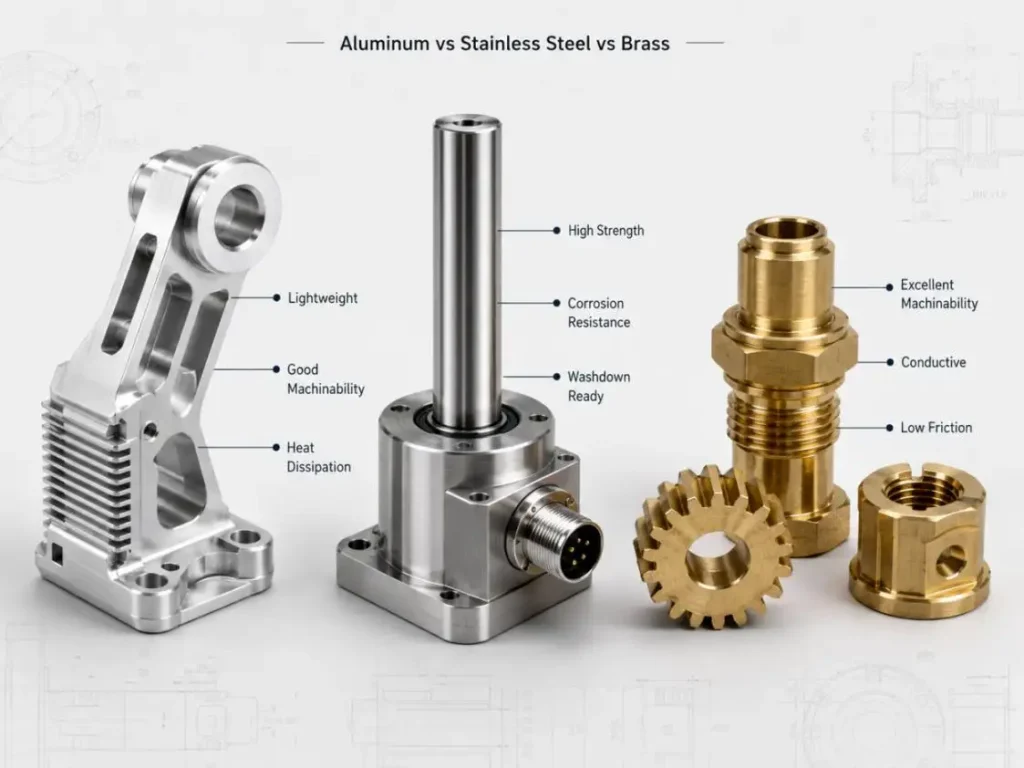
This guide provides a neutral, side-by-side comparison of these three metals. You will learn their key properties, machining behaviors, typical applications in automation, and how professional CNC services like SunOn's turnkey approach help you select and produce the right part for each function.
Why Material Selection Matters for Automation Parts CNC Machining
Choosing the wrong metal can lead to premature wear, excessive weight, or hidden cost increases. Conversely, the right material improves reliability and reduces long-term maintenance. Automation Parts CNC Machining allows you to achieve tight tolerances (from ±0.1 mm down to ±0.002 mm) regardless of the metal, but each alloy responds differently to cutting tools, heat, and surface finishing.
•Performance with stress: Automated components are often subject to repetitive stress, vibration, and friction. Fatigue resistance of the selected material is essential.
•Consideration of the environment: Only corrosion resistant alloys can be selected due to humidity, various chemicals, and temperature changes.
•Economic Consideration: Each type of alloy is processed with a different ease. This ease of machining impacts lead time, tool wear, and overall part cost.
1. Aluminum – Light and Flexible
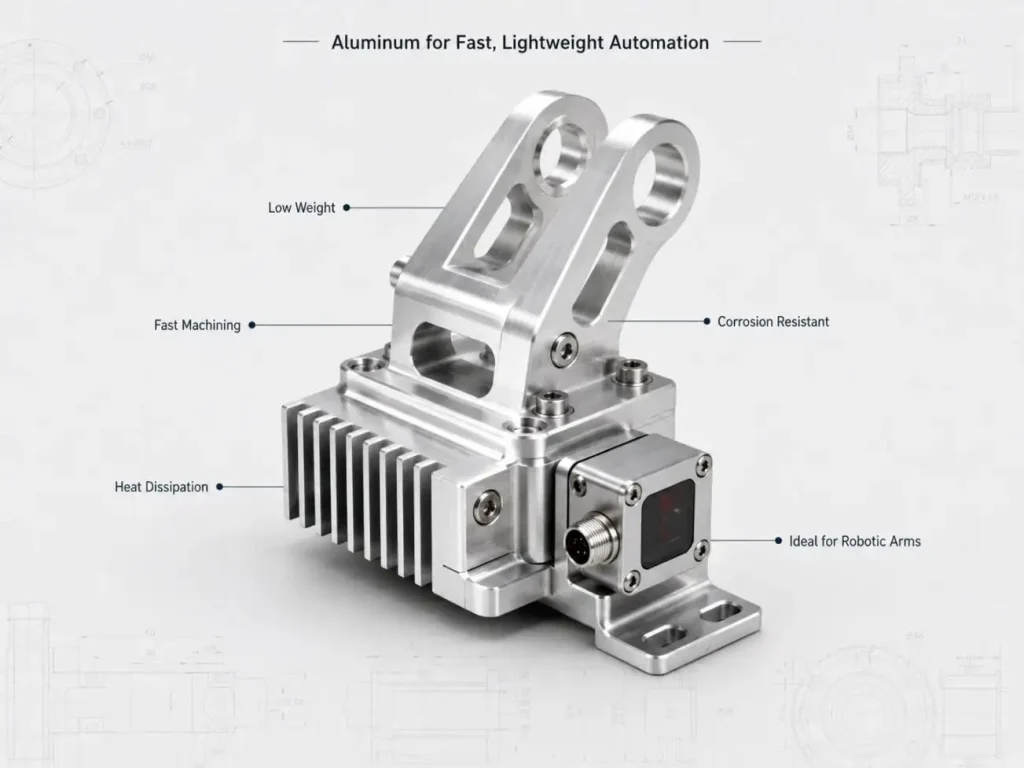
Lightweight aluminum is ideal for automation parts, since they can be designed to accelerate without the worry of overloading the automation system's servo motors. Aluminum has the additional benefit of being corrosion resistant.
1)Important Aluminum Properties for CNC Machining
•Low weight: Inertial forces are minimized because aluminum is 1/3 the density of steel.
•Naturally resistant to corrosion: Good enough for most indoor automatic applications as well as many outdoor applications.
•Good machinability: Creates short and manageable chips, and can be cut at a high speed for better tool life.
•Aluminum's thermal conductivity makes it an effective metal to use for heat dissipation from motors and electronics.
•Post-processing: Flexible and readily accepts surface treatments.
2)Common Parts Made from Aluminum
•Links and end-effectors for robotic arms
•Conveyor brackets and sensor housings
•Control cabinet and servo drive heat sinks
3)CNC Machining Aluminum
•Edges which are built up can be minimized by using carbide tools which are kept polished and sharp.
•Higher spindle speeds (8,000 – 15,000 RPM) with appropriate coolant improve surface finish.
•It is common to achieve a surface finish of Ra 0.8 µm without the need of a secondary surface treatment or polishing.
2. Stainless Steel – Fortified with Strength and Corrosion Resistance
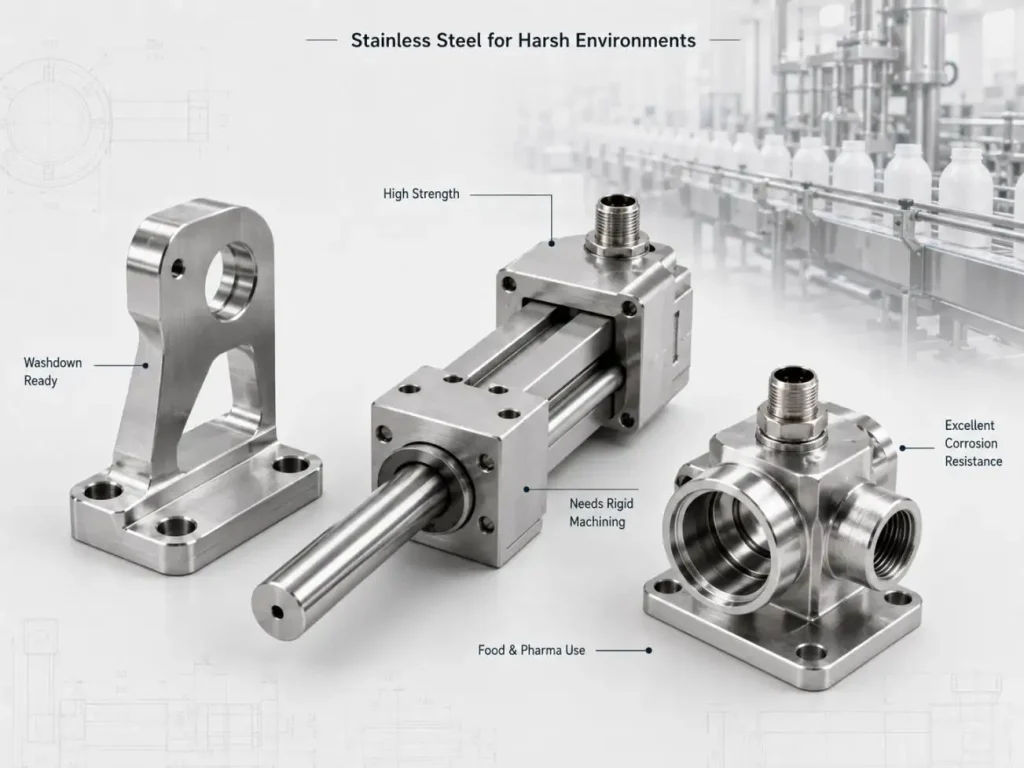
When automation parts need to stand up to a harsh washdown and a high mechanical load, along with the exposure to chemicals, stainless steel is the alloy of choice and the only practical option. Its durability and cleanability makes stainless steel a choice for food and pharmaceutical automation along with outdoor automation.
1) Key Properties of Stainless Steel for CNC Machining
•Superior Strength: Stainless steel has the ability to withstand high static and dynamic loads with impact resistance.
•Remarkable Resistance to Corrosion: Of all the metallic materials, Stainless steels 304 and 316 are the closest to being wholly resistant to rust and corrosion as regards to the action of acids and alkaline cleaning solutions.
•Their Benefits: high quality, refined and non-porous stainless steels that are easy to cure and meet FDA and GMP requirements
•Difficulties in Machining: Stainless steel hardens during machining which demands more rigid setups, lower speeds and larger coolant supply.
2) Commonly Used Stainless Steel Automation Components
•Shafts, guide rods and pins.
•Sensor and valve housings that will come into contact with harsh and/or aggressive environments.
•Mounting brackets for automated kiosks and EV charging stations located outdoors.
3) Stainless Steel Specifics for CNC Operations
•To avoid work hardening, inserts should have a positive rake and be sharp.
•Machining speeds should be just under those used for aluminum, keeping an even feed rate to reduce risk of chipping.
•Passivation should occur after the cutting process to renew the protective corrosion layer.
3. Brass - Machinability and Conductivity
Brass has good electrical conductivity and low friction which make it amenable to use for some structural automation components. Its presentation is also a positive. Brass is a copper and zinc alloy, which gives it interesting properties in Automation Parts CNC Machining in these applications.
1) Key Properties of Brass for CNC Machining
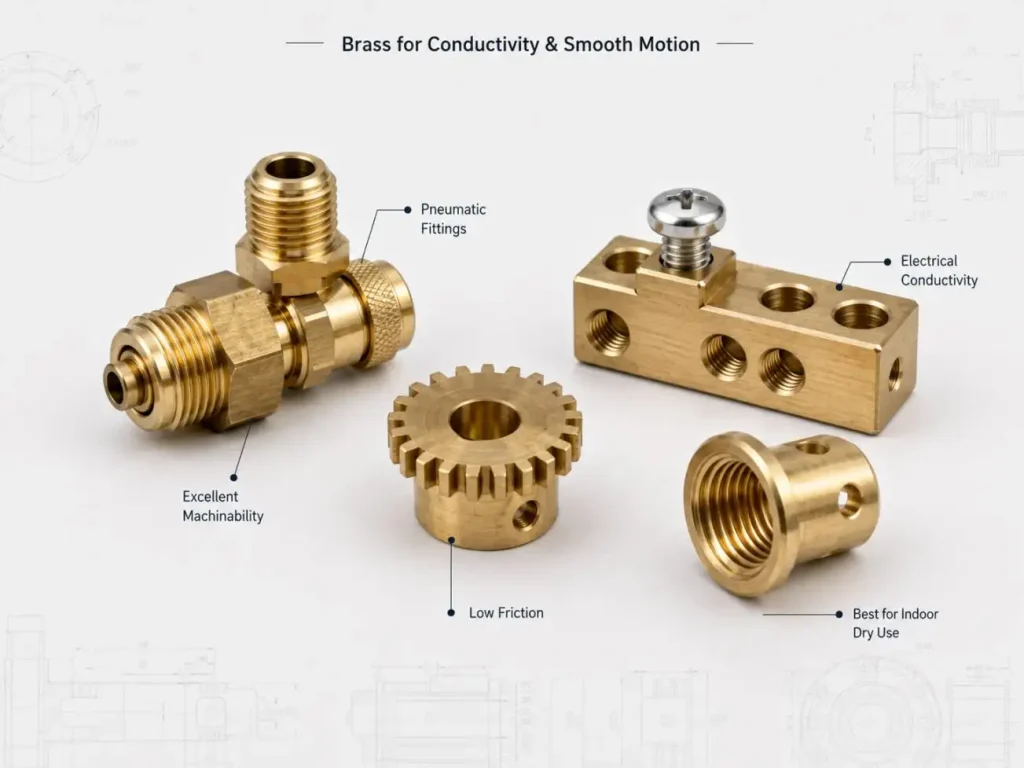
•Excellent machinability: Brass is often rated at 100% relative machinability (free-cutting brass), and produces fine, powdered chips during machining.
•Good electrically conductive: Brass is good for use in grounding contacts, terminals, and anti-static components.
•Low friction against steel: Due to low friction against steel, brass is best suited for use in bushings, nuts, and pads in sliding mechanisms.
•Corrosion resistance in mild environments: brass is a good choice for dry indoor applications. However, it is less resistant than stainless steel in acidic or salty environments.
2) Common Automation Components from Brass
•Pneumatic fittings and quick-connect couplings
•Miniature gears and anti-backlash nuts
•Electrical connectors and grounding blocks
3) CNC Considerations for Brass
•Brass can provide a mirror finish if a shallower depth of cut is done at high speeds.
•Sharp HSS or carbide tools with polished flutes prevent chip welding.
•No special coolant required; mist or dry machining is often sufficient.
Head-to-Head Comparison: Which Metal Suits Your Automation Part?
| Property | Aluminum | Stainless Steel | Brass |
| Density (g/cm³) | 2.70 | 7.90 – 8.00 | 8.40 – 8.70 |
| Tensile strength (MPa) | 200 – 400 | 500 – 1000+ | 300 – 500 |
| Corrosion resistance | Good (indoor) | Excellent (wet/chemical) | Fair (indoor dry) |
| Machinability rating | Very good | Moderate | Excellent |
| Relative material cost | Low | Medium-high | Medium |
| Surface finish options | Anodizing, painting, polishing | Polishing, electro-polishing, passivation | Polishing, nickel/chrome plating |
How SunOn's Expertise Elevates Automation Parts CNC Machining for Any Metal
Selecting the right alloy is only half the solution. Producing reliable, precision-machined automation parts requires advanced equipment, skilled programming, and rigorous quality control. SunOn Industrial Group combines over 25 years of experience with a one-stop CNC machining service — from DFM review to surface finishing and delivery.
1.Key Technical Advantages at SunOn
•Ultra-precision capability: Achieves dimensional tolerances from ±0.1 mm to ±0.002 mm, essential for bearing fits and servo interfaces.
•5-Axis CNC for intricate designs: Fully automates the machining of complex components (e.g., multi-facet valve bodies, robotic joints) within a single set up, enhances the precision and decreases time delays.
•72-Hour Rapid Prototyping: Great for small batch manufacturing (1-100), eliminates the expense for tool costs and allows for multiple design improvements prior to final production.
•Surface Finish Ra 0.8 μm as Standard: A finer surface finish lowers friction and wear for moving components within automation.
•Process Optimization by Material: For Aluminum: Fast milling & Min. Quantity Lub. For Stainless Steel: Peck Drilling & Rigid Tools. For Brass: Carbide Tools w/ polish to help maintain the surface.
2.End-to-End Quality Control
•3D Design and DFM Review: Before any programming occurs, engineers examine 3D designs to check if the designs are manufacturable relative to the geometry of the manufactured part.
•In-Process Inspections: A CNC probe measures an important value. Also, after a process step is completed, a CMM is used to measure the completed step.
•Certifications: As necessary, certifications for materials and inspections are presented.
3.Examples of Use in Automation
All three of the metals are seen in one automated assembly line.
•Aluminum: Used for Lightweight transport plates in a robotic pick and place system which are fastened. Anodized for scratch resistance.
•Stainless steel: Guide shafts for a linear actuator in a food-packaging machine — electropolished for hygiene.
•Brass: Air line fittings and a wear-resistant lead screw nut — machined to provide consistent low friction over millions of cycles.
SunOn's team regularly helps automation designers remanufacture legacy steel parts in aluminum for weight reduction, or upgrade brass bushings to self-lubricating composites — always guided by neutral engineering analysis.
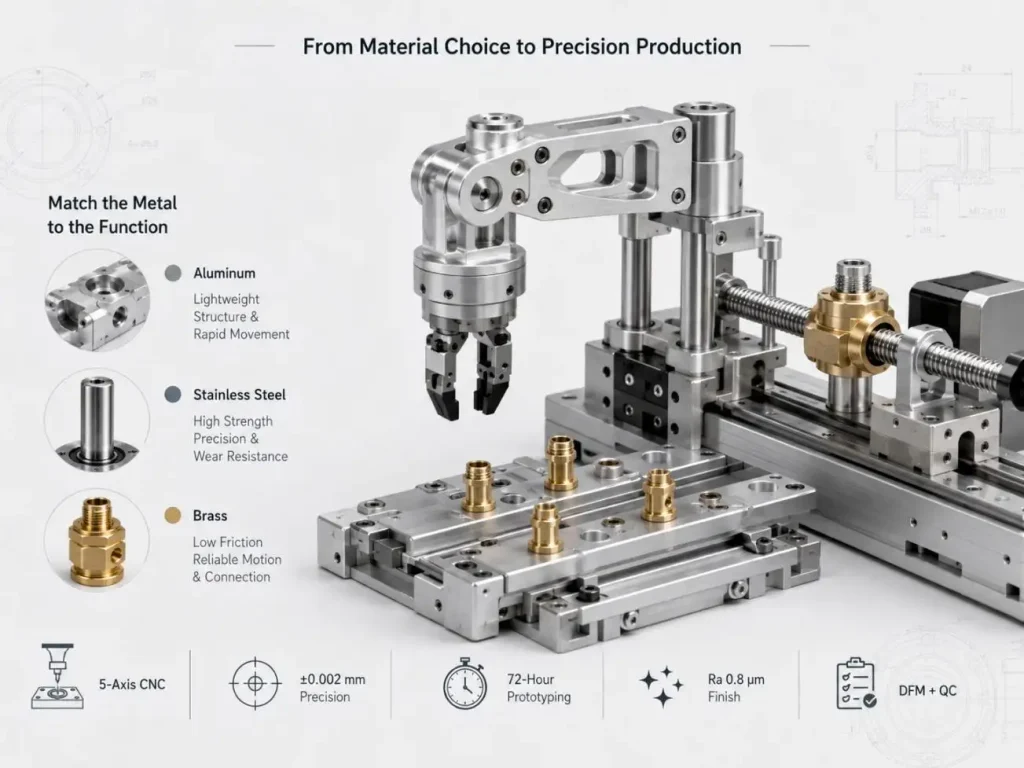
Conclusion: Match the Metal to the Function
No single metal is “best” for Automation Parts CNC Machining. Aluminum offers unmatched weight savings, stainless steel provides durability and corrosion resistance, and brass excels in high-machinability or conductive applications. By understanding their trade-offs, you can design automation parts that perform reliably and cost-effectively.
With SunOn's CNC machining capabilities — including 5-axis technology, rapid prototyping, and over 25 years of material expertise — you are supported from material selection through to certified production. Whether you need one complex aluminum prototype or 10,000 stainless steel components, the same precision and consistency apply.
Ready to optimize your next automation part?
[GET A QUOTE] or contact SunOn to discuss your material and design requirements. No mold costs. Customized designs. Fast turnaround — as fast as 72 hours for prototypes.
FAQs
Q1. What methods does SunOn implement for precision manufacturing with varying metals?
SunOn achieves a precision range of ±0.1 mm to ±0.002 mm through the use of cutting parameters, engaging in-process probing, and applying CMM inspection.
Q2. What is required in the CNC machining of stainless steels?
For the machining of stainless steels, a positive rake angle carbide tool is
needed. A robust support system is also needed to avoid tool breakage.
Q3. Why is brass not ideal for high-load automation structures?
Yes. Brass is better for bushings and fittings than for primary load members.
Q4. What is SunOn's capability for achieving metal surface finishes?
As standard, SunOn achieves surface finishes of Ra 0.8 μm with anodizing, plating, and polishing available for further enhancement.
Q5. Is treated aluminum corrosion-resistant enough for outdoor automation?
Yes, with anodizing or painting. Unprotected aluminum will oxidize, but in most outdoor environments it will retain a functional surface.
