


Automotive Alu-Zinc Die Casting Mold | Extended Tooling Life & High-Precision
Why are Aluminum-Zinc Die Casting Molds Related to the Automotive Industry?
Automobile industry tools are required to perform a high number of cycles for quality automobile production. As for Alzinc die casting molds, these are designed to outperform aluminum while maintaining lightweight construction, hence offering superior thermal conductivity.
The Most Important Takeaways are:
• Automotive alu-zinc die casting molds result in significantly low tooling life, hence fewer replacements, and lower maintenance costs.
• Automotive die casting molds are extremely precise, which are suitable for high-tolerance engine parts, transmission housings, and electronics casings.
• Automotive die casting parts are lightweight, which boosts efficiency and lowers energy consumption in production.
• Automotive die casting is economical because the aluminum alloy used in production is highly durable and recyclable.
Automotive production is paired with the unmatched strength and corrosion resistance of aluminum-zinc die casting molds; this makes them ideally fit for aluminum-zinc die casting high-volume production.
Advantages of Automotive Aluminum-Zinc Die Casting Molds
The efficiency of alu-zinc molds is the result of the alloy composition and design of the mold.
1. The Strength of Aluminum Alloy Molds
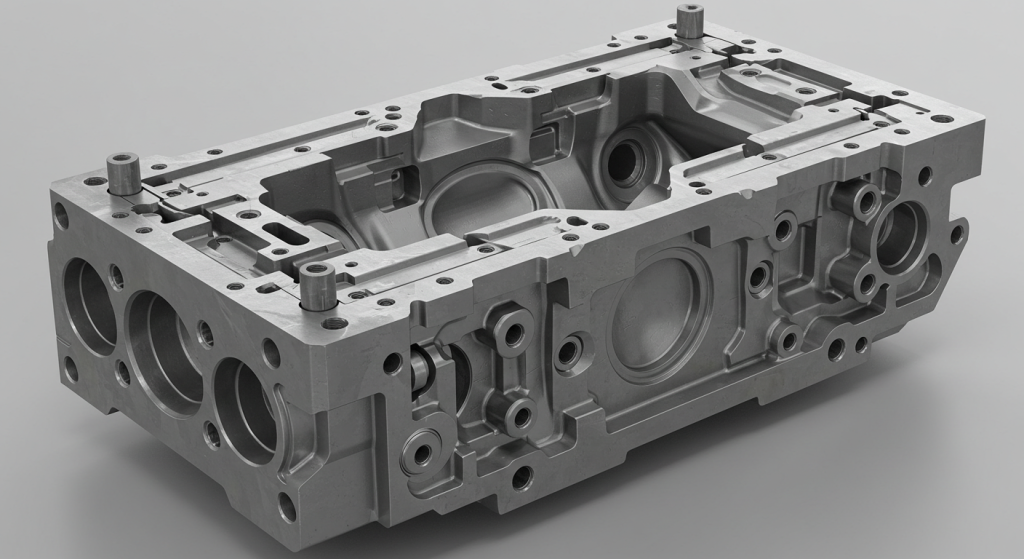
Because of their strength, which makes them resist abrasion, fatigue, and deformation over countless cycles, alu-zinc die casting molds can be used on both raw and ornamented darts of automobiles.
2. Mold Wear Containment and Surface Finish
Compared to other materials used in die casting, alloys of aluminum-zinc die-cast aid in tool life because of their shorter cooling cycles and absence of thermal stressing, which reduces wear on the die.
3. Dispersion of Thermal Stress
The aluminum-zinc alloy die molds. The other molds used in die casting wear out more quickly. This is mainly because of their poor surface quality.
4. Resistance to Thermal Fatigue
Unlike most other die molds, aluminum die cast molds are easily machined to desired geometries such as ribs and intricate shapes.
5. Freedom From Internal Stresses
The ease of machining aluminum die cast molds to shapes such as intricate ribs and other geometries is a testament to their low internal stresses.
Advantages in Manufacturing and Process Work
The alloy’s advanced physical properties and manufacturing technologies create automotive die-casting molds with efficacy.
Computerized Design Manufacturing and Computer-Aided Design
As with the other processes of CAD/CAM software, CNC Machining allocates the aluminum zinc mold into equally spaced portions in the cavity of the parting line. The software also determines flow rates that optimize mold flow, cooling passages, and tools.
Enhancing Mold Durability with Advanced Techniques
One enhancement in die casting mold durability prediction simulation software, combining Mold Flow & Wear, and Lean manufacturing, helps reduce downtime.
High Volume Production Capacity
The virtually unobstructed die-casting of engine housings, transmissions, and electronic housings, coupled with the high volume factors of automotive die casting, makes the alloy’s tooling durability an advantage.
Refurbishing and Maintaining the Mold
Worn molds protected through routine and periodic maintenance are most isolated in operational costs and worn dimension automotive parts counters. These molds are also the most dominant in cost across the automotive part dimensions set to retain.
The benefits that come from the improved productivity and performance from the use of aluminum-zinc die automotive casting molds include the following:
• Uninterrupted operation of the automotive die casting molds means that production at high volumes and with minimal pauses is possible.
• The maintenance with aluminum-zinc die casting is held at a minimum, and therefore, the per-cycle cost is low.
• There is a lower processed scrap level and therefore the automotive parts have high quality and consistency.
• There is great automotive production volume due to high throughput gains.
• The die casting process is more efficient with improved thermal management.
• Critical automotive parts have high-quality and consistent uniform surface finishes.
• There is increased manufacturing productivity due to operational molds having less overall downtime.
Proprietary Beneficial Use Cases
Automotive Engine Components
Molds made of aluminum-zinc alloys are used for making engine blocks, transmission housings, and other key components because of their high strength, thermal stability, versatility, dimensional accuracy, and multifunctionality.
Housings for Automotive Electronics
We love the automotive alu-zinc die casting molds for the automotive electronic housings for the high accuracy and extrusion precision of the molds in compliant automotive electronics, as well as the strict tolerances and superb finish.
Automotive Parts: Structural and Ornamental
Aluminum-zinc molds in mass production for structural supports and ornamental trims for automotive parts is a win for both high durability and aesthetic value, a rare combination in the industry.
Lightweight Automotive Die Casting Advantage
Aluminum-zinc alloys significantly reduce the weight of the molds and thus improve energy efficiency and significantly reduce the stress placed on the production machinery.
Aerospace-Grade Applications
Aluminum-zinc molds allow the crossover between automotive and aerospace parts. They increase tool life and make complex geometries easy and accessible.
Aluminum-Zinc Compared to Other Alloys
Alu-zinc alloys, like other alloys, must be die-cast into molds, which is a reason for the comparison of using aluminum-zinc to traditional molds of other alloys, such as zinc and aluminum.
- Automotive molds made of aluminum and zinc as a comparison → Pure aluminum-zinc molds are the better option. They are light, durable, and more wear-resistant than pure aluminum.
- Comparison of Alu and zinc die casting molds → Alu-zinc possesses mechanical strength, which optimizes tool life. For alu-zinc, tool life is longer and maintenance is less. Tooling costs are reduced.
- Molds made of aluminum-zinc alloys have greater wear resistance relative to the cost of steel molds and other superior wearing materials.
- “Al-zinc alloys are cost-effective in the long run.” The lifecycle cost of die casting molds for cars is significantly reduced.
The combination of the aforementioned benefits and the economical nature of automotive alu-zinc die casting molds adds to their value in the current era of manufacturing.
Optimizing the Tool Life of Modern Molds
To ensure the automotive aluminum-zinc molds are the most durable and efficient, the following factors must be looked at:
1. Optimize Cooling Channel Design: Reduce wear and thermal fatigue and improve management of the tool.
2. Choose the Correct Tool Steel: Improve resistance to wear, and the stability of dimensions.
3. Preventive Mold Maintenance Systems: Reduce downtime and increase tool life.
4. Advanced and Modern Simulation Software: Improve the design based on wear prediction.
5. Lean Manufacturing Method: Maintain quality and reduce the time of the cycle.
6. Balance Cycle Time with Durability: Reduce the mechanical and thermal stress.
The life and productivity of alu-zinc die casting molds can be augmented through improvements in engineering and manufacturing processes, coupled with the economic advantages posed by the alloy.
Reasons Why SunOn Mould is Selected for the Automotive Sector for Zinc-Aluminium Die Casting
SunOn Mould serves the automotive sector with high-performance alumin-Zinc die casting, die casting molds for which it specializes in designing and manufacturing. In addition to these, we provide:
• Engineering and CNC machining of die casting molds for automotive parts, in mass production.
• Precise CAD Engineering, CAM, and machining of the components.
• The use of predictive simulation software to increase die casting mold life and die wear prediction.
• Custom parts for engines, housings for electronics, trim ornaments, and other structural components.
In terms of precision, cost, and life cycle value, SunOn provides high-quality extended automotive production for precision cost cost-effective automotive parts
Conclusion
Automotive die casting using aluminum with zinc is one of the key parts in automobile production. The combination of alu-zinc alloy with the sophisticated mold design and high precision fabrication technology guarantees consistently high quality of the parts produced and long life(high wear resistance and extreme wear condition interval).
Their combination of great strength and light weight makes them more cost-effective than traditional aluminum or zinc molds. The sought-after combination of optimum tooling and the value it brings in sustaining cost-effective production, in addition to reduced operational downtime, is seamless. This makes the partnership with SunOn Mould highly attractive. There’s unrivaled quality in the aluminum-zinc automotive die casting molds that SunOn Mould fabricates masterfully.
Enhanced strategies in production design and maintenance bring in sustainable goals of the automotive industry, thriving on optimised manufacturing. This is driven in the production through the life of the tooling in automotive aluminum-zinc molds.
