


Automotive CNC Machining for EV Components: Challenges and Solutions
Automotive CNC machining for electric vehicle components is far more than conventional machining with tighter tolerances. EV motor housings, inverter enclosures, cooling plates, battery structures and busbars must meet interconnected requirements for alignment, sealing, heat transfer, cleanliness and electrical safety.
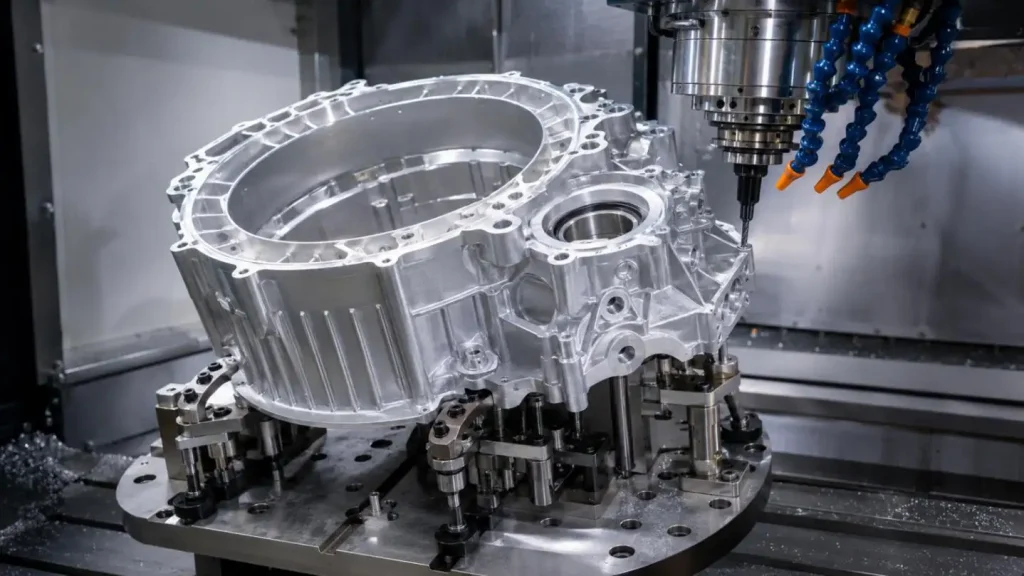
A part may pass dimensional inspection and still fail after coating, cleaning or assembly. Successful Automotive CNC Machining therefore begins with the component's function—not a blanket tolerance applied to every feature.
Why EV Components Fail After Machining
Several failure modes are particularly common in EV component manufacturing projects:
•Motor and E-axle housings: Bearing bores may shift after unclamping, increasing runout, bearing load and NVH
•Inverter housings: Machining operations can reveal porosity within die-cast walls or produce inadequate sealing surfaces.
•Battery cooling plates: Burrs and residual metal chips may obstruct narrow coolant channels.
•Copper busbars: Ductile material forms edge burrs that can damage insulation or reduce safe electrical clearance.
•Large battery structures: Long sealing surfaces distort after material removal, heat treatment or uneven bolt tightening.
These examples demonstrate that automotive CNC machining cannot be controlled by linear dimensions alone. Flatness, position, coaxiality, surface texture, particle cleanliness and leak-test requirements are often more critical than nominal dimensions.
How Heat, Datums and Clamp Force Affect Accuracy
Aluminum expands approximately 23 µm per metre for every 1°C temperature increase, depending on the alloy. A 500 mm housing measured at a 5°C temperature difference may change by roughly 0.058 mm. Inspection temperature and stabilization time therefore matter for large EV parts.
Thin walls create another challenge. Excessive fixture pressure can temporarily flatten a housing during machining. Once released, the part springs back. A more reliable Automotive CNC Machining plan may use:
•Symmetrical material removal
•Low-force, multi-point support
•Separate roughing and finishing operations
•A stabilization period between operations
•Functional datums shared by machining, inspection and assembly
Reducing setups also limits datum-transfer error, but a 5-axis machine is not automatically more accurate. Fixture design, thermal control, tool condition and measurement uncertainty still determine the result.
Compare the Process Routes Before Selecting CNC
| Decision | Options | Best Decision Trigger |
| Starting material | Billet vs. casting, extrusion or forging | Prototype speed, annual volume, porosity and production-equivalence needs |
| Machine route | 3-axis multi-setup vs. 5-axis machining | Feature orientation and datum-transfer risk |
| Workholding | Rigid hard fixture vs. low-force supported fixture | Wall thickness, opening size and free-state geometry |
| Machining sequence | One-pass machining vs. rough–stabilize–finish | Residual stress and flatness requirements |
| Leak testing | Pressure-decay/flow vs. helium tracer gas | Specified leak rate, test volume, medium and cycle time |
| Inspection | CMM only vs. in-process probing plus CMM | Production volume, drift detection and traceability |
For early EV development, billet machining offers fast design iteration, but it does not reproduce the porosity or residual stress of a production die casting. SunOn supports 5-axis CNC machining, metals including aluminum, stainless steel, titanium and brass, and engineering plastics such as PEEK and nylon. Its service range covers dimensional accuracy from ±0.1 mm down to ±0.02 mm, depending on the project, with machined finishes to Ra 0.8 µm. The company also offers 72-hour rapid prototyping and low-volume orders of 1–100 pieces, making these capabilities relevant to design verification before production tooling.
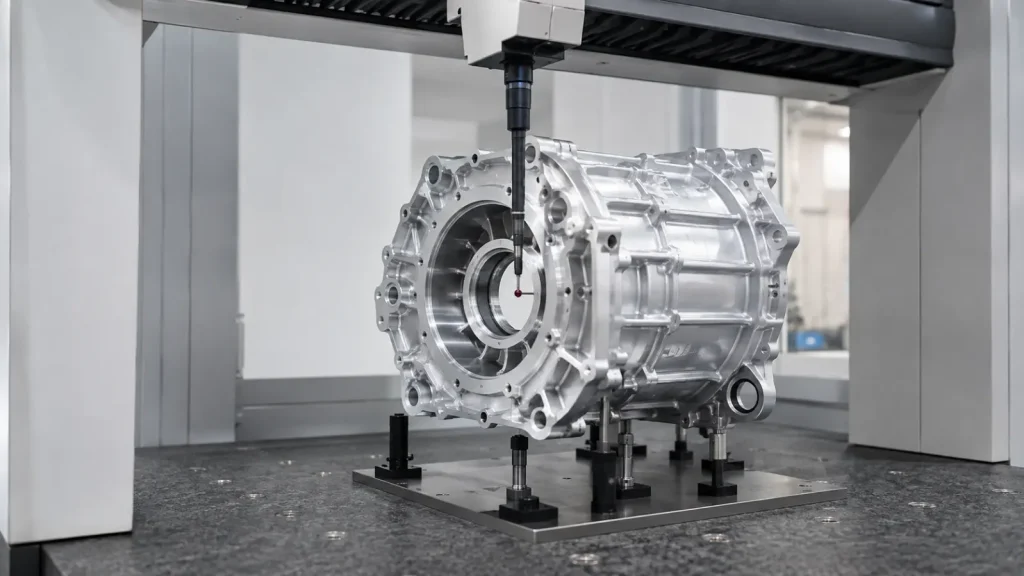
Match Automotive CNC Machining to the EV System
Different components require different control priorities:
| EV Component | Primary CTQs | Main Manufacturing Risk |
| Motor housing | Bore diameter, coaxiality, runout, datum position | Distortion and bearing misalignment |
| Inverter enclosure | Seal-land flatness, connector position, leak rate | Exposed casting porosity |
| Cooling plate | Channel geometry, cleanliness, sealing surface | Burrs, chips and local leakage |
| Battery interface | Large-profile flatness and hole position | Thermal movement and fixture deformation |
| Copper busbar | Edge condition, hole position, contact surface | Smearing, burrs and coating interference |
SunOn's combination of CNC machining, aluminum die-casting support, plastic molding, post-processing and assembly is useful where an EV project includes both machined metal structures and molded automotive enclosures. Its automotive manufacturing scope includes structural brackets, electronic enclosures and lighting housings, alongside secondary processing and assembly. SunOn automotive capabilities
Protect CTQs During Finishing and Assembly
Automotive CNC Machining does not end when the part leaves the machine. Cooling passages should be deburred, flushed, dried and protected from secondary contamination. Abrasive media should not be used where it can remain trapped in internal channels.
Anodizing, painting or plating may affect hole size, grounding areas and sealing boundaries. SunOn offers these finishing options, but drawings should identify masked datums, threads, seal lands and electrical contact surfaces. Critical features should be rechecked after finishing.
During assembly, bolt sequence, torque and gasket compression must be controlled. Production maintenance should also cover cutter replacement, fixture-locator wear, probe calibration, coolant concentration and washer-filter condition.
Build an RFQ Around Functional Risk
A useful Automotive CNC Machining RFQ should include:
•3D model and controlled 2D drawing
•Material grade, temper and starting-stock route
•Functional datums and CTQ characteristics
•Prototype and annual production quantities
•Surface treatment and masking requirements
•Leak medium, pressure, stabilization time and acceptance limit
•Cleanliness specification and packaging method
•Required inspection, capability and PPAP documents
SunOn can review these inputs through its DFM, material selection, programming, machining, finishing and inspection workflow. For an EV component under development, sharing the functional requirements—not only the CAD file—allows SunOn's engineers to recommend a more realistic Automotive CNC Machining route and identify production risks before quotation.
FAQs
Q1. What EV elements does SunOn offer with Automotive CNC Machining?
SunOn assesses motor housings, inverter enclosures, structural brackets, cooling components, connector housings, and other custom EV components. Final assessment will depend on part size, geometry, and functional or material tolerances.
Q2. What materials does SunOn machine for automotive components?
SunOn works with aluminum, stainless steel, titanium, brass, and engineering plastics PEEK and nylon. For a given application, material choice should consider the balance of strength, coolant exposure, thermal and electrical conductivity, and the required surface treatment.
Q3. What machining tolerances are offered?
SunOn has published a range of dimensions from ±0.1 mm to ±0.02 mm. The achievable tolerance will ultimately depend on material, geometry and features, machine setup, and the measurement technique. This should be defined during DFM. Check SunOn's CNC capabilities
Q4. What level of surface finish is offered for machined EV components?
SunOn has stated a machined surface finish of Ra 0.8 μm. For sealing surfaces, flatness, waviness, and tool mark direction should be controlled to the same extent, or possibly more, than a surface roughness value of Ra.
Q5. Does SunOn offer 5-axis automotive CNC Machining?
Yes. SunOn CNC machining is applicable to complicated structures and features that need to be removed in multiple axes. It can eliminate many setups and datum transfer errors on housings with bores, holes, openings and faces machined on multiple sides.
