


Automotive Injection Mould | High-Precision Moulding Services
Precision Engineering Driving the Future of Car Manufacturing
The automobile industry is one of the most challenging industries in the world that needs accuracy, scalability, and durability at all production levels. Dashboards, bumpers, connectors, safety housings, and nearly all the vehicles on the road today contain parts produced using automotive injection moulding. The core of this process is the automotive injection mould - the tool that is designed to form high-quality and repeatable automotive components out of thermoplastic in the molten state.
The use of custom automotive plastic moulds has never been as essential due to the increased demands for lightweight vehicles, fuel efficiency, electric mobility, and safety standards. SunOn Mould is contributing to the work of the car manufacturing companies to attain these objectives by designing and manufacturing high-precision injection moulds that satisfy the requirements of the global automotive industry.
Why is Automotive Injection Moulding a Necessity for the Industry?
The manufacturing of an automobile will not only involve the production of parts, but it also involves consistency, compliance, and cost effectiveness. Car parts moulding through injection moulding gives an ideal combination of these factors. In comparison to conventional machining, which may be costly and time-consuming to undertake in mass production, plastic injection moulds of vehicles allow manufacturers to:
- Create complicated shapes with high precision.
- Ensure high repeatability of millions of components.
- Minimise wastage of materials through optimal mould tooling.
- Improve operations using lightweight, but durable thermoplastics.
- Adhere to international automobile safety and quality regulations.
The outcome is a process capable of supporting mass production of the OEMs as well as custom automotive moulding solutions for specialised or prototype production.
Use of Automotive Injection Moulds
The automotive industry is a very diverse industry, and the automotive injection mould design serves a broad range of parts that can be seen and those that are not visible to the drivers, which are located under the hood.
Interior Components
- Instrument panels, centre consoles, dashboards.
- Door panels and trim.
- Air vents and glove boxes.
- Sitting parts with built-in moulded plastics.
Exterior Components
- Bumpers and grilles.
- Mirrors on the side and door handles.
- Headlight and taillight lighting housings.
- Aerodynamic components exterior plastic moulds.
Engine/Under-the-Hood Components.
- Engine covers and intake manifolds.
- Fluid and fuel systems part moulds are made of plastic.
- Radiator supports and air filter housings.
- Thermoplastic blends of high-heat-resistant components.
Electrical Components & Safety
- Airbag casing injection moulds.
- Moulds of an automotive electrical connector.
- Electronic control unit (ECU) housings are made of plastic.
- Wiring harness channels and moulds of fuse boxes.
Having such a broad range, car mould suppliers can offer manufacturing solutions as well as contribute to the innovation of vehicles and their efficiency.
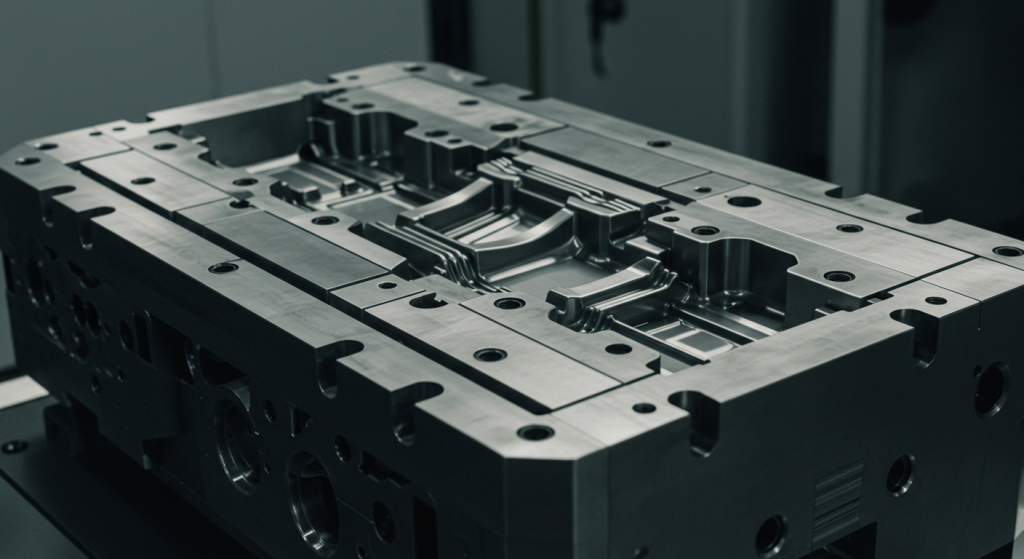
The Technical Basis of Automotive Injection Moulds
Material Selection
Car plastics have to be robust against heat, pressure, vibration, and contact with chemicals. Throughout time, thermoplastics that are commonly used are:
- Polypropylene (PP): To be utilised in bumpers, panels, and interior.
- ABS (Acrylonitrile Butadiene Styrene): To be applied in dashboards and trims.
- Polycarbonate (PC): Lighting use.
- Nylon (PA66): To be used in engine parts that need heat resistance.
- TPE (Thermoplastic Elastomers): To seal and flexible components.
Tooling Design & Engineering
- Mass production automotive moulds (Multi-cavity).
- Hot runner system to minimise wastage.
- Automotive cools down the system design in moulds to ensure that the cycle is efficient.
- High precision automotive mould design CAD/CAM.
- Moldflow simulation to simulate the flow of plastic and avoid defects.
Manufacturing Technology
- High precision base mould CNC machining.
- Fine details: EDM (Electrical Discharge Machining).
- Aluminium steel hybrid mould technology.
- Inserting and overmoulding of multi-material components.
Sturdiness and Quality Improvement
Moulds used in cars should be able to withstand millions of cycles without any serious wear. Reliability is achieved through wear-resistant steel tooling, surface treatment, and ISO-qualified quality assurance processes by the manufacturers.
Automobile Injection Moulding Compliance and Standards
The most demanding standards of traceability, safety, and repeatability are obtained in Automotive OEMs and Tier 1 suppliers. This is why recent mould producers work under internationally acclaimed certifications:
- General quality management- ISO 9001.
- IATF 16949: Quality management system, automotive.
- Automobile injection moulding that is ISO certified.
- Moulding standards for automotive OEMs in the world.
- Validation by First Article Inspection (FAI) and Statistical Process Control (SPC).
Benefits of Automotive Injection Moulding
Small Tolerance and Uniformity - Safety-critical components are required.
Cost Efficiency - Mass production can be done with less scrap through cost-efficient manufacturing of plastic moulds used in automotive.
Design Flexibility - Allows building of lightweight complex structures.
Scalability - Participates in prototype to production automotive moulding and large-scale production.
Stability - Automotive moulds are developed with millions of cycles.
Global Supply Chain Integration - Automotive injection mould manufacturers provide 1440 globally at consistent standards.
Why SunOn Mould? Automotive Injection Moulds?
At SunOn mould, we are the market leaders in designing and manufacturing tooling and moulds, providing services that are trusted by the world's automotive companies.
End-to-End Services: Concept to the final mould.
Precision Engineering: Sophisticated tooling and CAD / CAM design.
ISO Certification: Making sure that automotive industry standards are met.
Flexible Solutions: Both prototype production and large-scale production.
Global Presence: Helping OEMs and Tier 1 suppliers in the global markets.
Fast Turnaround: Optimised processes that deliver fast without affecting the quality.
When you require a custom automotive injection mould of a dashboard component, long-lasting under-the-hood tooling solution, or a highly precise mould of an automotive electronic component, SunOn Mould offers a dependable, scalable, and innovative solution.
Future Trends in Automotive Injection Moulding
The automotive sector is experiencing a technological change, and the moulding technology is changing with technological change.
Lightweighting Solutions: More developed composites and plastics in place of metals.
Electric Vehicle (EV) Parts: Battery housing and charging connector injection moulds.
Sustainability: Bioplastics and recyclable plastics.
Automation: Moulding robotics and AI surveillance.
Miniaturisation: Sensors and smart electronics micro moulding.
These trends indicate that automotive moulding will continue to be at the centre of innovations in the automotive industry of the world.
Conclusion
The moulding determines the future of transportation, involving the beauty of a car dashboard, the power of its parts under the hood, etc. This technology makes vehicles safe, efficient, and sustainable as the tooling used is highly precise, scalable, as well as meeting global standards of compliance. At SunOn Mould, we can mix both technical knowledge with the desire to create innovations, which have provided an innovative solution to the automotive mould in customised product manufacturing that keeps the industry moving. We make moulds that give you the basis for your success, whether it be a startup making special parts or an automotive giant running the mass production machine.
