


Automotive Overmolding Material Selection: TPE, TPU, Silicone, and Engineering Plastics
Automotive Overmolding combines a rigid substrate with a second material to add sealing, grip, cushioning, vibration isolation, electrical protection, or a selected surface feel. Typical applications include dashboard controls, center-console parts, door components, air vents, electronic enclosures, connector seals, lighting housings, and structural brackets.
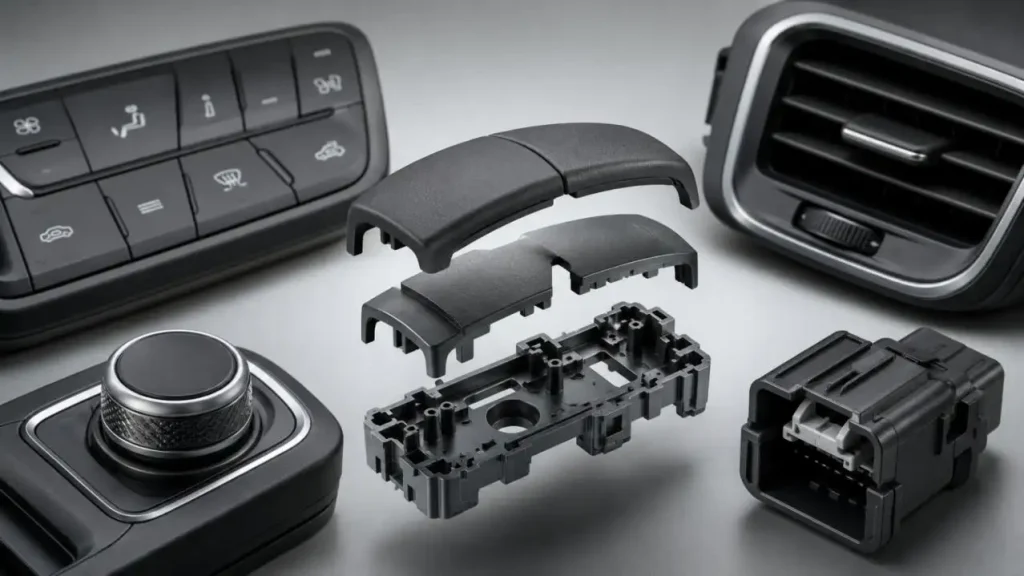
Material selection is central to Automotive Overmolding because the two materials must perform as one component during molding, assembly, and vehicle use. At SunOn, we evaluate material compatibility together with part geometry, mold construction, process conditions, surface requirements, and expected production volume.
How Automotive Overmolding Materials Function
The rigid substrate generally gives dimensionally stable support. The functional surface is added using the overmolded elastomer. Automotive Overmolding is achieved either by insert molding or multi-shot injection molding.
An appropriate material pairing must consider several factors:
•Adhesion: The elastomer must either bond to the substrate grade or be retained using mechanical interlocks.
•Temperature: Both materials must withstand the temperatures of the molding process and the maximum expected during service.
•Differential Shrinkage: Distortions such as warping and edge lifting will occur from differential behavior during the shrinkage of a part.
•Chemical Resistance: The materials must be able to withstand the cleaning solvents, oils, coolants, and other fluids that may be encountered during the life of the automobile.
•Surface Performance: Color, gloss, grain, tactile feel, scratch resistance, and visible flow marks should be reviewed together.
Automotive Overmolding Material Comparison
| Material | Typical Role | Useful Characteristics | Main Technical Checks |
| TPE | Soft-touch layer, seal, anti-rattle feature | Broad hardness range and thermoplastic processing | Substrate adhesion, compression set and shrinkage |
| TPU | Protective layer, grip or strain relief | Abrasion resistance, tear strength and toughness | Moisture, hydrolysis resistance and processing temperature |
| Silicone or LSR | Seal, gasket or electronic protection | Broad temperature capability and electrical insulation | Cure conditions, flash control and substrate compatibility |
| PP | Lightweight rigid substrate | Low density and chemical resistance | Stiffness, surface energy and TPE grade compatibility |
| PA | Structural substrate | Strength, wear resistance and heat performance | Moisture absorption, drying and dimensional change |
| ABS or PC/ABS | Visible interior substrate | Appearance, impact performance and moldability | Heat exposure, residual stress and chemical contact |
These descriptions are general. Formulation, reinforcement, additives, hardness, and supplier grade can significantly change performance.
TPE for Automotive Overmolding
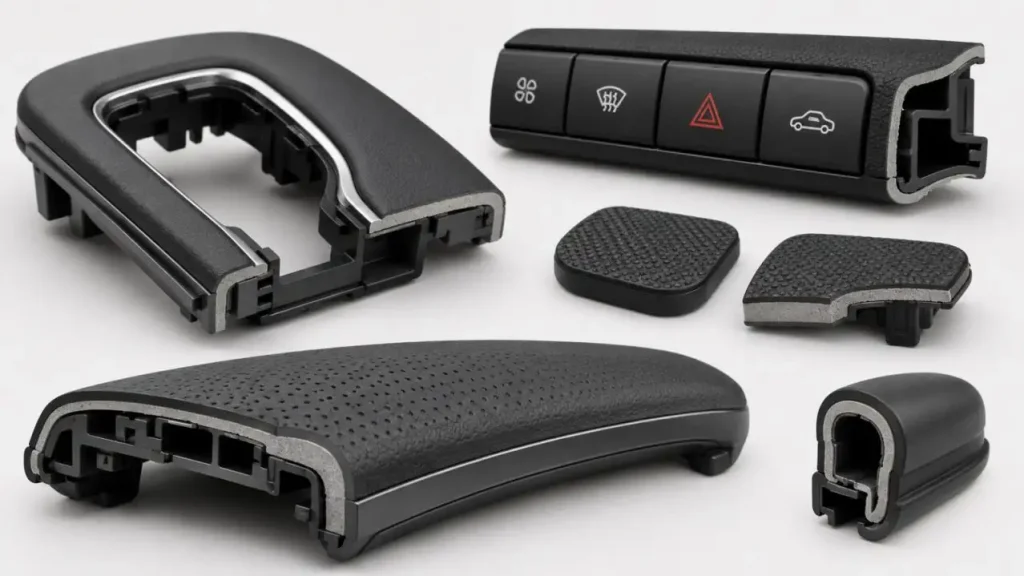
TPE is widely used in Automotive Overmolding for grips, interior controls, seals, console parts, anti-rattle features, and soft-touch surfaces. However, adhesion is grade-specific. A TPE developed for polypropylene may not bond adequately to PC, ABS, PA, or PC/ABS without a compatible formulation or mechanical retention.
Useful TPE design considerations include:
•Overmold Thickness: Avient identifies approximately 1.5–3.0 mm as a useful wall-thickness range for many TPE overmolding applications, although the final value should be validated for the selected material and geometry.
•Corner Radius: Sharp transitions are prone to stress concentrations. To mitigate this, use a minimum radius of 0.5 mm.
•Draft Angle: To facilitate part release, 3–5 degrees of draft may be required on long draw surfaces.
•Warpage Control: For long thin parts, minimize warpage by ensuring the thickest layer is the rigid substrate.
TPU for Wear and Impact Protection
In the case of Automotive Overmolding, consideration of TPU can be made due to its higher performance against abrasion and tearing as well as better long term performance against repeated handling and movement of cables. Typically, TPU is considered for the purpose of providing strain relief to connectors, for protective coverings, for cable interfaces, grips and other exposed functional surfaces.
As an engineering thermoplastic, TPU has the characteristic of hygroscopy, the ability to absorb air borne moisture. For the purpose of controlling issues such as foaming and surface defects, Covestro is recommending a maximum level of 0.05% residual moisture for their TPU, and the removal of moisture is recommended at a temperature of 80–110°C for 1–3 hours depending on the grade and hardness. Reserved moisture will have a negative impact on surfaces and will result in defects.
Material Chemistry: The selection of grade will result in a variation of chemical resistance, abrasion resistance and flexibility at lower temperatures. These are achieved in the polyester and polyether based TPUs.
Silicone and LSR for Sealing
For applications in Automotive Overmolding, the use of silicone and LSR (Liquid Silicone Rubber) can be considered when the requirements are for sealing that remains effective over a wide temperature range and when the requirements are for flexibility and electrical insulation.
Wacker estimates that most of their silicone rubber variants operate in the range of −50°C and +250°C, while specialty grades may operate in the range of −110°C and +300°C. These estimates are not considered universal design limits.
•Cure Compatibility: Rigid substrates must withstand the temperature and time needed for curing silicone.
•Adhesion Method: Certain combinations employ self-bonding silicones. Other combinations utilize surface treatments, primers, and/or mechanical locking.
•Flash Control: Low-viscosity LSR (Liquid Silicone Rubber) requires very precise shut-offs, excellent alignment, and controlled venting of the mold.
Key Technical Challenges in Automotive Overmolding
| Challenge | Possible Effect | Engineering Response |
| Incompatible materials | Delamination or weak peel strength | Verify the exact grades and include interlocks where appropriate |
| Unequal shrinkage | Warpage, edge lifting or poor fit | Balance wall thickness and validate through sampling |
| Trapped air | Burns, short shots or weak bonding | Vent at flow ends and avoid deep blind pockets |
| Substrate movement | Flash or dimensional error | Support and locate inserts securely |
| Excessive flow length | Incomplete filling or lower bond consistency | Reposition gates or use multiple flow paths |
| Moisture contamination | Splay, bubbles or unstable surfaces | Dry and handle hygroscopic materials correctly |
For TPE tooling, Avient lists vent depths of approximately 0.013–0.025 mm as a reference range. It also reports typical cooling times of about 15–40 seconds per 2.5 mm of overmold thickness for its materials because the rigid substrate insulates one side of the TPE layer. These values should be treated as starting points rather than fixed production settings.
SunOn's Automotive Overmolding Approach
SunOn supports Automotive Overmolding from mold design and injection molding through secondary processing and assembly.
•Material Review: We compare substrate and elastomer data with the part's temperature, chemical, tactile, and structural requirements.
•We design gates, vents, shutoffs, cooling channels, textures, and inserts based on the selected material system.
•We run trial samples to verify attachment, sizing, appearance, sealing, and fit before production approval.
•We plan mold steel selection, cavity layout, maintenance, and process control based on anticipated production volume.
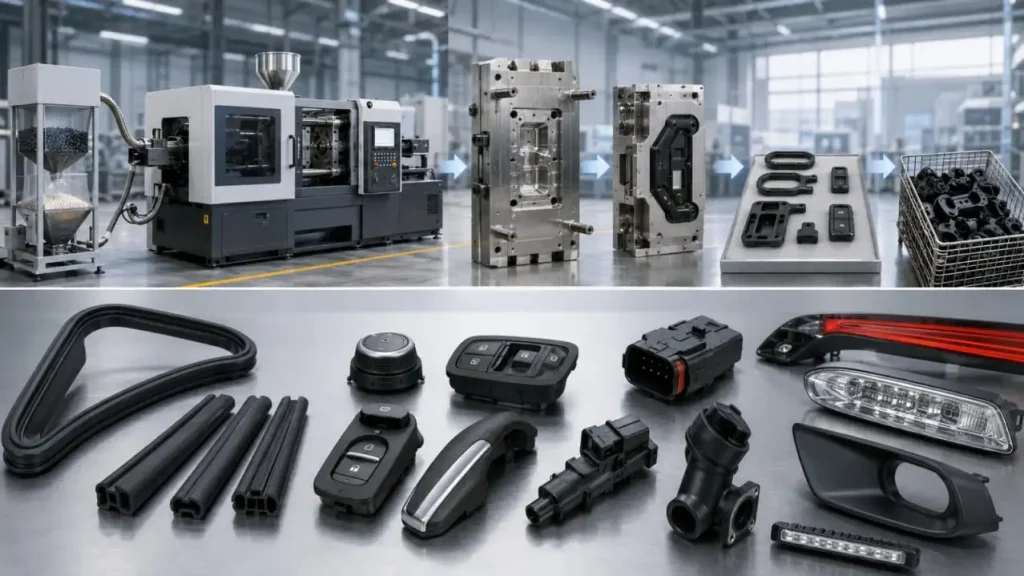
Secondary Services:We provide painting, printing, finishing, and assembly to match each project's requirements.
In Closing
Selecting the right materials for automotive overmolding means balancing adhesion, moisture resistance, shrinkage, and thermal or chemical exposure,alongside part geometry and tooling constraints.TPE, TPU, silicone, PP, PA, ABS, and PC/ABS each bring distinct performance characteristics suited to specific applications.
Incorporating the connection of materials, mold engineering, sampling, and injection molding and secondary processing, From material selection and mold engineering to sampling, injection molding, and secondary processing, SunOn delivers end-to-end overmolding capability for modern automotive interiors, e-systems, lighting, and integrated assemblies.
FAQs
Q1. What does Automotive Overmolding refer to?
Automotive Overmolding describes the process of combining a rigid substrate with a second material to provide sealing, grip, cushioning, or protection.
Q2. What are the materials used for Automotive Overmolding?
The materials used are mostly: TPE, TPU, silicone, PP, PA, ABS, and PC/ABS.
Q3. Can TPE be used for automotive interior parts?
Yes. TPE is widely used for soft touch surfaces, seals, grips, and anti-rattle elements.
Q4. When is TPU used for Automotive Overmolding?
TPU is used when parts require abrasion resistance, toughness, and flexible strain relief.
Q5. What are the benefits of using silicone for Automotive Overmolding?
Silicone can provide a seal and insulation with a high degree of flexibility over a wide temperature range.
