


Chemical-Resistant Silicone Compression Molding Services
What Does Chemical-Resistant Silicone Compression Molding Mean?
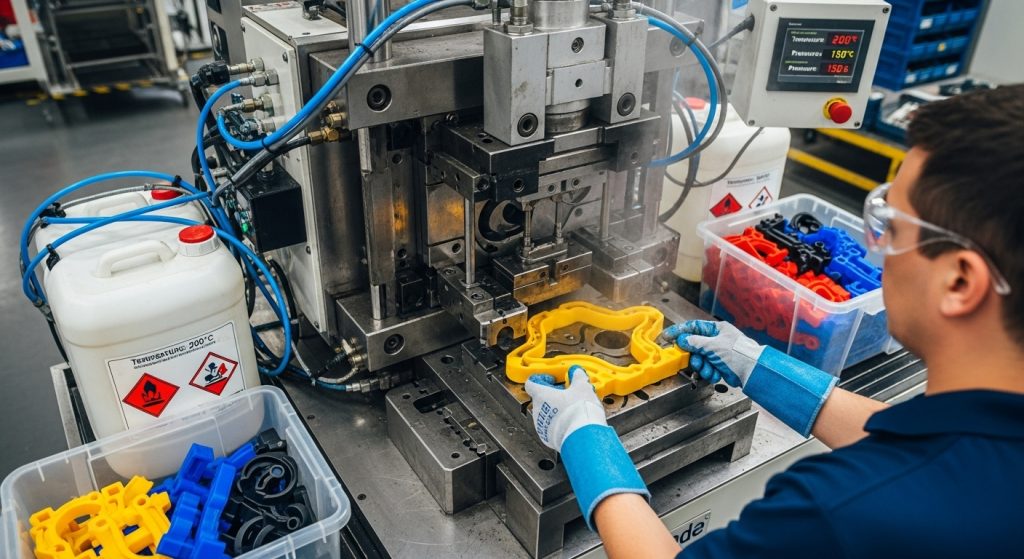
Chemical-resistant silicone compression molding is a production technique that involves the forming of silicone elastomers at the pressure and temperature in an accurate die under pressure. However, when it is applied to chemical-resistant silicone, the technique yields parts that withstand exposure to oils, solvents, acids, and industrial chemicals without losing their flexibility or structural integrity.
Key Features Include:
- Silicone rubber with high temperature, which can be used in industrial and automobile manufacturing.
- Dimensional accuracy +-0.05 mm, tight gasket tolerances, seals, and complex components tolerances.
- Silicone is wear-resistant, chemical degradation, and high-temperature components.
Silicone Compression Molding Materials Used in Chemical-Resistant
The choice of the material is the key to the intended performance under extreme conditions. Silicone materials used include:
- High-performance silicone rubber (VMQ, FVMQ) - Flexible, chemically resistant, and heat-tolerant.
- Thermoplastic silicone rubber is a recyclable material with high chemical and heat resistance.
- Biocompatible and able to be used in healthcare in chemical exposure, Medical-grade silicone.
- Industrial silicone elastomers - Applied in automobiles, industrial machinery, and electronics.
The other factors are soft touch or hard silicone molding, thermally stable compounds, and tailored silicone compounds for specialized chemical exposure.
Silicone Compression Mold Design and Engineering
Precision engineering is important in designing chemical-resistant silicone compression molds so that not only is its performance guaranteed, but also its manufacturability. In SunOn Mould, we use modern methods:
- Complex geometries and multi-cavity production. Custom silicone mold design.
- Optimization of 3D CAD silicone mold modeling to improve mold flow, curing, and cooling.
- Prototype to production mold to facilitate a smooth pass over to high-volume production.
- Molding at +-0.05 mm accuracy of high-precision parts with tolerance.
Another type of mold is equipped with surface finish optimization, which produces smooth, defect-free silicone parts to be used in industry and in industry and medical use.
Silicone Compression Molding Process
The compression molding process converts the raw silicone material into the precision parts. The workflow is usually composed of:
- DFM Review - Determine part design to meet silicone molding design requirements and chemical resistance.
- Mold Making - Machine and finish molds to high precision.
- Compression Molding - This involves pouring silicone into the mold, heating and pressing the mold, and then curing it to the required hardness and shape.
- Mold Trials and Quality Testing - Check T1 samples, check functionality, chemical resistance, and tolerance.
- Operation Run - Mass production of silicone components, then deflashing, trimming, and post-curing of silicone components (where applicable).
The procedure enables making accurate silicone compression molded items, such as gaskets, seals, tubing, and elaborate customized items.
Uses of Chemical-Resistant Silicone Compression Molding
Silicone compression molding is very popular in various industries because of its versatility, chemical resistance, and durability:
Automotive Industry
- Engine seals and gaskets
- Vibration mounts and dampers.
- O-rings used are high-temperature in nature and resistant to chemicals.
Medical Devices
- Biomimetic seals and tubing.
- Silicone laboratory chemical exposure components.
- Medical equipment custom elastomer parts.
Electronics
- Keypads and switches
- Silicone coverings and Insulating covers.
- Components that need chemical and heat-resistant properties.
Industrial Equipment
- Vibration isolation parts, diaphragms, and O-rings.
- Machinery silicone machinery components.
- Bushings and chemical-resistant seals.
Food-Grade & Consumer Applications
- Protective grips and wearables.
- Silicone-approved kitchenware by the FDA.
- Food processing silicone gaskets that are chemical-resistant.
Aerospace Applications
- Chemical-resistant silicone components of low weight.
- Aircraft seals and gaskets for high temperatures.
- Elements that are exposed to chemicals in aviation.
Advantages of Chemical-Resistant Silicone Compression Molding
The use of chemical-resistant silicone compression molding would be of great benefit:
- High Precision - Part dimensions of very high tolerances.
- Durability - Prolonged working life in severe chemical and thermal conditions.
- Chemical Resistance - Resistant to oils, solvents, acids, and other chemicals.
- Temperature Resistance - Will work in very hot and cold environments.
- Cost Efficiency - Minimal material wastage, low tool cost in comparison to other modes of moulding.
- Flexibility of Design - Multi-cavity molds, complex shapes, and customized sizes.
- Biocompatibility - Both medical and food-grade safe.
Technical Advantages
- High-Performance Silicone Components
With the high-temperature and chemically resistant silicone elastomers, we assure the components that will be reliable in the severe industrial environment.
- Multi-Cavity Silicone Molds Compression
Facilitate large-scale production, cut down the cycle time, and enhance the quality of production.
- Rapid Prototyping
Silicone molds are available for rapid prototyping, which enables testing, design validation before full-scale production to reduce errors and lead time.
- Control of Precision and Tolerance
Tolerance ± 0.05 mm of chemical-resistant silicone components.
Important in seals, gaskets, and detailed designs.
- Automated Production
Modern silicone molding of high industrial quality with automation guarantees consistency of production, repeatability, and low human error.
Why Choose SunOn Mould?
At SunOn Mould, we fabricate the entire spectrum of silicone compression molding that is chemical-resistant:
- Modifications in the Silicone Compression Molding Supplier - made to order.
- OEM Solutions - can start small and grow to large volumes.
- Rapid Prototyping- design in test before mass production.
- Processes that are ISO certified - quality, reliability, and conformity to industry standards.
- Precision CNC Machining Integration - makes molds of the highest standards.
Our industries of support are medical, automotive, electronics, industrial machinery, aerospace, and consumer goods. This technique ensures reliability, tight tolerance, and long life cycle of seals and gaskets used in automobiles and in medical apparatus and equipment, as well as in industrial machinery.
Conclusion
Chemical-resistant silicone compression molding is a precise and versatile technology that is a perfect structure and material in the creation of durable, flexible, and chemically resistant parts in various industries. In SunOn Mould, you can expect our experience in custom silicone compression molding, which is accompanied by high-speed prototyping and precision machining using CNC machines and production certified by ISO. Our solutions are cost-effective, lead times are quick, and our silicone parts can withstand the most demanding chemical and thermal temperatures.
