


Chromium-Molybdenum Steel Comparison: 4140 vs 4130 Guide
Chromium-molybdenum steels are very attractive in the engineering and manufacturing because of their superior strength, toughness, and versatility. These alloys have one that is very common namely 4140 steel and 4130 steel which are used in automotive parts as well as structural structures. Their differences are essential to engineers and fabricators to maximise the performance of their materials and at the same time be economically effective and durable.
This paper gives a detailed comparison of chromium molybdenum steel which focuses on mechanical properties, chemical composition, heat treatment, fabrication method, and its practical use. The readers will have some knowledge about making informed material decisions on high-performance projects.
Differences in Composition Chemicals
Both 4140 and 4130 steels have a similar array of base of an alloy of iron, carbon, chromium and molybdenum alloying elements, although minute variations in alloying elements affect their mechanical properties.
4140 Steel: Has a higher amount of carbon (0.38-0.43) in them, has chromium (0.8-1.1) and molybdenum (0.15-0.25). The carbon increases tensile strength, hardness and fatigue resistance.
4130 Steel: is a slightly lower carbon (0.28 to 0.33), chromium (0.8 to 1.1) and molybdenum (0.15 to 0.25) steel. Reduced carbon enhances ductility and weldability and thus 4130 is more appropriate in structural usage where the need is to perform forming and joining.
Accurate differences in the compositions influence weldability, machinability and performance with stress, and this must be used in determining materials used in engineering projects.
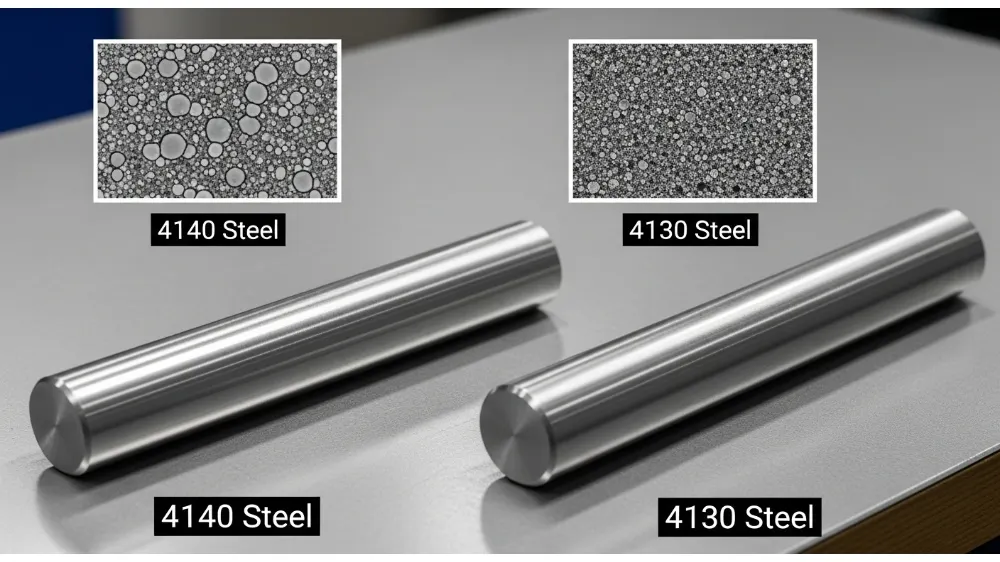
Comparison of Mechanical Properties
The difference between 4140 and 4130 steels in practical application is mechanical properties:
4140 Steel: It is popular due to its tensile strength (approximately 95100 ksi) and great fatigue strength. Yield strength is usually between 60-65 ksi and hardness does go up to 28-32 HRC in annealed form. These features render it suitable to heavy load applications.
4130 Steel: It has a little less tensile strength (approximately 90-95 ksi) but it is more ductile and stronger on impact. It has a yield strength of 55-60 ksi and annealed condition hardness of approximately 24-28 HRC. This blend enables improved performance in components which are subjected to bending or torsion.
All in all, 4140 is able to perform in high stress, high fatigue conditions, but 4130 is beneficial in those structures that need to be flexible and have good performance of welding.
Hardening and Heat Treatment
The heat treatment can influence the performance of chromium-molybdenum steel greatly.
4140 Steel: It can be tempered and hardened to enhance tensile strength and wear resistance. Quenching and tempering are standard, and a perfect balance of hardness and toughness is attained.
4130 steels: Are also heat treatable, however, with its reduced carbon level, it attains moderate hardness with better ductile properties. It would also make 4130 a superior choice of welded assemblies where excessive hardness may result in cracking.
Knowledge of the behaviour of each steel to thermal processes enables engineers optimise the strength, toughness and machinability of a particular product.
Weldability and Fabrication
The nature of welding is one of the distinguishing factors.
4130 Steel: It has better weldability as it has low amount of carbon. Techniques used are gas tungsten arc welding (GTAW) or gas metal arc welding (GMAW) which yield strong joints without preheating in most instances.
4140 Steel: It is more susceptible to cracking unless preheated or post weld tempered. Filler materials and controlled heating are usually used by welders to avoid brittle areas.
Machinability is also dissimilar: 4140 is harder, thus cutting and shaping it is harder than 4130 which is simpler to form and bend.
Applications of 4140 Steel
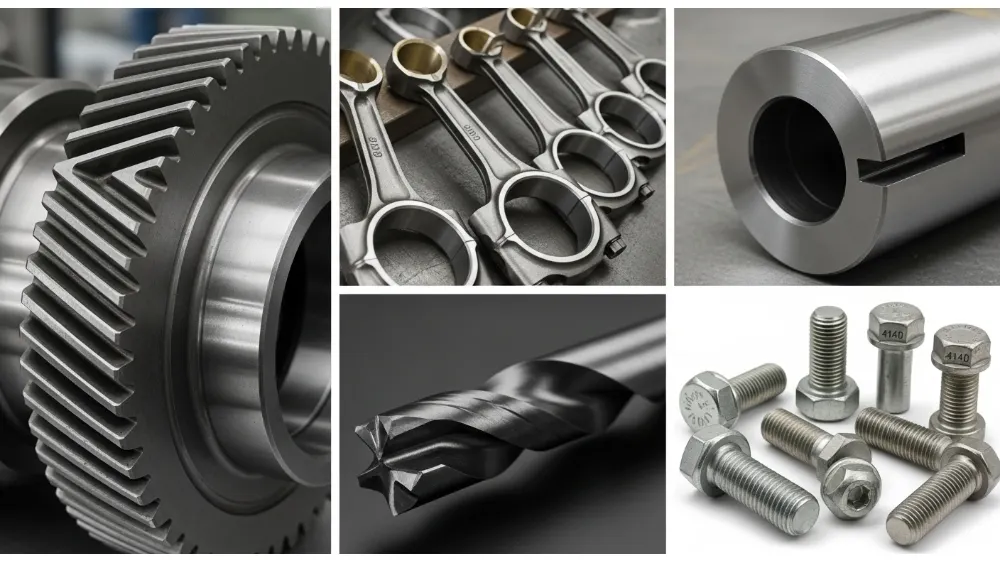
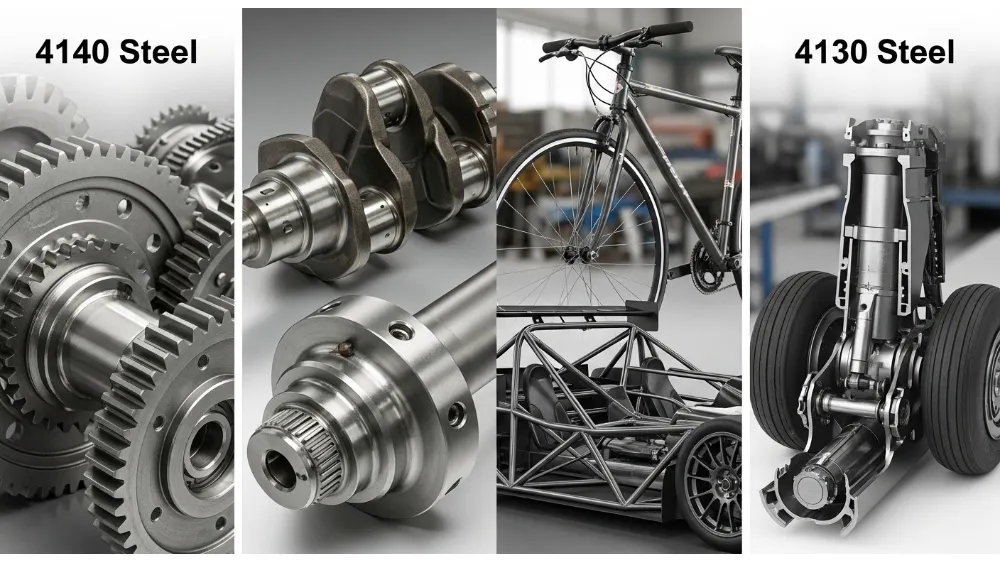
The 4140 steel is widely employed to work in the field where the high strength of the steel, its fatigue resistance, and wear performance are needed:
- Gears, shafts and high performance car parts
- Heavy machineries and axles
- High surface hardness tools and dies are needed
- Equipment that is subjected to cyclic stress in industries
Its capacity to resist deformation and deal with stress allows it to be used in components that are under high dynamic loads.
Applications of 4130 Steel
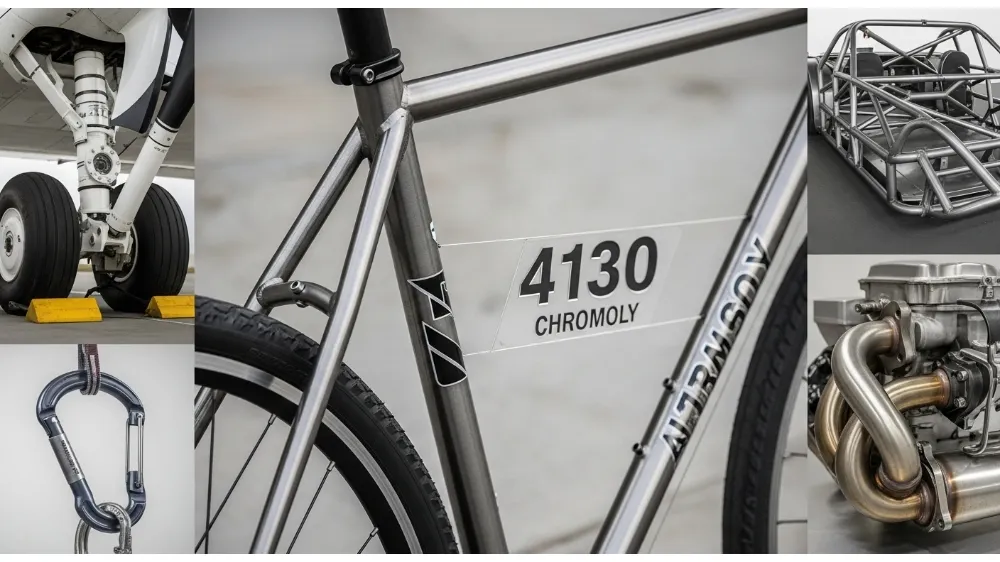
4130 steel is gleaming in structural and tubular applications where toughness, ductility and weldability are important:
- Frame work on fuselage and aerospace
- Roll cages, bicycle frames, motor car chassis
- Pipelines and pressure vessels
- Fabrication of general fabrication with complex joints or bends
These moderate strength in combination with high ductility enable the engineers to manufacture safely large welded assemblies.
Coating and Resistance to Corrosion
The two steels are prone to corrosion as they are not stainless. Life can be prolonged in outdoor or wet conditions through surface protection (or coating) like galvanizing, plating, or powder coating. Critical parts are increased in life through proper maintenance and protective coating.
Cost Considerations
The 4140 steel is a little more costly than the 4130 one owing to the higher amount of carbon and possible more intricate machining involved. 4130 is less costly than the 4140 when dealing with the large structures as the substrate needs less post-processing and is simpler to weld. The cost-effectiveness of materials depends on production volume, machining necessity and the preferred mechanical properties.
Right Steel to Select Your Project
There will be a decision between 4140 and 4130 which will necessitate the assessment of:
- Tensile, compressive, fatigue
- Necessary ductility and toughness
- Limitations in fabrication and welding
- Capabilities of heating
- Cost and availability
Knowing what you need in terms of your project will guarantee you the right type of steel grade that will be selected to balance between strength, durability and efficiency.
Standards and Specifications in the Industry
Both 4140 and 4130 are ASTM compliant:
- 4140: by product form- ASTM A29, A108 or A193.
- 4130: Tubular and structural section ASTM A500 or A513.
Mechanical property and dimensional accuracy are assured in compliance with standards, which are essential in engineering projects.
Frequently Asked Questions (FAQ)
Q1: What is the significant distinction between 4140 and 4130 steel?
A: 4140 contains more carbon, which gives it more tensile strength, but 4130 contains less carbon to give it better ductile strength and better weldability.
Q2: Can 4140 and 4130 be welded?
A: 4130 can be welded easily without preheating whereas 4140 can need controlled heating and post-weld tempering.
Q3: Which steel to use in high stress shafts?
A: 4140 steel is superior in high stress rotating shafts because it has more tensile strength and fatigue resistance.
Q4: Aerospace frames use 4130 steel?
A: Yes, the ductility, the weldability, and moderate strength of 4130 make it the most suitable choice in the aerospace structure.
Q5: What is the effect of heat treatment on these steels?
A: 4140 is hardened and made stronger by heat treatment but 4130 maintains higher ductility and toughness.
Q6: Does 4140 and 4130 resist corrosion?
A: They are both prone to corrosion and will normally need a coating or other protective finishes when used in external, or wet, environments.
Q7: Which type of steel would be more economical in the case of tubular structures?
A: 4130 tends to be cheaper because it can be easily machined and welded, particularly on large assemblies.
Conclusion
Both 4140 and 4130 steels have significant applications in current manufacturing and engineering. 4140 steel is best used in high-strength, high-fatigue working conditions whereas 4130 steel is preferred in structural engineering that demands the use of weldability and ductility. The choice of right grade guarantees maximum performance, safety and cost-effectiveness of mechanical and structural elements.
Knowledge in the chromium molybdenum steel comparison enables engineers to take informed decisions, weighing mechanical needs and fabrication limits for high-performance outcomes.
