


How CNC Machining Is Used in Aerospace: A Complete Guide
The aerospace industry demands the highest standards of precision, performance, safety, and reliability. Every bolt, housing, bracket, or structural element must perform flawlessly under extreme conditions—from rocket launches to transcontinental flights. To meet these demands, manufacturers turn to CNC machining in aerospace as one of the most essential processes for producing precision parts and components.
In this guide, we’ll explain what CNC machining is, why it’s crucial in aerospace, how it’s applied across different components, what materials are used, key benefits, and how manufacturers ensure quality and performance. This overview is designed to help engineers, designers, and decision‑makers make informed choices when integrating CNC machining into aerospace projects.
What Is CNC Machining in Aerospace?
CNC (Computer Numerical Control) machining refers to a manufacturing process in which pre‑programmed software controls machine tools like mills, lathes, routers, and grinders to cut and shape materials with high precision. In aerospace, CNC machining is used to fabricate critical parts that must meet extremely tight tolerances and stringent quality standards.
Unlike manual machining, CNC systems eliminate human error and deliver repeatable accuracy, making them ideal for components whose failure could jeopardize aircraft performance or safety. The digital control also allows complex geometries—even multi‑surface and 3D contours—to be produced reliably and consistently.
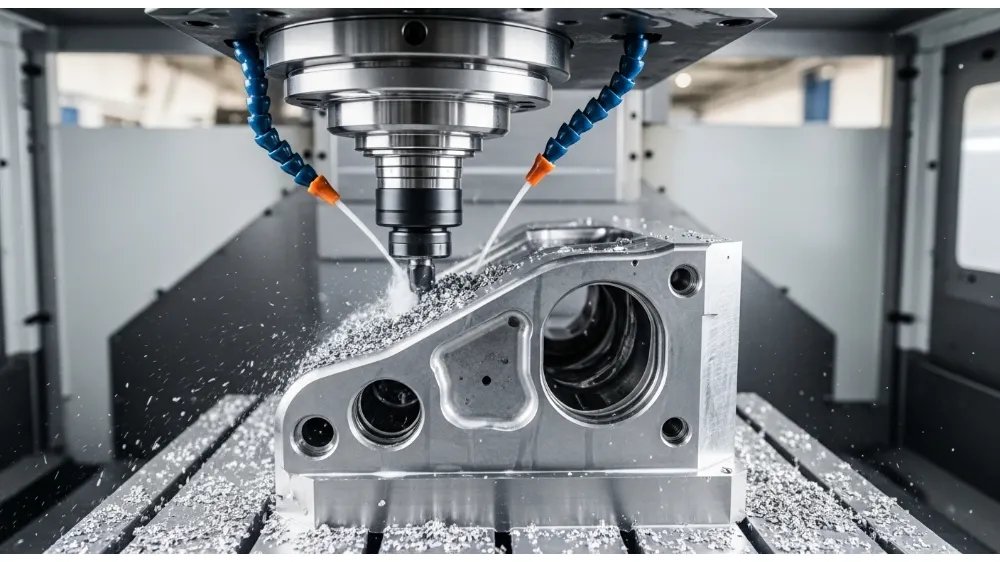
Why Precision Matters More in Aerospace
Every aerospace application carries unique challenges. Parts must withstand extreme temperatures, high stress, vibration, and rapid pressure changes. A tiny dimensional inconsistency can result in performance loss or catastrophic failure.
Precision is critical in areas such as:
- Engine systems, where blade imbalance or misalignment can lead to failure.
- Landing gear assemblies, where structural strength is paramount.
- Flight control surfaces, which must move precisely and reliably.
- Avionics housings, requiring exact fits for sensitive electronics.
Because of these requirements, aerospace machining processes typically aim for tolerances as tight as 0.0001 inches (0.002 mm) or better, far exceeding most automotive or industrial standards.
Core Applications of Aerospace CNC Machining
CNC machining in aerospace is applied across a wide range of components and systems. Here are the major areas where it makes a difference:
Engine Components
Jet engines consist of hundreds of precisely machined parts like turbine blades, compressor housings, fuel nozzles, and fan discs. The machining process must handle high‑temperature alloys and complex geometries while maintaining excellent surface finishes and strength.
Structural Components
Aircraft frames, wing spars, bulkheads, and fuselage elements are typically CNC machined from lightweight alloys that balance strength with weight reduction. With CNC machining, these parts can achieve the exact geometric profiles required for aerodynamic efficiency and structural integrity.
Landing Gear & Support Systems
Landing gear parts, such as struts and joint assemblies, are high‑stress components that demand excellent dimensional accuracy. CNC machining ensures that these parts meet stringent safety and performance standards.
Avionics and Electrical Casings
Avionics housings, sensor brackets, and electrical connector mounts require precise hole placement, stable surfaces, and durable fits. CNC machines produce these intricate parts to ensure reliable integration and operation of avionics systems.
Interior & Exterior Trim
CNC machining also extends to cabin panels, fairings, and decorative exterior elements where both functionality and aesthetics matter. These parts often require intricate cutouts and lightweight designs.
Prototyping and R&D
The aerospace industry continually innovates and tests new designs. CNC machining enables rapid prototyping, allowing engineers to produce functional prototypes for evaluation before mass production. These prototypes help identify fit, form, and functional issues early in the design cycle.
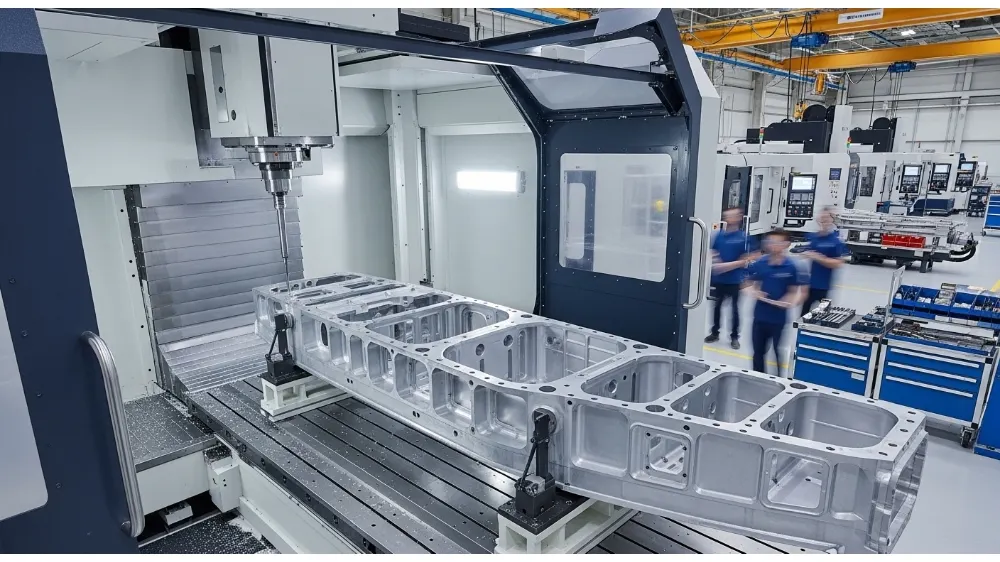
Materials Used in Aerospace Machining
Aerospace machining involves a variety of materials, selected for strength‑to‑weight ratio, corrosion resistance, heat tolerance, and fatigue performance:
Aluminum Alloys
Aluminum is widely used because it is lightweight, corrosion‑resistant, and relatively easy to machine. Alloys like 2024 and 7075 are standard in structural airplane parts and skin panels.
Titanium and Superalloys
Titanium is prized for being stronger yet significantly lighter than steel, with excellent temperature and corrosion resistance. Superalloys (like Inconel) are used in high‑temperature engine parts. Though challenging to machine, CNC tools can handle these materials with appropriate tooling and coolants.
Stainless Steel
Used for hydraulic fittings, landing gear parts, and other structural components, stainless steel combines strength and durability.
High‑Performance Plastics & Composites
In addition to metals, aerospace uses engineered plastics and composite materials for lightweight, non‑structural components, interior parts, and connectors. CNC machining can handle high‑performance polymers like PEEK and composite layups with proper tooling and strategy.
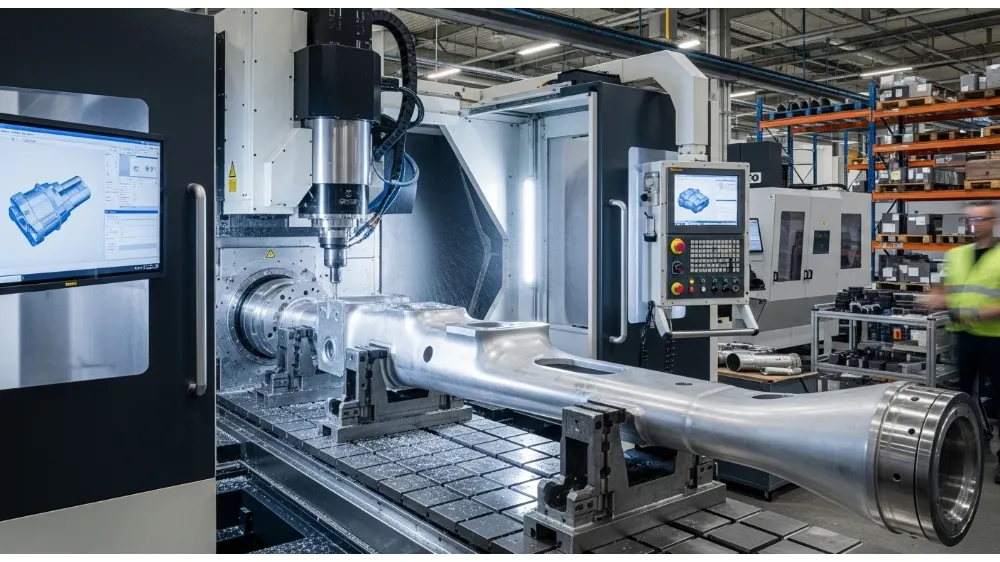
CNC Machining Technology Used in Aerospace
3‑Axis Machining
This is the most basic CNC setup, moving tools along three axes (X, Y, Z). It is efficient for simpler geometries and larger aerospace parts.
5‑Axis Machining
Five‑axis machines add two rotational axes, enabling the tool to approach parts from nearly any angle without repositioning. This capability is essential for complex contoured surfaces like turbine blades and sophisticated fuselage elements.
CNC Turning & Grinding
Turning is used for cylindrical parts like shafts, pins, and bushings, while grinding refines surface finishes and ensures dimensional accuracy on high‑precision parts.
Hybrid and Additive Integration
Some advanced facilities combine CNC machining with additive manufacturing (3D printing) to optimize material usage and create hybrid components with internal channels or lattice structures before machining final surfaces.
Automated Quality Control
Integrated inspection systems, such as CMMs (coordinate measuring machines), laser scanning, and in‑line monitoring, ensure each aerospace part meets quality standards. These systems help certify parts with documentation and traceability required for aerospace compliance.
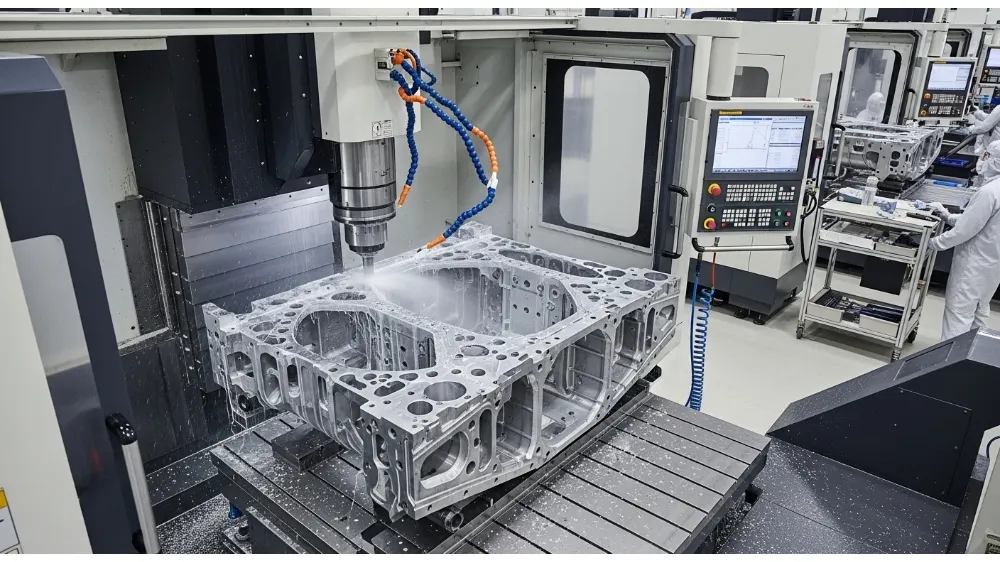
Benefits of CNC Machining in Aerospace
Precision CNC machining offers distinct advantages over traditional manufacturing:
- Micron‑level accuracy ensures parts fit precisely and function reliably.
- Repeatable quality across multiple production runs.
- Reduced manual error and improved safety.
- Material versatility supports a range of alloys and composites.
- Faster prototyping accelerates innovation and design verification.
These benefits help aerospace manufacturers meet strict certifications and performance criteria, such as AS9100 quality standards, which many facilities adhere to when producing flight‑critical components.
Challenges in Aerospace CNC Machining
Machining advanced aerospace materials can be demanding:
- High‑temperature alloys require specialized tooling and machining strategies.
- Lightweight composites need careful handling to avoid delamination or damage.
- Tight tolerances demand advanced programming, tooling, and inspection.
Overcoming these challenges requires experienced engineers, robust equipment, and rigorous quality control.
FAQ – Common Questions About CNC Machining in Aerospace
Q1: What makes CNC machining critical in aerospace manufacturing?
A: CNC machining delivers high precision and repeatability, vital for safety and performance in aerospace parts.
Q2: What materials are commonly machined for aerospace parts?
A: Aluminum alloys, titanium, stainless steels, superalloys, and high‑performance plastics.
Q3: Why is 5‑axis CNC machining important?
A: It enables machining complex geometries without repositioning, improving accuracy and speed.
Q4: Can CNC machining be used for prototyping aerospace parts?
A: Yes, CNC machining is widely used for rapid prototyping to validate designs before production.
Q5: How does CNC machining support safety and compliance?
A: CNC processes combined with rigorous inspection and documentation help meet aerospace standards like AS9100.
Conclusion
CNC machining in aerospace plays an indispensable role in modern aircraft and spacecraft production. Its ability to produce high‑precision, complex, and reliable components from advanced materials makes it a backbone of aerospace manufacturing. As aerospace technology evolves—driven by demands for lighter, stronger, and more efficient systems—CNC machining technologies will remain central to innovation, safety, and performance across the industry.
