


CNC Machining Manufacturer
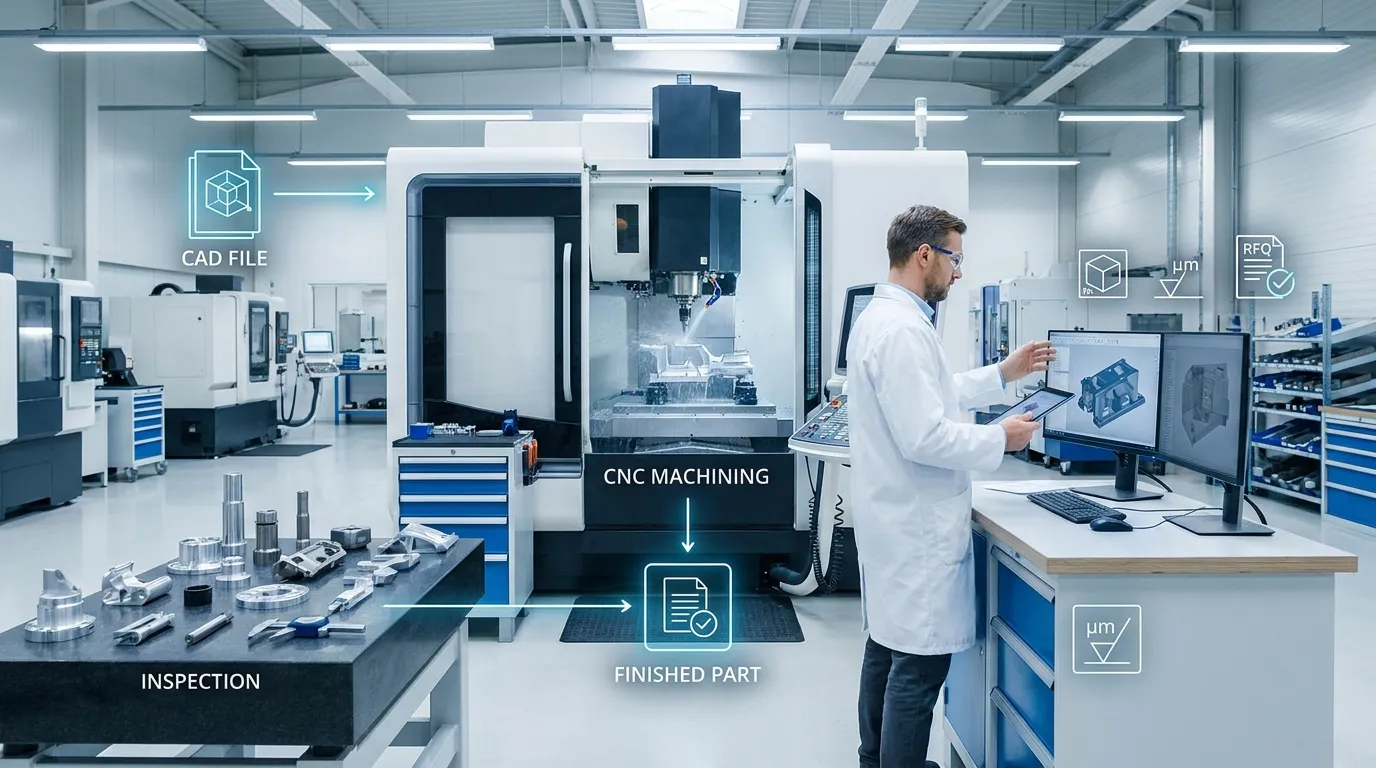
Choosing the right manufacturer is not only about finding a machine shop. Buyers need to confirm material, part geometry, tolerance requirements, surface finish, quantity, inspection expectations, export communication, and whether the supplier can support the project from early prototype review to production planning.
SunOn helps buyers prepare RFQ details, review manufacturability, compare CNC with related processes, and move from drawings or CAD files to machined parts, finishing, assembly, or OEM/ODM manufacturing support.
Custom CNC Machining Manufacturer for Global Buyers
A CNC machining manufacturer should help buyers reduce sourcing risk before production starts. The most important questions are practical: Can the supplier machine the part? Can they understand the drawing? Can they discuss critical tolerances? Can they support the required material and finish? Can they communicate clearly before quoting?
SunOn works with buyers that need custom CNC parts for product development, industrial equipment, electronics, automotive-related components, machinery, automation equipment, new energy products, consumer products, and other manufacturing projects.
Our CNC machining support can be used for:
- Functional prototypes
- Engineering samples
- Low-volume CNC machined parts
- Small-batch production
- Custom metal components
- Plastic machined parts
- Fixtures, housings, brackets, shafts, covers, connectors, and mechanical parts
- Parts that may later move to molding, die casting, finishing, assembly, or OEM/ODM production
For RFQ projects, buyers should send drawings, CAD files, material requirements, quantity, tolerance needs, finish requirements, and inspection expectations. This allows the manufacturing team to review feasibility before confirming the machining plan.
CNC Machining Capabilities Buyers Should Confirm
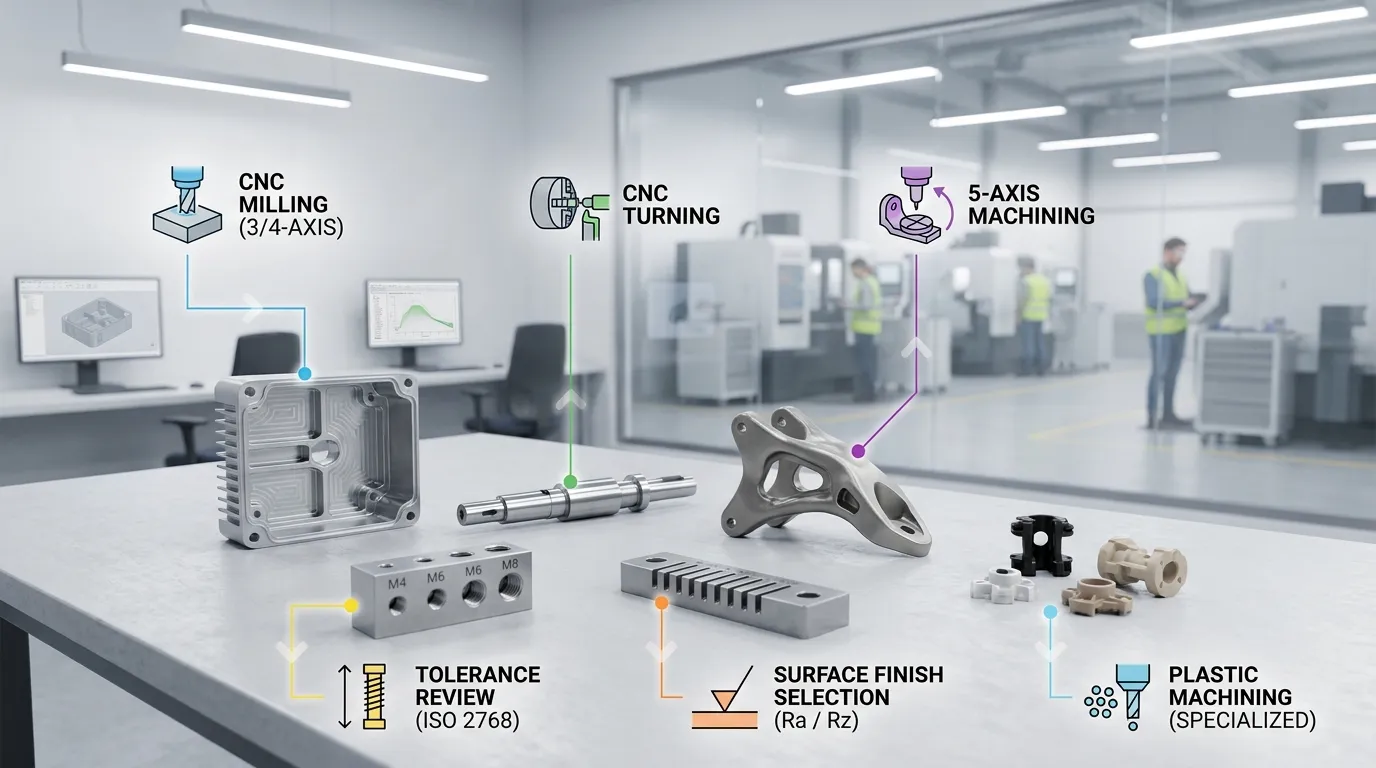
Before choosing a CNC supplier, buyers should compare capability against part requirements. A simple “we provide CNC machining” statement is not enough for technical procurement. The supplier should help clarify process, geometry, material, tolerance, finish, and inspection needs.
| Buyer requirement | CNC capability to confirm | Why it matters | RFQ details to send |
|---|---|---|---|
| Flat, block, or prismatic parts | CNC milling | Supports pockets, slots, holes, surfaces, and complex profiles | 3D CAD, 2D drawing, material, finish |
| Round or cylindrical parts | CNC turning | Suitable for shafts, pins, spacers, bushings, and threaded parts | Diameter, length, tolerance, thread details |
| Complex multi-side geometry | 5-axis machining or multi-setup review | Reduces setup risk for complex surfaces and hard-to-reach features | 3D CAD, critical features, application |
| Tight or critical dimensions | Tolerance review before quote | Tight tolerance affects cost, machining sequence, and inspection | 2D drawing, GD&T, critical dimensions |
| Cosmetic or functional surfaces | Surface finishing and coating review | Finish affects appearance, corrosion resistance, friction, and assembly | Finish type, color, coating, roughness needs |
| Prototype or production stage | Quantity and production plan | Prototype, low-volume, and production projects need different planning | Quantity, target schedule, revision status |
| Quality documentation | Inspection expectation review | Reports and checks should be clear before production | Inspection report, sample approval, test needs |
This table helps buyers prepare a clearer RFQ and reduces back-and-forth during quotation.
CNC Milling, Turning, and 5-Axis Machining: Which Process Fits Your Part?
CNC milling is often used for parts with flat surfaces, pockets, slots, holes, grooves, and complex contours. It is suitable for housings, plates, brackets, covers, fixtures, and custom mechanical components.
CNC turning is better for round parts. Typical examples include shafts, pins, sleeves, spacers, bushings, threaded components, and cylindrical parts that require accurate diameters or concentric features.
5-axis CNC machining is useful when the part has complex angles, multi-side features, curved surfaces, or geometry that would be difficult to machine with simple setups. It can help reduce repositioning and improve consistency for complex parts, depending on the design.
For many RFQs, the buyer does not need to choose the exact machine setup alone. It is better to send the 3D model, 2D drawing, material, quantity, and application so SunOn can review the suitable CNC process.
Materials for Custom Metal and Plastic CNC Parts
Material selection affects machining time, tolerance control, surface finish, strength, weight, cost, and application performance. Buyers should specify the required material grade when known. If the grade is not final, the RFQ can include the application, strength needs, environment, and finish expectations.
Common CNC material categories include:
- Aluminum: Often used for lightweight housings, brackets, prototypes, heat-related parts, and machined enclosures.
- Stainless steel: Used when corrosion resistance, strength, or durability is important.
- Steel: Suitable for structural, mechanical, fixture, tooling, and industrial parts.
- Brass and copper: Used for conductive parts, fittings, connectors, and components where machinability or conductivity matters.
- Titanium: Considered for lightweight, strong, or corrosion-resistant parts when the application requires it.
- ABS, PC, PMMA, nylon, and POM/Delrin: Used for plastic prototypes, covers, mechanical parts, sliding parts, and functional test components.
- PEEK and PTFE: Used when the application needs higher performance plastic properties, depending on design and availability.
Material behavior should be reviewed before machining. Thin walls, deep cavities, small holes, sharp internal corners, and tight tolerances may create risk depending on the chosen material.
Tolerance, Surface Finish, and Inspection Details Matter Before Quoting
Technical buyers should mark critical tolerances clearly. Not every dimension needs the tightest tolerance. Over-tight requirements can increase machining cost, inspection time, and production risk.
A good CNC RFQ should identify:
- Critical dimensions
- GD&T requirements if applicable
- Mating surfaces
- Hole, slot, thread, and insert requirements
- Flatness, concentricity, or perpendicularity needs
- Surface roughness requirements
- Cosmetic surface expectations
- Areas that must not be damaged during finishing
Surface finishing should also be discussed early. CNC parts may need anodizing, plating, painting, powder coating, polishing, bead blasting, passivation, or other post-processing depending on the material and application.
Inspection requirements should be confirmed before production. If the buyer needs dimensional reports, sample approval, functional checks, or special documentation, these details should be included in the RFQ.
Prototype, Low-Volume, and Production CNC Manufacturing
CNC machining is often a strong choice for product development because it does not require production tooling. It can support early prototypes, design validation, engineering testing, and low-volume functional parts.
For small-batch projects, CNC machining can help buyers produce usable parts while the design is still being refined. It also works well when the part is too complex, too low-volume, or too frequently revised for tooling.
For production planning, buyers should also compare CNC machining with other processes. Plastic injection molding may be better for repeatable high-volume plastic parts after the design is stable. Die casting may fit some metal production projects when tooling, volume, and geometry make sense. SunOn can support buyers across CNC machining, mold making, injection molding, die casting, finishing, assembly, and OEM/ODM manufacturing planning.
What Should Buyers Send for an Accurate CNC Machining Quote?

A clear RFQ helps SunOn review the part faster and provide more useful manufacturing feedback. Missing files or unclear specifications can delay the quote or create quality risk later.
Before requesting a CNC machining quote, prepare:
- Product or part name
- Application or industry
- Prototype, small-batch, or production stage
- Quantity required
- 3D CAD model
- 2D technical drawing
- Material requirement
- Material grade if known
- Critical tolerance requirements
- Surface finish requirement
- Color, coating, plating, anodizing, polishing, or texture needs
- Threading, inserts, holes, slots, undercuts, or assembly details
- Inspection report requirement
- Functional testing requirement if relevant
- Delivery destination
- Target schedule if relevant
- NDA, BOM, project specification, or existing sample if available
The 3D CAD file defines the shape. The 2D drawing confirms tolerances, threads, surface finish, notes, and inspection requirements. Sending both helps reduce misunderstandings.
How to Compare CNC Machining Manufacturers
A CNC machining manufacturer should be evaluated by more than price. Low quote price can become expensive if the supplier misses tolerance details, uses the wrong material, ignores finishing requirements, or does not review manufacturability.
When comparing suppliers, ask whether they can:
- Review drawings before production
- Suggest suitable CNC processes
- Discuss material and finish options
- Identify difficult features or tolerance risks
- Support prototype and low-volume stages
- Provide post-processing and assembly support
- Communicate clearly with overseas buyers
- Confirm inspection expectations before machining
- Support related manufacturing processes if the project changes
SunOn is useful for buyers that want more than isolated CNC machining. Our broader service scope includes rapid prototyping, 3D printing, vacuum casting, mold manufacturing, injection molding, die casting, sheet metal fabrication, metal stamping, surface finishing, mechanical assembly, and OEM/ODM manufacturing support.
Common RFQ Mistakes That Increase Manufacturing Risk
Many CNC sourcing issues begin before production. The RFQ may look complete, but important technical details are missing.
Common mistakes include:
- Sending only a 3D model without a 2D drawing
- Not marking critical dimensions
- Using tight tolerances on non-critical features
- Forgetting thread, insert, or hole details
- Choosing a material without considering machining behavior
- Requesting a finish without specifying color or surface expectation
- Not explaining whether the part is a prototype or production part
- Not confirming inspection report requirements
- Ignoring assembly or mating-part requirements
- Asking for a quote before the design is stable
A better RFQ gives the manufacturer enough information to review cost, process, risk, finish, and inspection before production starts.
Why Choose SunOn for CNC Machining Support?
SunOn Mould supports buyers that need a practical manufacturing partner for custom parts, prototypes, and production planning. Our CNC machining service is part of a wider custom manufacturing system, which helps when a project needs more than one process.
A buyer may start with CNC prototypes, then move to injection molding, die casting, finishing, or assembly after design validation. Another buyer may need CNC machined parts as final components for industrial equipment, electronics, new energy products, or mechanical systems.
SunOn helps connect these stages through engineering communication, RFQ review, manufacturability discussion, CNC machining, post-processing, and OEM/ODM production support.
Frequently Asked Questions
What information is needed for a CNC machining quote?
Send the 3D CAD model, 2D drawing, material, quantity, tolerance, surface finish, application, inspection needs, and delivery destination. If the part needs threads, inserts, coating, plating, or assembly, include those details too.
Can SunOn support prototype and production CNC parts?
Yes. SunOn supports CNC machining for prototypes, engineering samples, small batches, and production planning. The best process depends on part geometry, material, tolerance, finish, and quantity.
Which CNC materials can be quoted?
SunOn can review CNC projects using common metals and plastics such as aluminum, stainless steel, steel, brass, copper, titanium, ABS, POM, nylon, PC, PMMA, PEEK, and PTFE. Final material grade should be confirmed during RFQ.
Do I need both 2D drawings and 3D CAD files?
It is best to send both. The 3D file defines the part geometry, while the 2D drawing confirms tolerance, threads, surface finish, inspection notes, and other technical requirements.
Can CNC parts receive surface finishing?
Yes. Depending on the material and application, CNC machined parts may need anodizing, plating, painting, powder coating, polishing, bead blasting, or other finishing. Specify finish type, color, coating, and cosmetic expectations in the RFQ.
When should I choose CNC machining instead of injection molding?
Choose CNC machining for prototypes, low-volume parts, functional testing, and designs that may still change. Injection molding is usually better for repeatable plastic production after the design and tooling plan are confirmed.
Request a CNC Machining Quote From SunOn
Share your CNC machining project with SunOn Mould for quote review, manufacturability discussion, and production planning. Send your product or part type, quantity, application, 2D drawing, 3D CAD model, material requirement, tolerance details, surface finish, coating or plating needs, threading or assembly requirements, inspection expectations, delivery destination, and target schedule.
Our team can review your RFQ, discuss CNC milling, CNC turning, 5-axis machining, material selection, finishing, inspection, prototype support, and OEM/ODM manufacturing options before production starts.
