


Core and Cavity in Injection Molding: Design, Function, and Applications
The core and cavity are key elements in the injection molding process determining the form, quality and precision of parts molded. The porosity establishes the outer layer of the product and the interior is created by the core. Awareness of core and cavity in injection molding play a crucial role in enabling engineers and designers to maximize the performance of the mold, minimize defects and achieve high quality of the part.
The applications of these components are in automotive, medical devices, consumer electronics, and industrial equipment. It has proper core and cavity design, which influences the production efficiency, dimensional stability, surface finish, and the manufacturing cost in general.
What Are Core and Cavity?
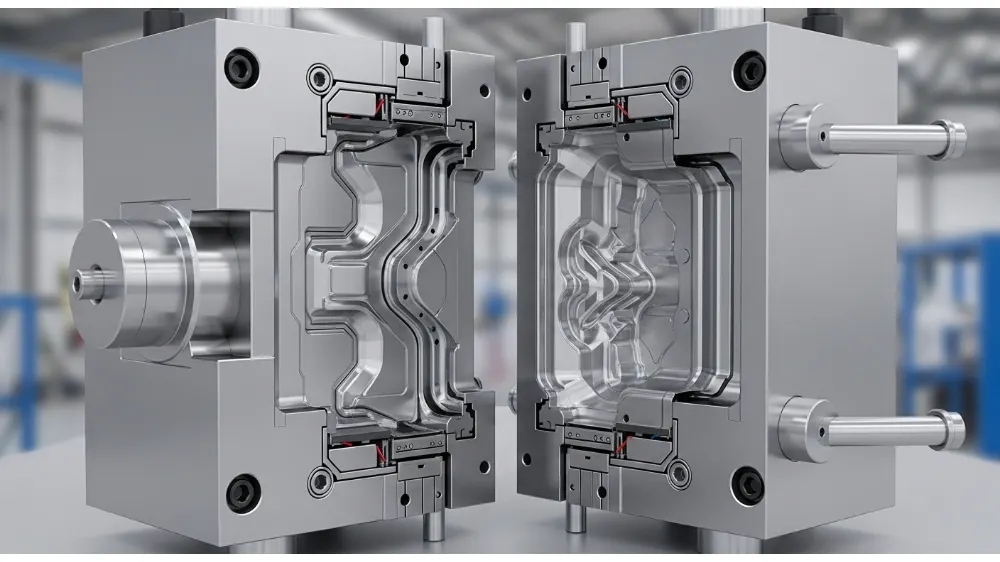
The hollow in a mold where the molten plastic flows to assume the external form of the part is referred to as the cavity. The solid part in the middle is the core which creates internal structures or holes, including holes, undercuts, and internal cavities within the part. They combined to determine the part geometry and final mechanical and aesthetic properties.
These elements of the mould have to be accurately machined and taken care of so that it can produce repeatable results and high quality. Cores and cavities are typically made of steel hardened or aluminum because they are sturdy and resistant to heat.
Core and Cavity Functions
Components indicate core and cavity can be used in several ways:
- Give the negative and positive space to part formation.
- Allow sophisticated geometries, thin walls and internal features.
- Have dimensional accuracy and uniform wall thickness.
- Promote even distribution of temperature and minimization of stresses.
- Resistance aids effective ejection of molded components out of the mold.
The cores and cavities, these functions render, are the key factors of the process of injection molding producing a direct influence on the speed and quality of the production.
Design Requirements of Core and Cavity
Cores and cavities It is important to design cores and cavities:
- Keep the right angles of draft to eject smoothly.
- Equalize wall thickness in order to prevent sink marks or warping.
- Take into account several moulds, with cavities.
- Add channels that control even distribution of temperature.
- Choose material that can sustain the cyclic and thermal load.
Design ensures that defects are minimized, cycle times are improved and the life of the molds is increased, which is vital in high volume production.
Core and Cavity Materials
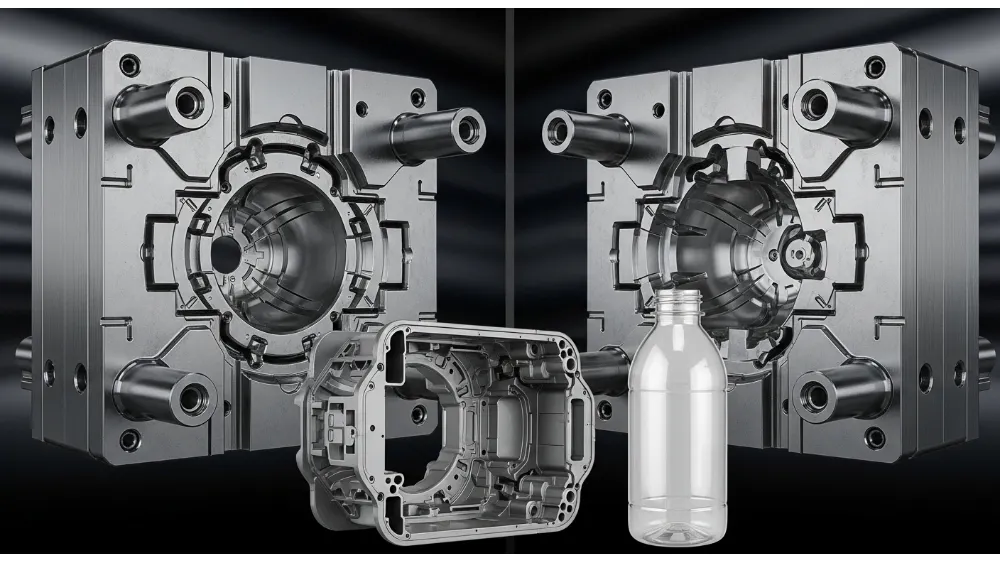
The cores and cavities are usually produced using tool steels, stainless steel and aluminum alloys according to the production needs. High-volume production is done with tool steels because they are wear and strength resistant. Aluminum molds are easy to machine and are suitable in prototyping or low volume production. The material selection influences thermal conductivity and surface finish of parts and the life of the molds.
Core and Cavity Manufacturing
The high-precision tools to machining core and cavity components are CNC milling, EDM (Electrical Discharge Machining), and grinding. These processes provide tight tolerances and finishes of surfaces required in injection moldings. Such sophisticated procedures as surface coating or nitriding can be implemented to make the part harder and more difficult to release.
Multi-Cavity and Single-Cavity Molds
Depending on the needs of the production, injection molds may contain one or several cavities:
- Single-cavity molds make one part per cycle, which is appropriate when prototyping or running small production.
- Multi-cavity molds make several copies of identical parts in one cycle, and this is more efficient with mass production.
- Multi-cavity designs need to ensure consistent quality by ensuring that fillings are balanced and evenly cooled.
The choice of the appropriate configuration will influence the cycle time, cost and the complexity of the mold.
Cooling and Thermal Management
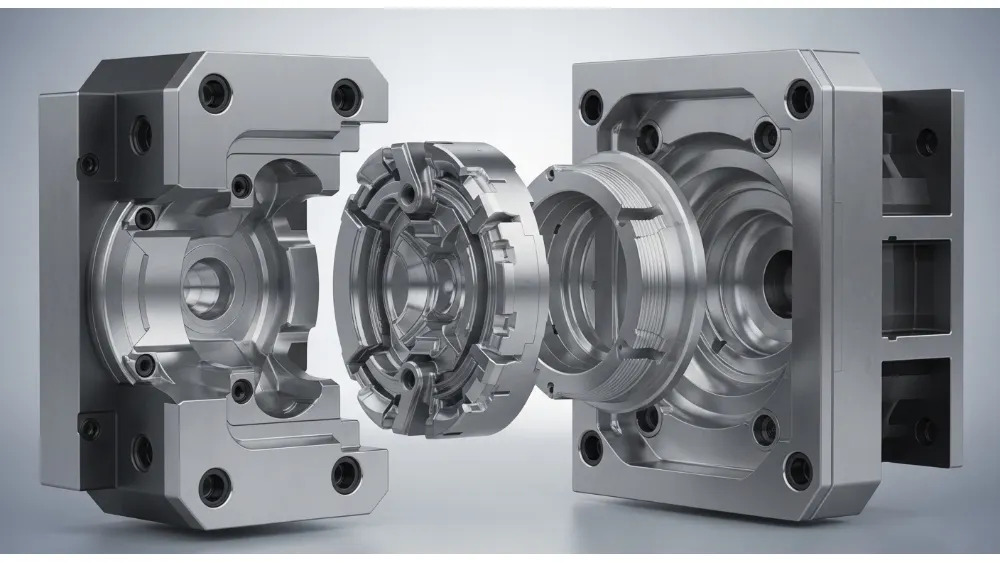
Microparticles contain core and cavities which have cooling channels that control temperature during injection. Proper cooling:
- Reduces cycle time
- Reduces internal stresses and distortions
- Assures consistency in the solidification of material
- Enhances surface finish and dimensional precision
The design of the moulds is also a key to thermal management that must affect the rate of production as well as the quality of parts.
Core and Cavity Maintenance
Frequent maintenance guarantees the durability of molds and high quality:
- Check wear, erosion or cracking.
- Wipe down clean surfaces and channels.
- Oil moving components like ejector pins.
- Check temperature homogeneity and cooling performance.
Preventive maintenance minimizes downtimes and maximizes services of the molds.
Merits of Well-Design Core and Cavity
Well planned cores and cavities have several advantages:
- Uniform part quality and precision.
- Shorter cycle time and enhancement of production efficiency.
- Ability to make elaborate forms and internal characteristics.
- Reduced sink marks, warping or flash.
- Reduce the total cost of production because of reduced rejections.
These benefits are essential in competitive manufacturing industries that are high in volume.
Common Challenges
Cores and cavities Designing and maintaining cores and cavities may be challenging:
- High-pressure injection wear and erosion.
- Thermal stress that leads to distortion or cracking.
- Problems of expelling undercut parts.
- Multi-cavity molds are expensive to tool at a high cost.
The problems may be reduced by means of material choice, appropriate mold design, and control of processes.
Core and Cavity Applications
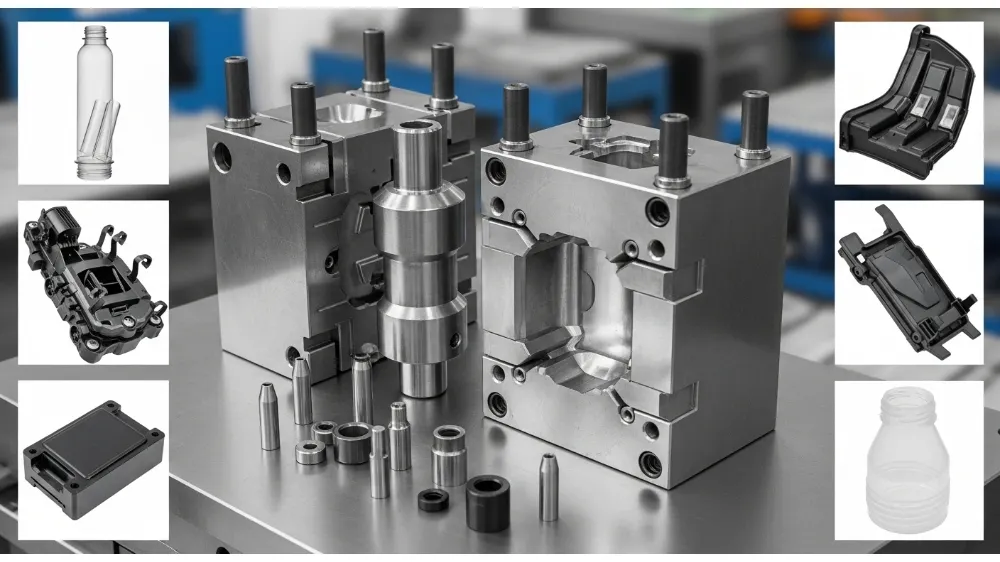
In various industries, cores and cavities are applied:
- Automotive: Dashboard, engine, trim interiors.
- Medical Equipment: Casing of diagnostic equipment, syringe bodies.
- Consumer Electronics: Smartphone shells, laptop cases, appliance components.
- Industrial Machinery: Gear housings, valves and enclosures.
Cores and cavities are required in high quality manufacturing due to the accuracy and reproducibility they offer.
Frequently Asked Questions (FAQ)
Q1: What does core and cavity have to do with injection molding?
The core creates internal characteristics and the cavity creates external surfaces of the molded part.
Q2: What are the content materials of cores and cavities?
It is tool steels, stainless steel, and aluminum alloys which are used based on volume and durability requirements.
Q3: What is the distinction in single-cavity and multi-cavity molds?
Single-cavity molds are used to make one part at a time, whereas multi-cavity molds are used to make several parts at the same time.
Q4: What is the impact of cooling on core and cavity performance?
Good cooling is used in order to get uniform solidification, to shorten the cycle time, and to minimize defects such as warping.
Q5: Is it possible to mold intricate shapes using cores and cavities?
Yes, well planned cores and cavities can be used to create sophisticated internal and external qualities.
Q6: What is the frequency of maintenance of molds?
To ensure quality and avoid down time, regular inspection, cleaning and lubrication is advised.
Q7: What are the industries that are heavily dependent on core and cavity molds?
These molds are used in the automotive industry, medical devices industry, consumer electronics industry, and industrial machinery industry.
Conclusion
The knowledge of core and cavity in injection molding is imperative in the manufacture of accurate, dependable and high quality of plastic components. Design, selection of materials, cooling, and maintenance will ascertain effective production, few defects, and reproducible outcomes. Expertise in core and cavity effect allow manufacturers to maximize on injection molding, lower production costs and respond to the needs of the modern industrial production.
