


Corrosion-Resistant Die Casting Aluminum Components | Guide
What is Corrosion-Resistant Aluminum Die Casting?
Corrosion-resistant die-casting aluminum components are resistant to corrosion and are manufactured through alloyed or formulated aluminum that is resistant to oxidation, moisture, and chemical exposures. Using a blend of precision die casting and corrosion protection, manufacturers have the opportunity to come up with durable and high-performance components in addressing critical parts.
These components have several key aspects, such as:
- Surfaces, which resist degradation with time, with the help of oxidation.
- Aluminum alloys are thermally stable and can be used in extreme temperatures.
- Accuracy and repeatability of tight-tolerance applications, Dimensionally.
- Lightweight structural integrity, which is strong and applicable in automotive, aerospace, and marine applications.
All these features ensure that they are perfect for precision die casting aluminum in difficult environments, whether it is marine-grade or aerospace structural castings.
Die Casting Materials Used in Corrosion-Resistant
The choice of an appropriate aluminum alloy is very important in terms of corrosion resistance and mechanical strength. Some of the alloys and blends used are:
- Aluminum A380 and ADC12: These are popular die casting alloys that have good corrosion resistance and high fluidity.
- Custom alloy blends: Designed to meet special purposes such as aerospace or marine.
- Castings made of aluminum that have undergone a heat treatment: It improves the mechanical properties and surface durability.
- Lightweight aluminum alloys: Lower the weight of parts and retain the high strength.
Incorporating surface finishes such as powder coating, anodizing, or electroplating, along with a careful choice of alloys, can enable manufacturers to produce aluminum die-cast metal products that withstand extreme conditions to avoid corrosion.
Die Casting Procedure of Aluminum Parts That Resist to Corrosion
The invention of corrosion-resistant die-casting aluminum components follows a series of very important steps:
- Mold Design and Tooling
The process of precision starts with the custom aluminum tooling. By employing digital simulations of the flow of the molds and thermal analysis, engineers can optimize multi-cavity molds, reduce porosity, and enhance solidification to create high-tolerance aluminum die cast.
- Alloy Melting and Injection
The alloys of molten aluminum are pressurized under high pressure and forced into the die mold. Automated die casting systems are necessary to have a uniform flow, proper filling, and reduced defects, which are necessary in components to be corrosion-resistant.
- Cooling and Solidification
Temperature and cooling are essential. Reduced internal stresses, along with dimensional stability, are provided in optimized solidification, even in thin-wall components or complex geometries.
- Ejection and Post-Processing
Components are ejected once cooled and finished by processes, such as CNC machining and polishing, and surface treatments. This ensures that the aluminum die-cast products are corrosion-free, accurate, and application-ready.
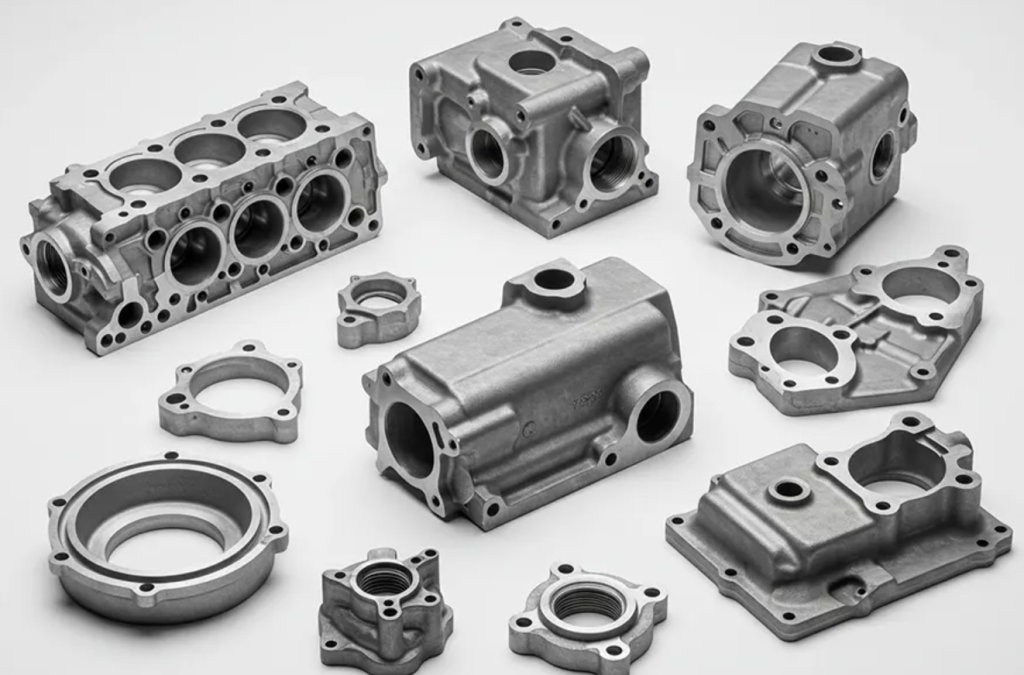
Die Casting Parts of Aluminum: Uses and Advantages
Automotive Applications
Automobile Parts Automotive die cast components made using corrosion-resistant aluminum are being more commonly applied to:
- Components and housings of the engine.
- Transmission casings and brackets.
- Chassis components and structural frames.
These components are lightweight in design, thermostatically stable, and long-lasting, and they are crucial in contemporary car manufacturing.
Aerospace Components
High-performance aluminum components are used in aerospace:
- Aircraft structural parts
- Engine housings
- Avionics enclosures
Corrosion-resistant die-casting aluminum components are safe, reliable, and light because their high tolerances are achieved through aluminum die casting and corrosion-resistant alloys to guarantee flight-critical parts are light.
Maritime and Outdoor Use
Materials in contact with the sea or with wet conditions that are of high humidity demand extraordinary levels of corrosion protection. Our marine-grade aluminium die casting, which is corrosion-resistant, offers:
- Salt spray resistance and oxidation resistance.
- High-humidity or coastal environments, Long life span.
- Marine equipment, boat housings, and outdoor machine durability.
Industrial Machinery and Electronics
Aluminum die-cast components provide the following:
- Exact dimensional stability.
- Ductile and Electrical Conductivity.
- Anti-oxidation and anti-wear protective coating.
Such characteristics render the use of aluminum die casting solutions in outdoor and high-humidity environments very dependable in the industry.
Advantages of Corrosion-Resistant Die Casting in Aluminum
- High-Tolerance Die Casting: It attains +-0.1-0.2mm accuracy on structural and functional components.
- CNC Machining Compatibility: Guarantees precise post-processing and finishing.
- Heat-treated Aluminum Casting: Improves mechanical strength and anti-corrosion.
- Multi-Cavity Molds: Ease of high production volume without affecting quality.
- Production: ISO certification ensures automotive, aerospace, and industrial standards.
- Protective Coatings: Addition of corrosion protection by anodizing, powder coating, or plating.
These technical features render specific aluminum die-cast components dependable in the tough environment, besides being economical and adaptable in design.
Achievement in Die Casting of Aluminum
Corrosion-resistant die casting. In SunOn Mould, we incorporate the latest technologies to improve the die casting:
- Smart Manufacturing Systems: The presence of automated production lines makes production repeatable and consistent.
- Digital Mold Simulation: Automates perfect part and temperature flow projections.
- Additive Manufacturing Integration: Allows complex component geometries of molds.
- Advanced Temperature Control: Guarantees controlled cooling and low internal stresses.
- High-Precision Casting: Lightweight and resistant to corrosion with minimal processing after casting.
With the integration of such technologies, we offer new technology to those industries that require high-performance and durable aluminum die-cast parts.
Quality Control and Standards
To guarantee quality over time and corrosion resistance, the quality must be strictly controlled:
- Aluminum die casts, which are ISO certified.
- Checked and tested dimensional accuracy and repeatability.
- Precision part aluminum casting in tight tolerances.
- Adherence to automotive, aerospace, and industrial standards.
- Corrosion, salt spray, and humidity.
This dedication to quality ensures that die-cast components made of aluminum are of high standards in terms of performance requirements in industrial and commercial applications.
Customization and Finishing Surface
The aluminum parts that are resistant to corrosion may be further strengthened with:
- Powder Coating - Color, protection, and UV protection.
- Anodizing - Provides corrosion resistance and increases wear resistance.
- Polishing - Provides aesthetic and smooth surfaces to be used by the consumer or industry.
- Electroplating - Provides an additional protective metallic coating to increase corrosion resistance.
These alternatives make sure that custom die cast parts of aluminum not only work well, but also look good and function accordingly.
Conclusion
Die-casting aluminum parts that are resistant to corrosion are also essential in industries where strength, lightweight construction, and durability are necessitated due to severe conditions. At SunOn Mould, we offer one-on-one aluminum die casting, which involves the combination of progressive alloy choice, state-of-the-art die casting, and corrosion resistance.
