


Custom Humanoid Robot Parts Manufacturing for Medical and Service Humanoid Robots
Progress in the design of medical and service humanoid robots is approaching the commercial stage. Humanoid robots need to safely interact with humans while displaying accurate movement, having small form factors, and having a long operational span. Compared to industrial robots, the development of humanoid robots brings many new challenges. These challenges require lightweight designs that can withstand movement and be manufactured with high precision at large scales.
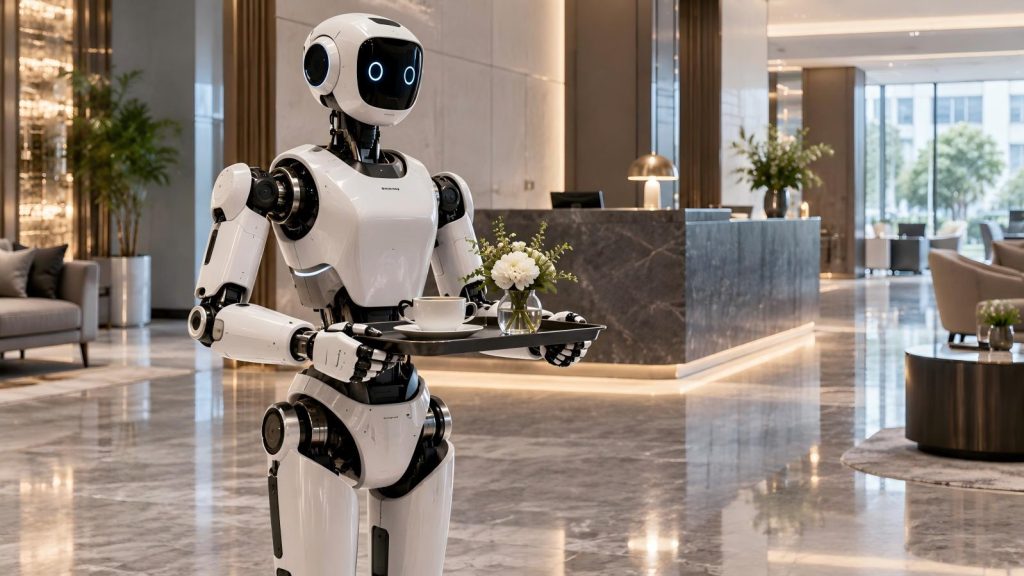
The development of custom humanoid robots is creating a new market for the Custom Humanoid Robot Parts Manufacturing. Through our holistic approach of engineering, we evaluate the integral relationship that exists between the different elements of manufacturing including, but not limited to, robot structure, selection of manufacturing materials, robotics process automation (RPA) tools, assembly, and machine interactivity. Our multi-faceted manufacturing services from prototyping through to production ranging from CNC machining to post-processing ensure our robotic clients have manufacturing partners to rely on.
Why Medical and Service Humanoid Robots Need Custom Manufacturing
Medical and service humanoid robots face different mechanical challenges compared with conventional automation equipment.
A humanoid robot may contain hundreds of mechanical components, including:
• Actuator brackets
• Gearbox supports
• Robotic hand components
• Sensor mounting structures
• Lightweight frame parts
• Protective covers
Each of the different components contribute to the overall performance of the robot.
| Requirement | Manufacturing Challenge |
| Motion accuracy | Tight Tolerance in Rotary Parts and Connectors |
| Lightweight Structure | Lightweight Design While Maintaining Stiffness |
| Long Operating Cycles | Long Cycle Time |
| Human Interaction Safety | Safe with Humans |
For instance, consider actuator mounting surface and bearing seats in a robotic arm joint. Manufacturing deviations may result in spiking vibrations, negatively impact position accuracy, and increase wear.
Precision in Custom Humanoid Robot Parts Manufacturing
Precision is a key consideration in custom humanoid robot parts manufacturing.
Robot components, as opposed to most structural parts, incorporate several functional surfaces. These surfaces define the functioning of motors, sensors, bearings, and mechanical links.
Important characteristics are:
| Characteristic | Usual Effect on Robot Performance |
| Dimensional Tolerance | Impacts Assembly |
| Concentricity | Helps Smooth Rotation |
| Flatness | Stay Aligned |
| Surface Roughness | Low Friction |
| Material Stability | Long Term Control |
For highly performing robotic joints, manufacturers look into:
• Precision in Bearing Holes
• Alignment of Shafts
• Flatness of Mounting Surfaces
• Accuracy in Thread Placement
Aluminum Alloy for Lightweight Robot Frame Structures
Unlike stainless steel, aluminum alloys possess higher strength to weight ratios, which is preferred in high speed applications such as motor brackets. They also resist corrosion, shed the dust and burrs produced by machining better, and are easier to machine.
Starting at the prototyping stage, aluminum alloys are often chosen for robot frames and other structural elements as aluminum CNC machining allows for quick design modifications without the need to produce molds.
Engineering Plastics for Lightweight Functional and Protective Robot Elements
Engineering plastics can be used for:
• Robot covers
• Sensor protective elements
• Internal supports
• Insulation
Unlike metal, plastics are lighter and offer greater design freedom.
SunOn provides plastic injection molding services for complex plastic designs, along with mold production.
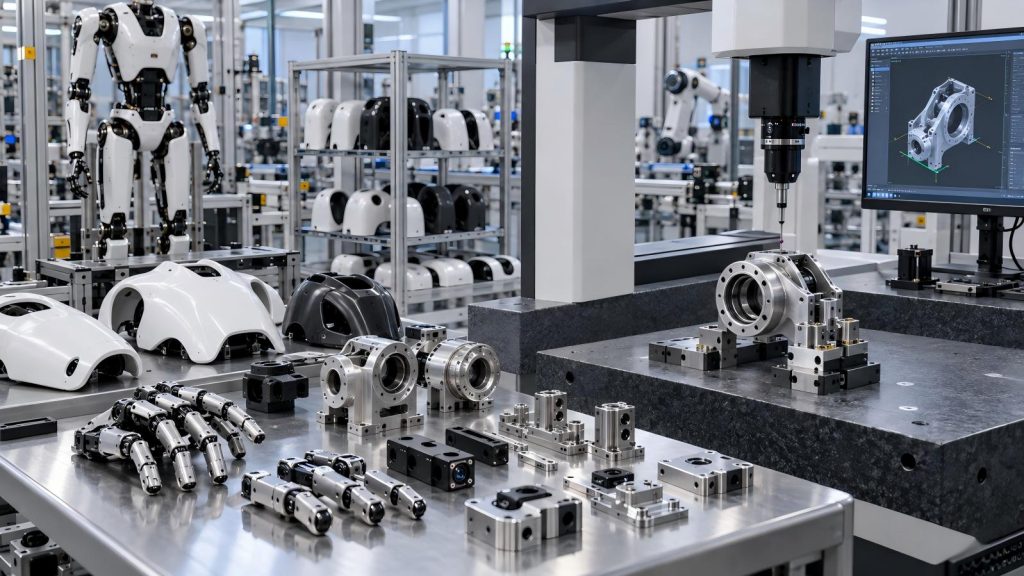
Selecting Manufacturing Processes for Humanoid Robot Components
Manufacturing processes are a crucial consideration during the production of humanoid robots. Different manufacturing processes are suitable at various stages of custom humanoid robot components production.
CNC Machining: Precision Parts and Prototypes
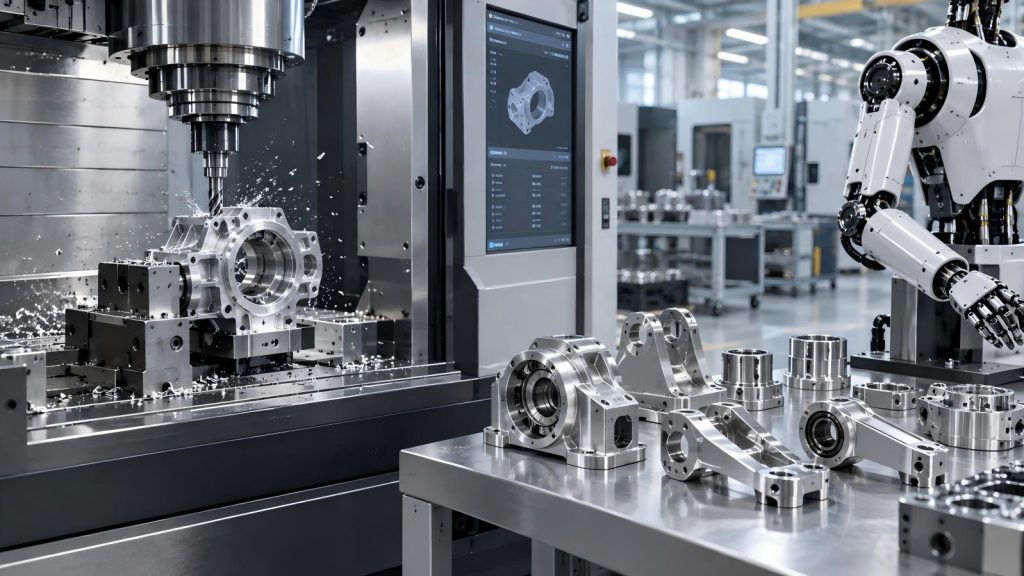
CNC machining involves the creation of customized designs, followed by removal of excess material in order to reach the final design. This approach is useful in the early stages of the development of humanoid robots due to the changing designs as a result of many tests that are conducted.
Advantages:
• Low tooling investment
• Fast modification of designs
• Suitable for complex designs
• Useful for alloyed metals as well as engineering thermoplastics.
Typical applications:
• Prototype joint housings
• Actuator brackets
• Precision mechanical connectors.
CNC machining services for prototype and low volume production offered at SunOn can assist developers of robots validate the mechanical designs of their robots before commitment to mass production.
Injection Molding and Die Casting: Production Scaling
Robotic design stabilization often triggers the evaluation of processes that are more production oriented. For Robot Manufacturing, Injection Molding and Die Casting can facilitate production scaling.
| Process | Suitable Parts | Main Advantage |
| CNC Machining | Prototype, precision parts | High flexibility |
| Injection Molding | Plastic covers, shells | High repeatability |
| Aluminum Die Casting | Metal housings, structural parts | Efficient mass production |
| 3D Printing | Concept verification | Fast iteration |
SunOn provides customers with integrated mold manufacturing, injection molding, aluminum/zinc Die Casting, and post-process capabilities in order to support customers transition from prototype validation to production.
Design Optimization Through DFM for Robot Parts
Successful Custom Humanoid Robot Parts Manufacturing starts long before a first part is machined or injection molded.
At SunOn, the focus of engineering is placed on:
• Wall thickness
• Access for machining
• Designs for mold releases
• Assembly reference and positioning
• Structural reinforcement
• Requirements for surface treatments.
Poor manufacturability leads to:
• Longer machining times
• High tooling costs
• Difficult assemblies
• Poor quality production.
Through DFM, balance for mechanical performance and manufacturability can be achieved.
Quality Control for Medical and Service Robot Components
Due to the close proximity of medical and service robots to people, reliability testing is critical.
A professional Custom Humanoid Robot Parts Manufacturing process should include:
Dimensional Inspection
Common Inspection Methods:
• CMM Measurement
• Critical Dimension Inspection
• Surface Inspection
• Assembly Verification
Mechanical Reliability Evaluation
Depending on the application requirement:
• Load Testing
• Fatigue Testing
• Wear Testing
• Thermal testing
For example, actuator brackets must have dimensional stability while protective covers must have a snug, impact resistant fit.
SunOn integrates manufacturing and quality control processes to achieve consistency in the machining, molding, and assembly operations.
From Prototype to Mass Production: Building a Reliable Supply Chain
Humanoid robot development usually follows a staged manufacturing process:
| Development Stage | Manufacturing Focus |
| Concept Prototype | CNC machining and rapid validation |
| Engineering Verification | Material and structure optimization |
| Pilot Production | Process stability testing |
| Mass Production | Injection molding, die casting, automated production |
A good Custom Humanoid Robot Parts Manufacturing partner should do more than provide machining. Engineering interaction and process optimization, and scale of production are equally critical.
As leaders in medical and service humanoid robot manufacturing, SunOn uses their specialty in machining, molding, and tooling to assist OEMs. With our advanced engineering and manufacturing services, we are able to deliver the complete service from prototyping to manufacturing robotic components.
SunOn offers integrated support at each stage of custom manufacturing of humanoid robot parts. We help in the selection of precision and structural components and system manufacturing process optimization for the assembly of humanoid robotic systems.
We are your partners to help find the most optimized solutions for your requirements.
FAQs
Q1. What humanoid robot parts can SunOn offer?
SunOn manufactures many humanoid robot parts such as robotic joint housings, actuator brackets, structural frames, sensor mounts, and mechanical connectors and covers. The complexity, materials, and volume of the parts will determine the manufacturing process.
Q2. In what manufacturing processes does SunOn specialize for humanoid robot components?
SunOn has a variety of manufacturing processes that include:
• CNC machining
• Precision milling and turning
• Injection molding
• Die casting
• Mold manufacturing
• Surface finishing
• Secondary processing
This set of manufacturing processes allows SunOn's customers to manufacture from prototype to production.
Q3. Does SunOn manufacture low-volume prototype parts for humanoid robots?
Yes. SunOn manufactures prototype parts for humanoid robot development using CNC machining. CNC machining allows designs to be tested and robot structure to be built while performance is validated.
Q4. Which materials can SunOn use to manufacture humanoid robot parts?
SunOn can use materials such as:
• Aluminum and its alloys for structures
• Stainless steel for mechanical structures
• Engineering plastics for covers and other functional parts
• Others as required
The choice of material should balance strength, weight, thermal performance, cost, and other factors.
Q5. How does SunOn control precision in manufacturing robotic components?
To achieve the desired level of precision, SunOn has machining and inspection processes to control:
• Position and tolerance of holes
• Flatness
• Surface Finish
• Assembly fit
These are important for joints, actuator positioning, and other motion related components.
