


One-Stop Custom Injection Molding: How Integrated Services Lower Costs and Shorten Lead Times
To source custom plastic components, multiple suppliers are typically involved. One brings in the design, another the injection machinery, yet another the surface finishing, and a final one the assembly. With every step, time, cost, and risk are increased. An ideal solution is a service that offers all custom injection molding capabilities in-house. Using their own, pre-established systems, such a service can improve speed and reduce costs significantly. This article explains the benefits of such services and how they can be applied to custom injection molding.
The Hidden Costs of Modular Manufacturing
A modular style means step breakdowns in custom part manufacturing. While modular specialists tend to perform their step well, the modular workflow as a whole, tends to break.
•Excess Project Management: The integration of many suppliers consumes a significant portion of the engineering and procurement resources.
•Redundant Logistics: Moving the parts to multiple supply points amplifies the cost of logistics and increases the risk of loss and damage.
•Unreliable Quality: As every step of the process is performed by modular suppliers, each having their own quality standards. As a result, components may not meet the required standards and, even if they do, may require additional work.
•Longer lead times: Sourcing each operation separately extends lead time, because the operations are done sequentially.
A one-stop custom injection molding service solves all of the issues above and manages the entire step from raw resin to the finished assembled part.
What Is One-Stop Custom Injection Molding?
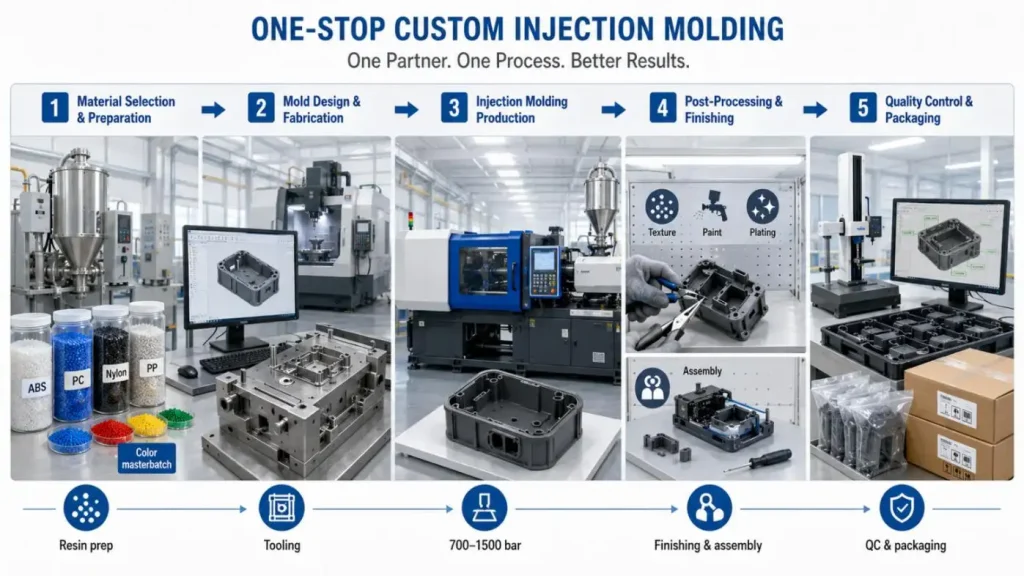
A custom one-stop injection molding service means that a single manufacturer offers the entire service for the custom plastic part. This includes all the operations prior to and subsequent to the injection molding.
•DFM Review: Designers examine models in 3D prior to machining the injection mold tool to spot problems including shrinkage or warping.
•Mold Building: The suppliers will proceed to build the injection molding tools as per the customization.
•Material Preparation: The materials are dried, and prepped with masterbatch, color, and additives.
•Injection Molding Production: The most advanced high-speed machines are employed to accomplish the pressure range of 700-1500 bar with the operative temperatures of 180-300 °C, and tolerancing of ±0.1 mm.
•Post-Processing & Finishing: Gate trimming, deflashing, surface treatment (gloss, matte, texture, UV, plating), and assembly are all available with no external fulfillment.
This integrated model offers complete processing of raw polymer resins into functional parts.
Step-by-Step Process of a One-Stop Service
An effective one-stop partner uses an organized flow. The structural order of each phase is handled by the partner directly.
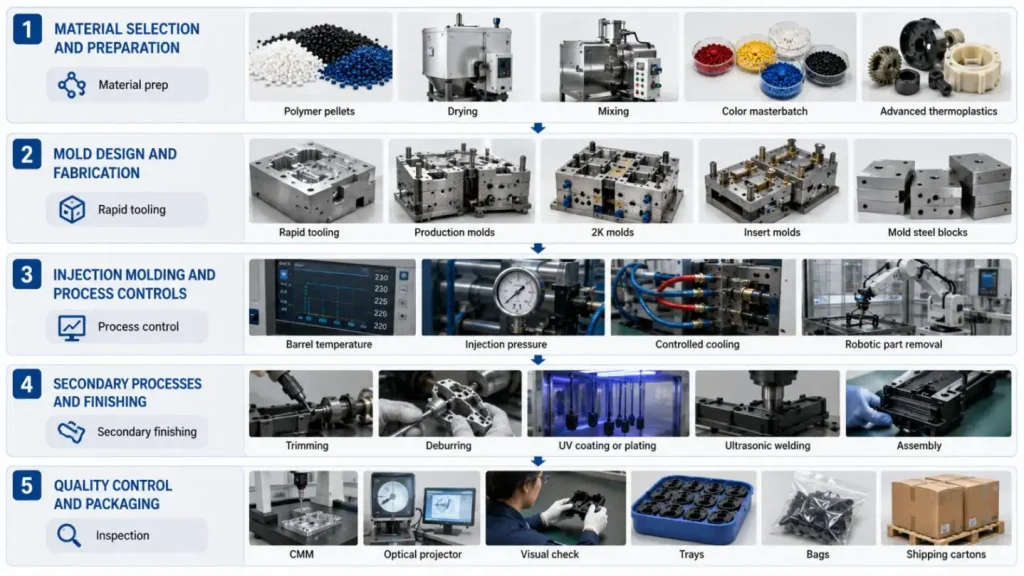
1. Material Selection and Preparation
•Selection of some of the most advanced thermoplastics at your disposal. These include: ABS, PC, Nylon, PP, POM, PET, PC/ABS, PE.
•Advanced custom compounds: We use application based fillers or even flame retardant fillers.
•Drying and Mixing: PC, Nylon and other highly hygroscopic polymeric materials can be dried onsite. Masterbatches can also be mixed to masterbatch desired color or specific Pantone or RAL shade.
2. Mold Design and Fabrication
•Rapid Tooling: Aluminum or soft steel molds for prototyping or small production runs (1k–10k parts) are delivered in 7–15 days.
•Production molds: For a production range of 100k to over 1M parts, the use of hardened steels P20 and H13 comes with a 20 to 30 day lead time.
•Advanced molds: 2K molds for two-component parts, metal or electronic insert molds and use of high cavity production are all done in-house.
3. Injection Molding and Process Controls
•Injection Pressure, Barrel Temperatures, and Packing Pressure: All of these are customizable per the material and the injection molded component design.
•Controlled Cooling: Mold cooling reduces warping.
•Automated Part Removal: It improves the accuracy and reduces the cycle time.
4. Secondary Processes and Finishing
•Surface Finishes: The texture of a post molding finish can be SPI A or B, gloss to matte to textured surface, or can be enhanced with UV coatings and/or electrolytic plating.
•Joining and Assembly: Methods for joining and assembly can be ultrasonic welding or insert hot melt, 3D printing, or gluing.
•Mechanical Post Processing: When tight tolerances are required, gates may be trimmed, deflashing and deburring are done, then CNC machining.
5. Quality Control and Packaging
•Dimensional Inspection: Part of quality control is taking a sample, then using CMM and optical projectors to measure and compare key dimensions to the CAD files.
•Functional Testing and Visual Inspection: A sample is tested from every lot to ensure that the lot meets the strength requirements and also has the correct quality and color.
•Packaging Verification: A sample is taken for each batch to verify that parts are packaged and labeled in a traceable code in trays, bags, and boxes. Packaging varies based on the requirements of the customer.
How Integration Reduces Cost and Increases Speed
Using a single custom injection molding service can quantify the time and cost benefits when compared to using multiple services.
1. Cost Reductions Achieved by Integration
•No Markups: Integration eliminates the need for a separate mold maker, molder, finisher, or assembler.
•Lowered Logistics Costs: Parts move on site via conveyor belts, or carts, rather than freight carriers.
•Lowered Rework Costs: Quality issues are identified immediately at the next stage in the process. For example, if a post finishing defect occurs, it is traced back to the molding process in hours rather than weeks.
•Material Optimization: Resins and masterbatches are inventoried and shared, which
2. Lead Time Compression
•Parallel engineering: Mold design, material acquisition, and design of secondary tools (e.g., fixtures for ultrasonic welding) can be done simultaneously.
•Short production lead time: For orders from 1,000 to 1,000,000 pieces, expect a 7–30 day production lead time after mold approval.
•Rapid silicone prototyping or soft tooling: This approach allows for early functional assessments of designs prior to production, resulting in a lower likelihood of large-scale changes to the design.
•Case in Point: A consumer electronic housing that utilizes a mold, a mold, painting, and assembly with a 12 week lead time using 4 vendors, can be done in 4–5 weeks with a single vendor.
3. Quality Assurance at Every Step
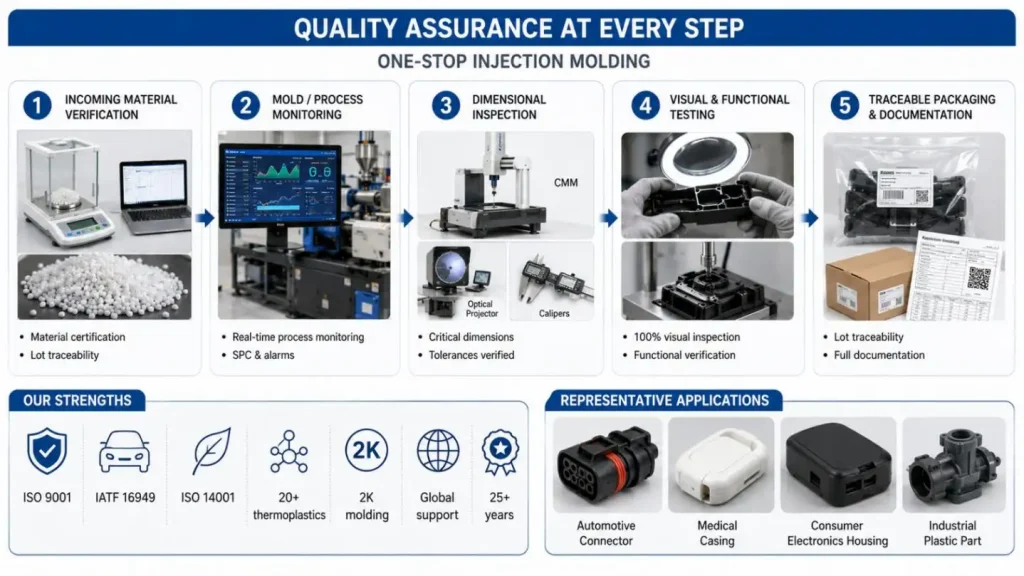
Quality is maintained and improved with vertical integration because of the added control. For example, SunOn vertically integrates operations and is certified for ISO 9001, IATF 16949, and ISO 14001.
•Verification of Incoming Material: Additives and resins can be potentially observed.
•Final Inspection: Verify the dimensions. Visually confirm and test the function of each operation.
•Production Observation: Logs each cycle of the molding process. Standards of AQL and/or customer requirements are satisfied.
•PPAP and Documentation: In the automotive and medical sectors, full PPAP is included along with control plan and material certifications.
Why SunOn is Your Best Choice
There are benefits beyond cost and lead time of utilizing an integrated custom injection molding company. Increased design and material flexibility and expertise are available early in the product development process.
•Design flexibility: Changes to a complex mold with thin walled features or tight tolerances are easy and can be done without concern for the ease of manufacturing.
•Material flexibility: Over 20 types of thermoplastics are readily available, and any engineered resins can be sourced as needed.
•Speed: Because of 2K injection and multi-cavity molds, we have shorter cycle times which allow us to produce goods in bulk.
•Coverage with Local Response: We have 27 branches across the world which helps us respond to requests with the required engineering and logistics support.
•25+ Years Experience: Our clients provide us work from numerous industries including automotive (dashboards and connectors), medical (instrument casings), consumer goods, electronics, and industrial.
Conclusion
Manufacturing fragmentation leads to high costs and longer delays. Our integrated approach to custom injection molding provides the customer with significant savings, lower costs, a high degree of consistency in part quality, and fast lead times of 7 to 30 days (for all needed units). For customers moving from low-volume prototyping to high-volume production, this integrated solution delivers parts with full plastic integration, thereby removing the friction of using multiple suppliers.
For your custom injection molding project, you may ask for a DFM and quote to help you streamline your supply chain.
FAQs
Q1. What is the usual duration to complete custom injection molding?
Lead time is between 7 to 30 days for orders from 1,000 up to more than 1,000,000 units depending on size of mold and parts.
Q2. Is prototyping possible prior to main production?
Yes, there is a 7–15 day lead time for a rapid prototype using either aluminum/soft steel tooling or silicone molding.
Q3. What materials are available for custom injection molding?
Materials include a wide variety of thermoplastics such as POM, PET, PP, PC, PC/ABS, PE, ABS plus many others, and engineered resins.
Q4. What options do I have for surface finish?
Your surface finish options include glossy, matte, and VDI texture finishes, along with UV Coating, Plating, and many other cosmetic variations.
Q5. What quality certifications do you have?
We are certified in ISO 9001, IATF 16949 (automotive), and ISO 14001 (environmental management).
