


Advanced Aluminum Alloys in Custom Metal Die Casting for High-Performance Parts
Custom Metal Die Casting is a well-established method of producing lightweight, complex, and highly accurate metal components in economically viable production quantities. The performance of die-cast components, however, relies on more than just the die-casting methodology. The die-cast system performance will be affected by the alloy composition, component design, die design, thermal and flow conditions and their control, and post-casting operations.
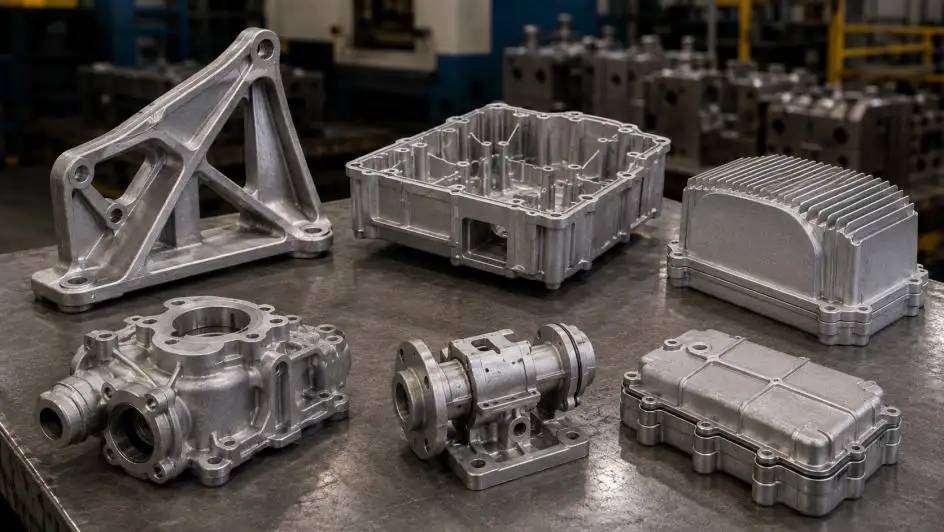
As automotive, electronics, automation, and energy-related products become more compact and functionally integrated, manufacturers are examining aluminum alloys that provide a more suitable balance of strength, castability, thermal performance, corrosion resistance, and cost.
What Are Advanced Aluminum Die-Casting Alloys?
"Advanced aluminum alloy" does not refer to one specific grade. In Custom Metal Die Casting, it generally describes an alloy selected or adjusted for a particular performance requirement.
• Higher mechanical strength: Better for making brackets, housings, supports and other parts that are subject to mechanical loads.
• Improved thermal conductivity: Better for use as heat sinks, housings for LEDs and other electronics, thermal management components and within thermally conductive housings.
• Better corrosion resistance: Better for use in outdoor, humid, and/or chemically aggressive environments are controlled-composition and lower-copper alloys.
• Greater ductility: Better for parts that need to be able to deform without breaking.
• Improved pressure tightness: Better for pump casings, housings for valves and other fluid control components that require a stable sealing surface.
• Enhanced wear resistance: Better for use in sliding, rotating, or applications where abrasive wear is expected are the more highly hardened alloys.
Aluminum is the most widely used metal in die casting because of its combination of low weight, corrosion resistance, good conductivity, and good dimensional stability.
How Alloying Elements Affect Performance
While being so light and so conductive, pure aluminum is generally not applicable for standard die casting at high pressures. Alloying improves fluidity, strength, hardness, castability, and service performance.
Silicon
Silicon improves fluidity, helping Custom Metal Die Casting fill thin walls and complex features. It may also reduce shrinkage and hot cracking, although machining, ductility, and thermal performance remain important considerations.
Copper
Copper can improve strength, hardness, and high-temperature performance, but higher levels may reduce corrosion resistance.
Magnesium
Magnesium increases strength and hardness, while excessive amounts may reduce ductility.
Iron and Manganese
Iron can reduce aluminum adhesion to die steel, while manganese helps manage iron-containing phases. Both require controlled composition to maintain casting quality.
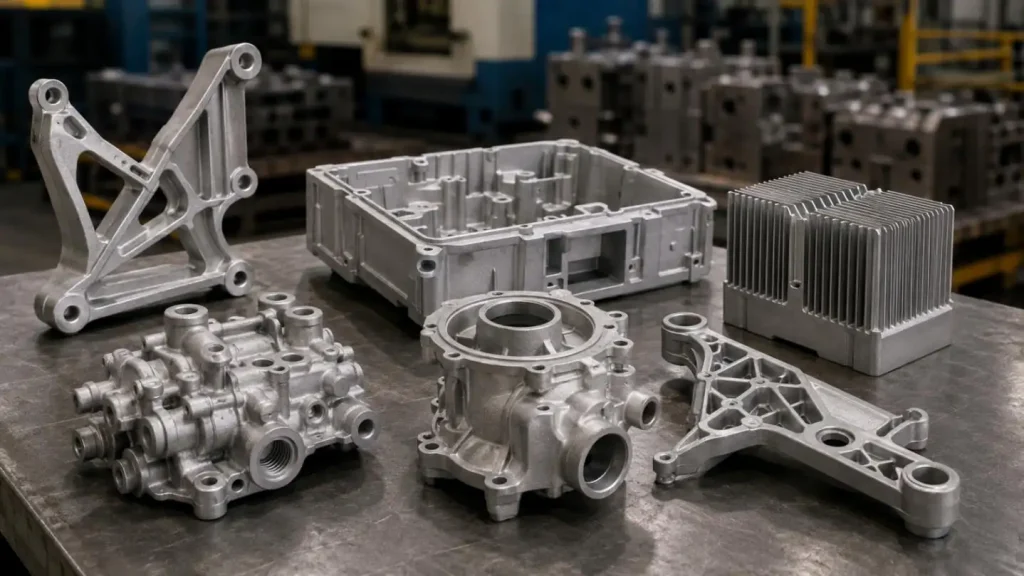
Comparing Common Aluminum Alloy Options
The following table provides a general selection overview. Actual properties will vary with limits of composition, casting parameters, geometry, porosity, heat treatments and test protocols.
| Alloy | General Characteristics | Typical Applications |
| A380 | Good balance of castability, strength, and machinability at low cost | Chassis, tools, brackets and housings |
| A360 | Good corrosion resistance and strength retention at elevated temperatures | Parts exposed to heating and outdoor applications |
| A383 | Excellent die filling | Thin walls and complex rib and housing structures |
| A413 | Excellent fluidity and ability to form a pressure-tight seal | Hydraulic components and fluid handling devices |
| A390 | Provides hardness and excellent wear resistance | Valves and other abrasion resistant applications |
| A518 | Good ductility, corrosion resistance and appearance suitable for finishing | Hardware and other appearance sensitive applications |
According to NADCA, A380 is listed as a highly utilized alloy. A383 is generally utilized for complex shapes, A413 for components that require pressure tightness, and A390 for applications that require wear resistance.
Thermal Management is a System Level Consideration
One of the growing applications for Custom Metal Die Casting is Thermal Management for Electric and Hybrid Electric vehicles, Telecommunications, Data Systems, Power Electronics, LED Lighting and other related fields.
Thermal Management is often the dominant design driver for casting components. A higher thermally conductive alloy does not mean the cast component will be a better cooling part. Some of the other design considerations are:
Fin design: Heat transfer can be improved with longer and thinner fins.
• Constant-Wall Thickness: Keeping wall thickness uniform enables better flow of the metal and reduces the occurrence of hot spots.
• Flat Interfaces: Components which must be brought into close contact should have precisely machined surfaces to provide better contact.
• Airflow: Fins should be positioned to optimize the preferred cooling method, natural or forced.
• Surface Treatments: Evaluate the coating for its ability to protect against corrosion and for its thermal transfer capability.
Based on the NADCA technical documents, lower silicon levels can increase the degree of filling and the level of thermal conductivity, but can also negatively affect filling of thin and intricate high-pressure die-cast sections. It is important to evaluate the characteristics of a material and the design of a component to determine the functionality of the alloy.
The Importance of Mold Design
The use of superior die-casting alloys will not guarantee the production of quality castings if the mold design is poor in controlling the filling, venting, cooling and ejection of the castings.
Consider the following when designing a mold:
• Gate and runner design: The metal should flow through the cavity in the desired filling time and with a controlled flow.
• Overflow and venting design: There should be an ample escape route for the air to exit the cavity.
• Balanced cooling: The goal should be to reduce the difference in solidification time between thin and thick sections.
• Placement of the parting line: The appearance of the part, and the degree of trimming and flash will be affected by the parting line. In addition, the parting line will affect the part's dimensions.
• Ejection design: The design should allow for ejection of the casting with no distortion and no obvious ejection damage.
• Design of wall thickness: Where possible, the design should include gradual thickness changes as opposed to abrupt changes.
The North America Die Casting Association recommends gradual changes in thickness where practical and the use of gradual thickness changes to maintain as uniform wall thickness as possible.
SunOn's Design and Manufacturing Policy
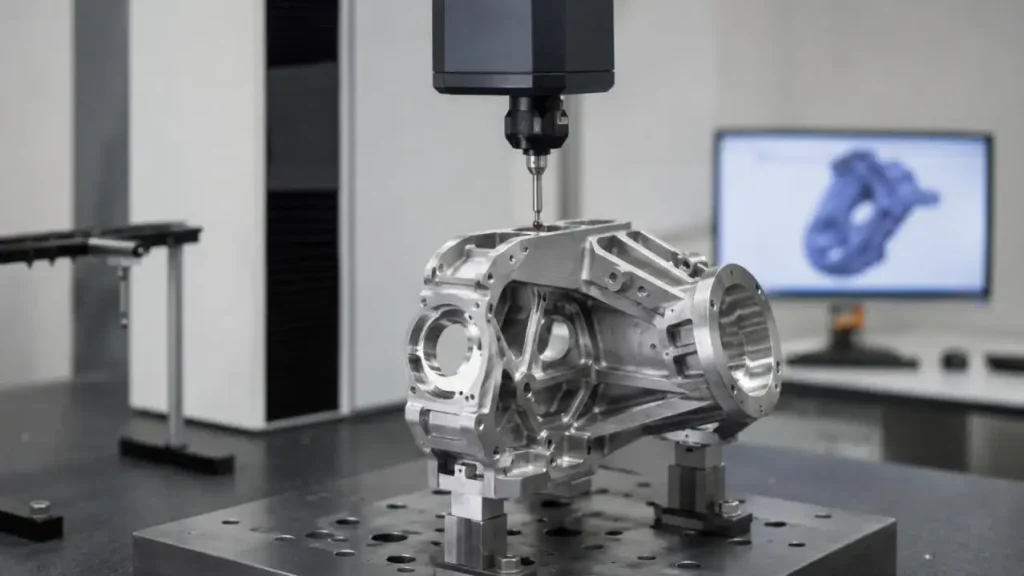
For aluminum die casting projects, SunOn supports a workflow from drawing review to Design for Manufacturability (DFM), mold-flow analysis, mold design, tool making, assembly, T1 trials, mold modification, and start of production. In addition to aluminum, SunOn also offers zinc die casting for applications requiring finer detail and thinner walls..
For the Custom Metal Die Casting project, SunOn may build the following molds:
• 8407 Steel: Where the properties of thermal cycling, polishability, and heat-check resistance are of primary interest, this hot-work tool steel may be used.
• H13 Steel: This steel provides an excellent combination of hot strength and toughness with thermal fatigue resistance.
• 4Cr5MoSiV1: This steel may be suitable for the external parts of the mold that may come under high temperature and pressure, and be subject to erosion.
• Beryllium-Copper Inserts: The use of localized inserts can accelerate the heat transfer in the sections of the mold where cooling is relatively slow.
SunOn further integrates die-casting, mold making, CNC machining, deburring, surface finishing, assembly and packaging. Its process flows include DFM, CNC/EDM toolmaking, mold trials, and T1 inspections and adjustments prior to production.
Choosing an Alloy for a New Project
A well informed Custom Metal Die Casting alloy decision should consider the entire operating environment rather than just one value.
Before the project team can determine an appropriate alloy, they should determine the following:
• Mechanical Loads: different types of requirements should be considered, including static, impact, vibration, and fatigue.
• Operating Temperature: both typical and atypical (peak) operating temperatures should be considered.
• Exposure: consider exposure to moisture, salt, chemicals, and/or outdoor exposure.
• Thermal: Take necessary considerations for thermal management, for example, heat removal.
• Dimension: consider both functional tolerances and other, less critical, dimensions.
• Finishing: consider both the required surface treatment and its compatibility with the alloy.
• Volume: consider the production (tooling, cycle, and maintenance) costs and the expected life of the mold.
Final Words
Selecting an advanced aluminum alloy for die casting means weighing castability, strength, ductility, corrosion resistance, and conductivity against cost and ease of finishing.
Successful part design requires coordinating alloy selection, part geometry, mold and gating system design, process parameters, and inspection,all as part of one integrated plan.Alignment of the designer, material supplier, and die-casting manufacturer early in the design process will assist in the coordination and in avoiding changes to the tooling.
FAQs
Q1. Are aluminum die-castings resistant to corrosion?
Most aluminum alloys have some degree of corrosion resistance. However, different alloys experience different levels of performance.
Q2. Why are aluminum alloys preferred for die casting?
Aluminum alloys are preferred because of the combination of low density, high strength, corrosion resistance, and good thermal conductivity.
Q3. Which aluminum alloy is most commonly used for die casting?
ADC12 is the most common alloy for die casting, as it is one of the most balanced alloys in terms of castability, strength, and machinability.
Q4. What is the role of silicon in aluminum alloys for die casting?
Silicon increases the fluidity of the molten metal and aids in the filling of thin sections and intricate shapes.
Q5. What properties does copper add to aluminum alloys?
Copper improves the alloy's strength and hardness at room temperature and at elevated temperatures.
