


Custom Plastic Housing Manufacturer for Lightweight Design
Minimizing weight has become a critical objective in the design of automotive and electronic applications. Lighter vehicle components increase fuel efficiency and range of battery-operated vehicles, while lighter electronic components increase portable and compact user-friendly systems. Restrictions resulting from the need to ensure impact resistance, dimensional stability, thermal management, seals, and reliable long-term performance must also be considered in conjunction with the objectives of lightweight design.
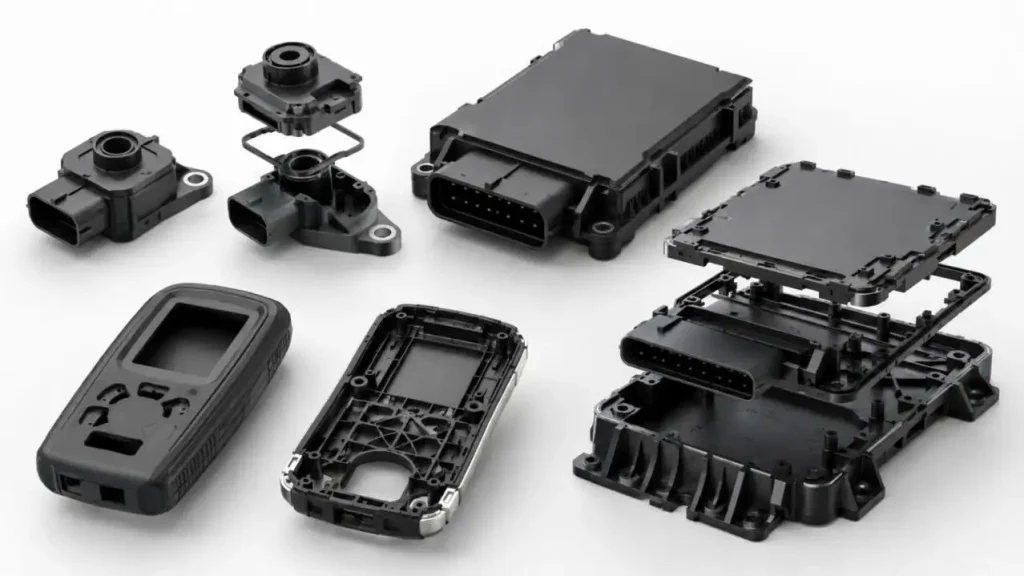
Being a Custom Plastic Housing Manufacturer, SunOn supports OEMs to create production-ready housings for such demanding applications. This is possible with the combination of their expertise and support in Custom Plastic Housing design, materials, mold design, injection molding, surface finishing, and assembly support.
Advantages of Custom Plastic Housing
Custom Plastic Housing offers lightweight housings by design flexibility and the potential to eliminate multiple components through integrated design and assembly.
Some of the advantages of lightweight design offered by Custom Plastic Housing include:
•Lower density: Thermoplastics can have a density that is significantly less than that of aluminum, steel, and other metals.
•Integrated design: Clips, fasteners, cable guides and other features of the housing can be incorporated in the housing.
•Removal of Brackets: Components of the housing may serve the function of brackets and fasteners.
•Design Close Together: Unnecessary space may be eliminated by designing Custom Plastic Housing to group components together.
•Design in Balance: Custom Plastic Housing may be designed to include surface space for your company's logos and graphics and to incorporate other design elements.
Injection Molding for Consistent Housing Production
Injection molding is well suited to complex housings because it combines repeatability, scalable production, and broad material flexibility.
SunOn’s suitable housing projects can support tolerances of approximately ±0.1 mm and production volumes ranging from around 1,000 to more than 1,000,000 parts. Actual tolerances depend on the resin, component size, wall thickness, geometry, tooling, and inspection requirements.
A Custom Plastic Housing Manufacturer may apply several manufacturing strategies:
•Thin-wall design supported by ribs and local reinforcement
•Multi-cavity tooling for stable high-volume production
•Insert molding for threaded inserts, contacts, bushings, or metal supports
•Overmolding for soft-touch surfaces, sealing edges, or vibration control
•Two-shot molding for dual-material or dual-color housings
•Controlled filling, packing, cooling, and shrinkage management
SunOn's production workflow lists a typical T1 mold lead time of approximately 25–45 days. Rapid-tooling schedules may be shorter for suitable designs, but project timing should be confirmed after DFM review.
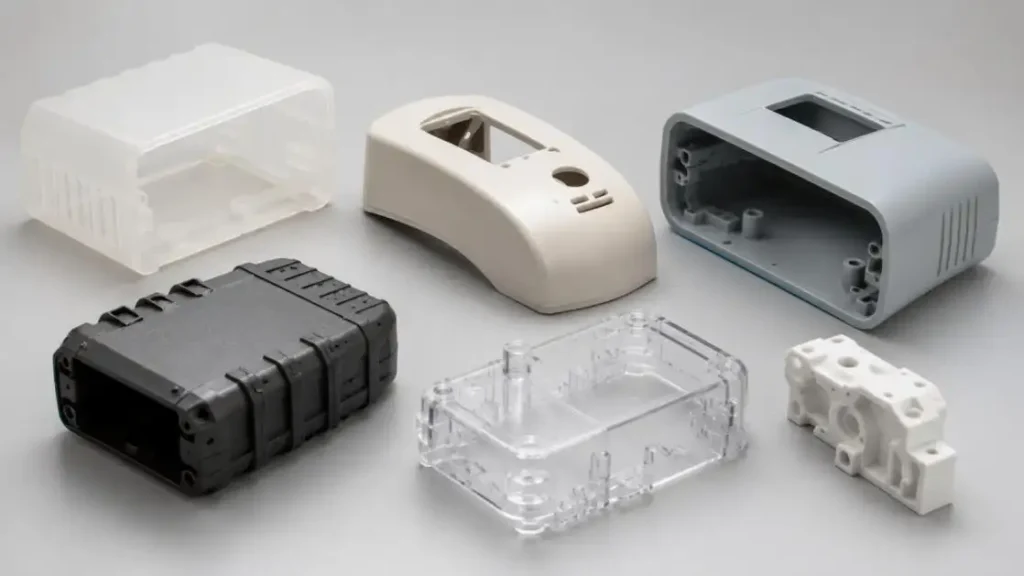
Material Options for Lightweight Plastic Housings
Material selection should consider operating temperature, impact load, chemical exposure, flammability, dimensional stability, appearance, and regulatory requirements—not density alone.
| Material | Typical Density | Primary Advantages | Design Considerations |
| PP | 0.90–0.91 g/cm³ | Low weight, chemical resistance, fatigue resistance | Lower stiffness than many engineering plastics |
| ABS | 1.04–1.06 g/cm³ | Impact resistance, good surface quality, easy processing | Limited performance at elevated temperatures |
| PC/ABS | 1.12–1.14 g/cm³ | Balanced impact strength, heat resistance, and processability | Grade selection affects flame and chemical resistance |
| PA/Nylon | Grade-dependent | Strength, toughness, and wear resistance | Moisture absorption may affect dimensions |
| PC | About 1.20 g/cm³ | High impact resistance, transparency, and heat performance | Requires controlled drying and molding |
| POM | About 1.41 g/cm³ | High stiffness, low friction, and dimensional stability | Better for precision features than minimum-weight enclosures |
These figures represent typical unfilled grades. Glass fibers, minerals, flame retardants, impact modifiers, and recycled content can alter both density and performance.
Automotive Housing Applications
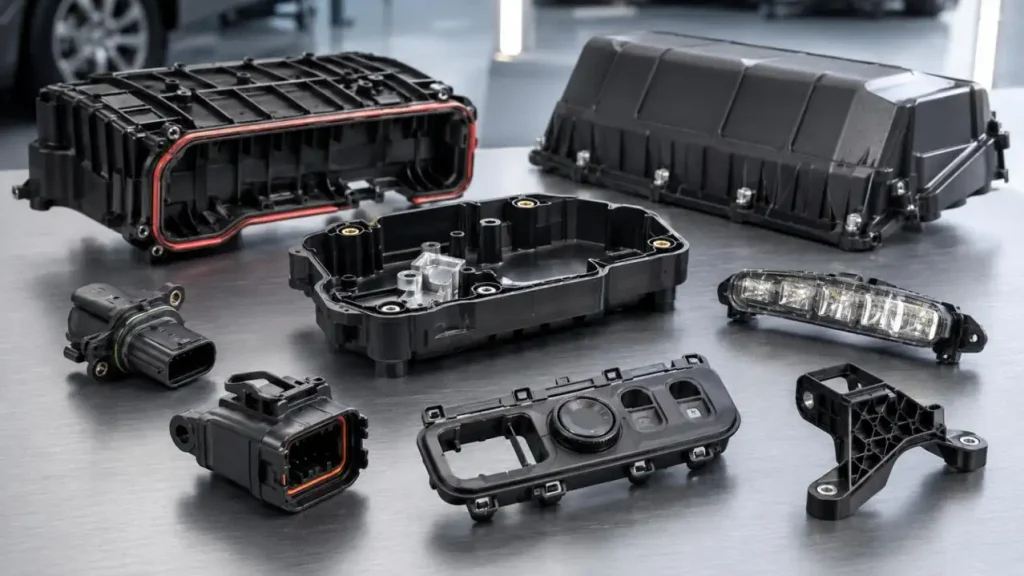
Custom Plastic Housing Manufacturers must consider vibration, thermal cycling, exposure to fluids, assembly loads and a long intended service life when designing their housings for automotive projects.
Common uses are:
•Sensor and connector housings
•Enclosures for electronic control units
•Covers for dashboard controls and interior components
•Housings for lighting and power electronics
•Covers and protective enclosures for battery systems
•Lightweight mounting brackets
Snap fits, sealing channels, and rib structures may be combined with insert molding to improve performance for primary assembly.
Electronics Housing Applications
Electronic housings typically include compact design, electrical insulation, thermal management, and impact resistance, as well as internal alignment.
Common products include:
•Handheld-device enclosures
•Industrial control housings
•Connector bodies and insulating shells
•Battery and power-supply covers
•Consumer-electronics frames
•Communication and network-equipment casings
Early collaboration with a Custom Plastic Housing Manufacturer allows engineers to review draft angles, wall thickness, gate position, ejection, ribs, bosses, snap-fits, ventilation, sealing features, and PCB mounting points before mold production begins.
Integrated Manufacturing and Quality Control
SunOn operates a 32,000-square-meter manufacturing facility... Beyond plastic housings, this integrated setup also supports metal components and assemblies that pair with your housing design from CNC-machined brackets to sheet-metal enclosures.
As a provider of Custom Plastic Housing manufacturing solutions, SunOn offers:
•Resin preparation and controlled material handling
•DFM, gating, cooling, and mold-structure review
•All inspection processes
•Measurement and inspection report drafting
•Various surface treatments and finishing
•Mechanical assembly and delivery preparation
SunOn holds ISO 9001, ISO 14001, and IATF 16949 certifications, covering quality management, environmental management, and automotive-grade manufacturing standards.
Final Words
Lightweighting is not as simple as substituting a metal component for a plastic one.Designing a housing component requires coordinating materials, structure, finishing, assembly, and validation as one integrated system — not as separate decisions made in sequence.
Involving a Custom Plastic Housing manufacturer early in the design to production process offers automotive and electronics design teams lower design risk, the ability to integrate multiple functions in a design, and the ability to prepare designs for production that is repeatable.
With integrated capabilities for tooling, injection molding, finishing, assembly, and quality assessment, SunOn offers support to design and produce a housing assembly that balances the competing demands of weight, strength, appearance, manufacturing, and total production costs.
FAQs
Q1. Can SunOn make thin-wall housings?
Yes, but a review will be required for material flow, geometry, and moldability.
Q2. What industries use custom housings?
Custom plastic housings are widely used in Electronics, Medical, and Industrial Consumer Products,from control units and sensor housings to connectors and device enclosures.
Q3. What materials are usually used?
Common materials include PP, ABS, PC, PC/ABS, PA, and POM.
Q4. Can plastic housings substitute metal enclosures?
Yes, provided strength, temperature resistance, and safety requirements are evaluated and confirmed during the design phase.
Q5. What is the standard molding tolerance?
Most projects fall around ±0.1 mm, but this is highly dependent on design and material selection.
