


Die Casting Advantages and Disadvantages: Complete Manufacturing Guide
Die casting is one of the most common manufacturing processes that is employed in the production of high volume metal components with an accuracy of volume. It is a process that involves pouring the molten metal into a mold cavity at high pressure. Automobile, aerospace, electronic, and consumer goods companies extensively utilize this process. The die casting guide with its benefits and drawbacks is significant to any engineer and manufacturer interested in ensuring optimization of efficiency, quality, and cost in the production process. This paper dwells on the processes of die casting, advantages, and disadvantages and gives some ideas on how to choose the right materials and methods.
What Is Die Casting?
Die casting is a type of metal fabrication whereby molten metal is pressurized in a high pressure in a steel mold, called a die. The method yields parts of high accuracy, finish, and repeatability. Die casting mostly works with non-ferrous metals which includes aluminum, zinc, magnesium and copper. The process can have complex geometries which would be hard or costly to get by other traditional casting or machining techniques. Die casting allows producing homogenous components quickly and with little post-processing.
How Die Casting Works
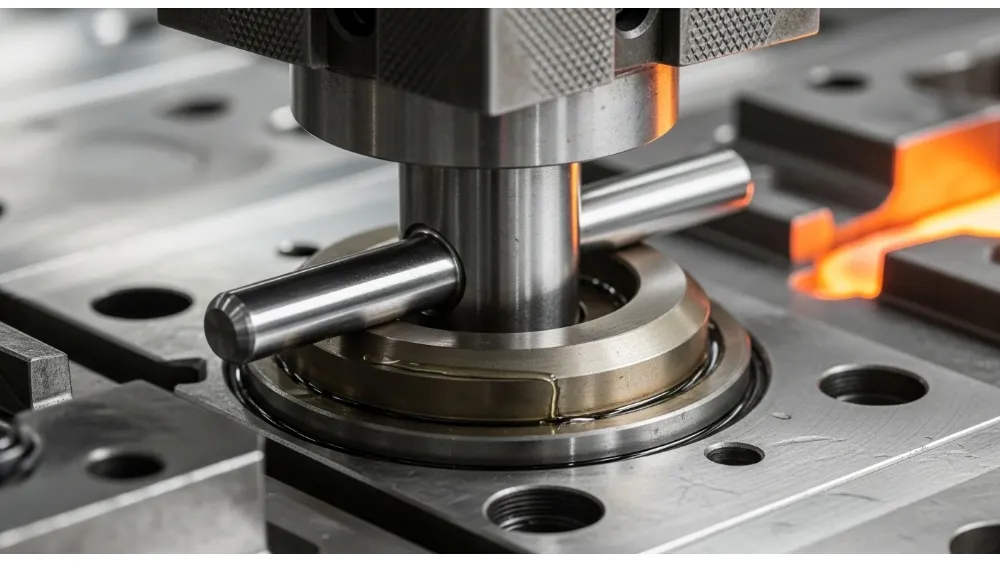
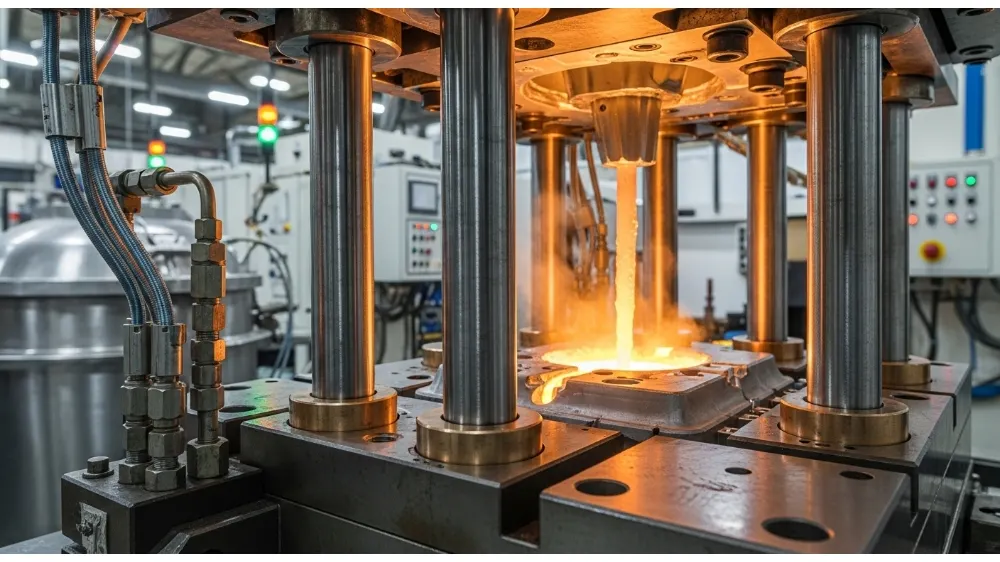
Die casting process begins by heating the metal to the desired heat. Very high pressure is then applied to the molten metal forcing it into the reusable mold cavity. Once solid, the die is opened and the casting is forced out. Further finishing procedures like trimming, deburring or machining can be done to get the end specifications. High pressure and controlled cooling are used to make parts with uniform dimensions, narrow tolerances, and smooth surface finishes. The use of automation and new machinery increases efficiency and repeatability of die casting process.
Advantages of Die Casting
Die casting has a number of strengths that have made it an ideal choice in most of the industrial applications.
High Rates of Production: It is an ideal process when large amounts of parts are required at a high rate as well as on a regular basis.
Superior Dimensional Accuracy: Die cast elements are very accurate, and their measurements are very often within a range of -0.1 mm, eliminating the necessity of post-machining.
Smooth Surface Finish: Die castings normally demand little finishing, which saves time and money.
Multifaceted Geometries: Multifaceted geometry, thin walls and internal structures are available with the high-pressure process that could be unavailable with other technologies.
Material Versatility: It can work with aluminum, zinc, magnesium, and copper which offer certain mechanical and thermal characteristics.
Strength and Durability: Die cast elements possess high structural integrity and they do not deform or warp.
Reusability of Dies: The Dies made of steel can be used thousands of times in production and reduce the long-run production expenses.
Disadvantages of Die Casting
Even with all the advantages it has, die cast possesses a few limitations that should be taken into consideration by the manufacturers.
Large Startup Tooling Costs: The steel dies and setup equipment are quite costly investments that small production runs are then less cost-effective.
Minimal Material Selections: Die casting is predominantly available in non-ferrous metals, and this may not be suitable to address some strength or magnetic specifications.
Porosity Problems: Internal porosity may occur due to air entrapment or due to inappropriate filling, which has an impact on mechanical properties.
Size Limitations: The large component size can be hard to cast because of die size and metal flow limitations.
Difficulty in Die Care: Dies need routine operations in order to provide accuracy, which increases the cost of running them.
Thermal Stress: The fast cooling of metal in the die can occasionally result in remaining stress, which impacts the performance of the parts.
Limited Post-Processing: Only a limited number of features may need machining in critical dimensions or threaded holes.
Applications of Die Casting
Die casting finds wide applications in many industries because it can be used to make large volume and accuracy components.
Automotive Industry: The die casting is strong and accurate in engine blocks, transmission housing and structural components.
Aerospace: Die cast parts made of lightweight aluminum or magnesium enhance fuel efficiency and performance.
Electronics: Electronics parts Housings, connectors, heat sinks are manufactured in large quantities with high precision.
Consumer Products: Appliances, power tools and hardware are popularly made using die casts.
Industrial Machinery: Die casts offer uniform functionality in pumps and gears as well as machine housings.
Die Casting Process Types
Die casting has two principal processes:
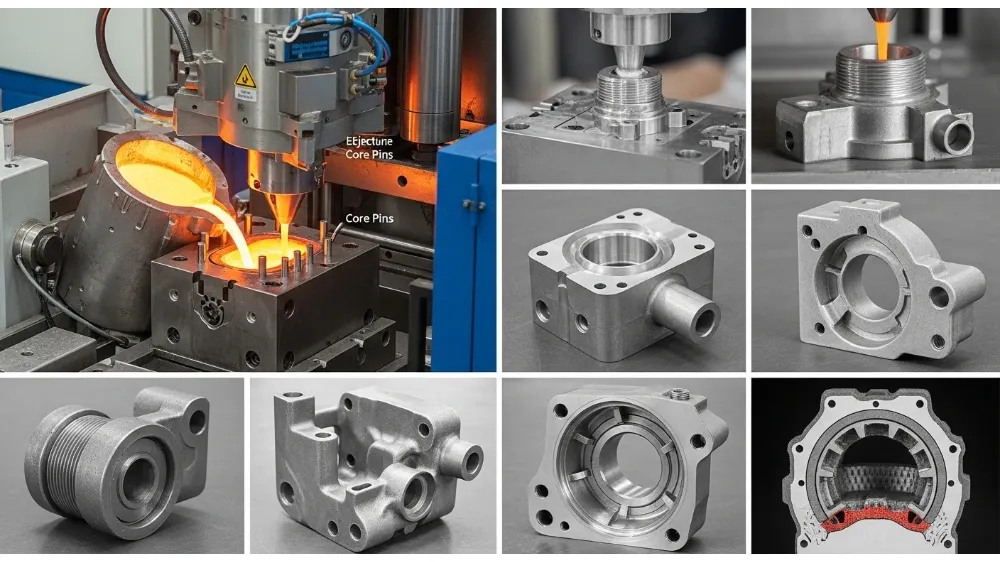
Hot-Chamber Die Casting: In this process, the injection mechanism is immersed in the liquid metal, which is usually the low-melting-point metals such as zinc and magnesium.
Cold-Chamber Die Casting: Molten metal is injected into a different chamber, which is applicable to metals with a higher melting point, including aluminum and copper alloys.
Each process possesses certain strengths in the speed, accuracy and compatibility of materials and the appropriate approach is selected based on the design of the parts and the quantity of the production.
The Influencing Factors of Die Casting
The die cast components quality is based on several factors:
Selection of Material: Each of the alloy, aluminum, zinc, magnesium and copper offers distinct mechanical, thermal and corrosion characteristics.
Die Design: Die is properly vented, gated and cooled, in order to minimize defects and enhance the finish.
Parameters: Injection Pressure, speed and temperature have to be maintained to avoid porosity and to achieve dimensional accuracy.
Cooling Time: The ideal cooling will avoid warping, cracking and residual stress in the part.
Maintenance: Die can be inspected and lubricated on a regular basis, which increases the die life and keeps part quality.
Cost Considerations
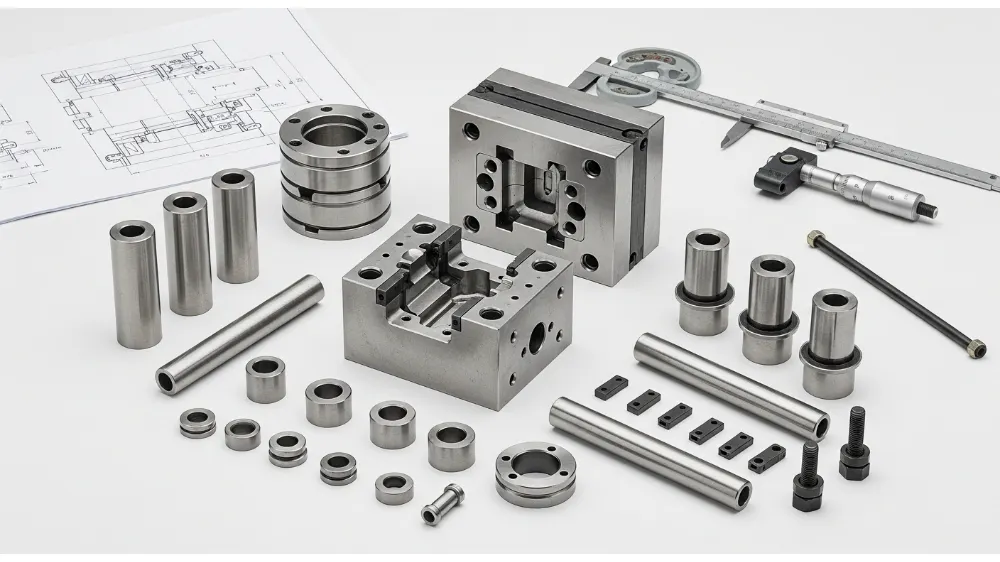
Although die casting is efficient and can be applied to large volumes, initial tooling is expensive. Small production runs might not be cost-efficient due to the high cost of steel dies, CNC machining, and set up. But when the production is in large volume per-part cost is low and a steady quality of production saves scrap, rework and the general production cost.
Conditions of the Environment and Safety
Die casting involves handling of molten metal, high pressure equipment, and cooling. Safety precautions are taken through protective gear, adequate ventilation and temperature control. To minimize environmental impact and sustainability in production, waste management and metal scrap recycling are important.
Frequently Asked Questions (FAQ)
Q1: What is die casting used for?
High volume, precision metal parts with complex geometry and smooth surface finish are produced, in large volumes, by die casting.
Q2: What metals can be die cast?
Typical examples of metals are aluminum, zinc, magnesium and copper alloys which are chosen depending on their strength, weight and usage requirements.
Q3: Does die casting make sense in the small production runs?
Die casting is normally cheaper when used in large volume production because of initial tooling costs.
Q4: What is the difference between hot and cold chamber die casting?
The submerged injection system on hot-chamber is employed with lower-melting metals and the cold-chamber with higher-melting metals.
Q5: What can be done to reduce such defects as porosity?
Internal porosity can be minimized by proper design of die, correct injection parameters, controlled cooling and venting.
Q6: Does die casting parts allow further machining?
Yes, such critical features as threaded holes or tight tolerances might need post-machining.
Q7: Why is die casting widespread in the car industry?
It manufactures lightweight, high-precision and durable components suited to use in engines and transmissions as well as structural parts.
Conclusion
Knowing the die casting guide, its benefits and constraints are critical to manufacturers that would like to make quality and affordable metal parts that are both high quality and precise. Although the process provides superior speed, repeatability, and complex production of parts, issues such as tooling cost, porosity, etc. should be addressed. Having the appropriate materials, the type of processes, and parameters will guarantee an optimized performance, life, and efficiency of production in both industrial and consumer-oriented uses.
