


Die Casting Mould Manufacturing for Automotive Parts: Design Challenges and Solutions
Throughout the years, automakers have incorporated numerous ways to manufacture vehicles with greater efficiency. Aluminum housings and aluminum components of powertrains and structural components of electric vehicles are heavily manufactured with high-pressure die casting (HPDC).
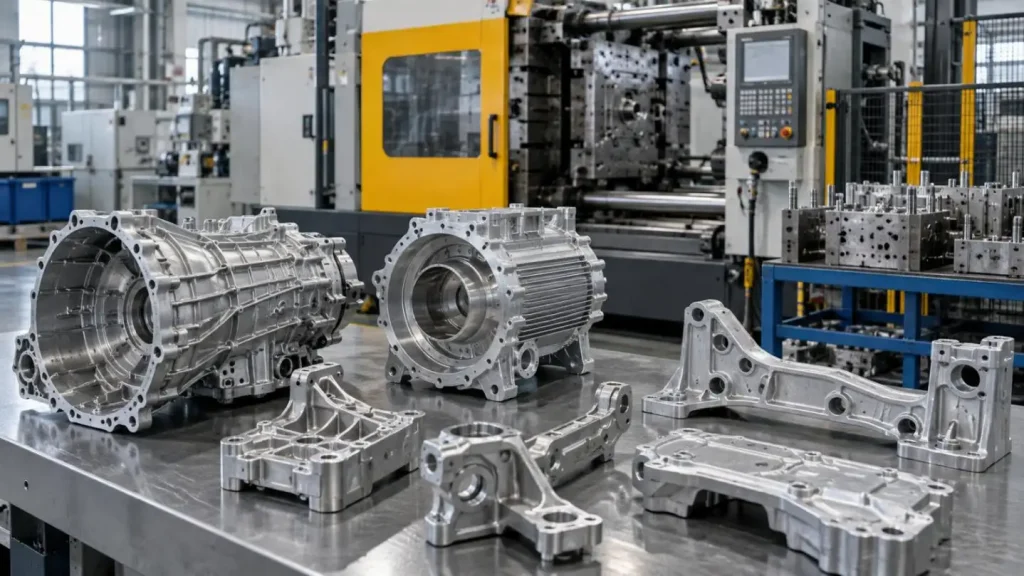
Automobiles present much more demanding conditions on the manufacturing of die casting molds than do other industrial die casting applications. A mold is subjected to countless cycles of high pressure injection, thermal cycling, mechanical stress, and very severe dimensional requirements.
At SunOn, we have made improving the manufacturing process of die casting molds with automation and mass production in mind our top priority to provide our customers with the ability to produce automotive components. We offer customized die casting mold services for automobiles and other industries including electronics and industries to meet our customers' needs from initial tooling development to volume production.
Why Automotive Parts Require Advanced Die Casting Mould Manufacturing
Die casting molds must be designed to incorporate the following considerations for an automotive component:
• Structure and castability of the component
• Flow of the metal
• Efficient cooling
• Long life span
• Short cycle time
• Low maintenance
Unlike most castings, automotive components tend to include:
• Lightweight design with thin-walled sections
• Strength design with reinforcing ribs
• Multiple attachment points
• Internal cavities and functional surfaces
• Tight assembly clearances
Because of all these considerations and requirements, die casting mold manufacturing must be a systematic approach to designing automotive components.
Automobile Design Challenges in the Manufacturing of Die Casting Moulds
Complex Product Geometries Increase DFM Importance
A challenge when manufacturing automobile components is dealing with the design and build issues of moulds that occur during manufacturing. Mould design at SunOn includes Design for Manufacturing (DFM) analysis for identifying risks prior to manufacturing.
| Design Factors | Impact of Design on Die Casting |
| Parting line | Control of flash and complexity of the mould |
| Draft | Ease of demoulding |
| Thickness | Shrinkage, quality of filling |
| Radius | Stress concentration |
| Runners and Gates | Molten metal flow |
| DFM Optimization | Increase stability of production, reduce number of modifications to the mould |
| Materials Selection | Directly determines lifetime of the mould |
As concerns the manufacturing of moulds, the steel grade selected for the mould directly influences the thermal fatigue and the wear of the mould, as well as the maintenance required.
Material Selection Determines Mould Lifetime
Die casting moulds in the automotive sector undergo repeated heating and cooling cycles during use. Therefore, materials need to provide:
• High-temperature strength
• Good toughness
• Resistance to thermal cracking
• Stable performance under pressure
Common material options include:
| Material | Main Advantages | Typical Application Consideration |
| H13 Steel | High thermal fatigue resistance and toughness | General aluminium die casting |
| 8407 Steel | Better heat checking resistance and polishability | High-performance mould applications |
| 4Cr5MoSiV1 | Good thermal shock resistance | High-temperature working conditions |
| Beryllium Copper | Excellent thermal conductivity | Local cooling components |
SunOn selects suitable mould steel according to production requirements, alloy characteristics, and expected service conditions instead of simply increasing material cost.
Solving Automotive Casting Defects Through Mould Engineering
A major purpose of professional Die Casting Mould Manufacturing is preventing defects before mass production.
Optimizing Runner and Gate Systems
The filling process influences the quality of the internal structure.
Design flaws like:
• Entrapped air
• Cold shuts
• Partial or uneven fills
• Chunks of uneven solidification
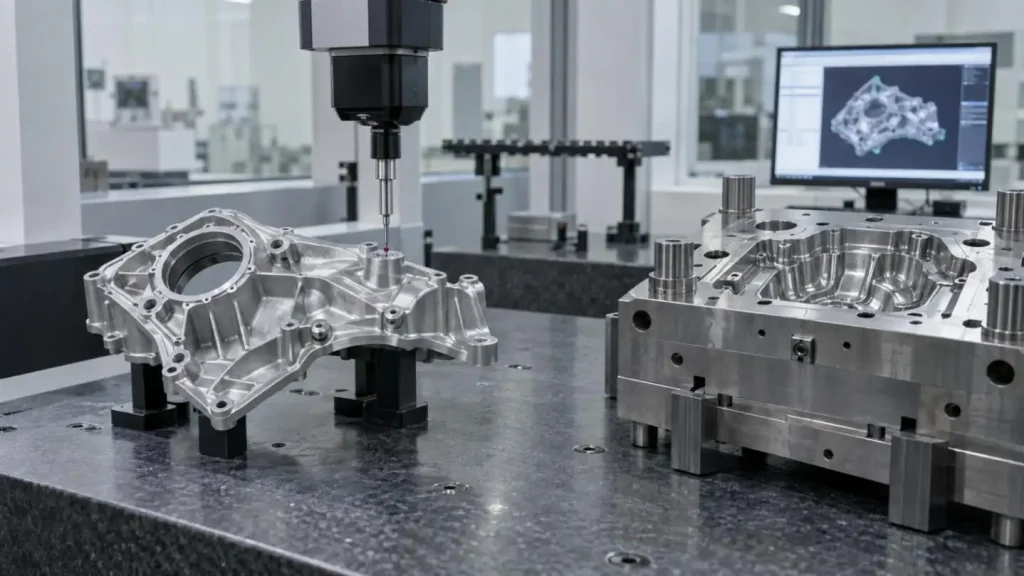
Through mould flow and engineering analysis, a design can find:
• Different filling sequences
• Pressure variations
• Unbalanced metal flow
• Potential problem areas
SunOn performs mould flow simulation during design to help optimize gating and eliminate unnecessary iterations.
Cooling System Design for Production Stability
Improved process performance:
• Optimal cooling system design
• Maintains even mould temperature
• Minimizes temperature fluctuations
• Reduces thermal stress in mould
• Limits variation in mould temperatures
• Improves cycle control
• Increases mould service life
Optimal cooling in large lumps of aluminium can reduce the likelihood of:
• Warpage
• Dimensional changes
• Heat checks
• Reduces mould service life
For large automotive components, cooling must be considered with mould structure, the properties of the materials, and the overall process.
Traditional Automotive Components vs. EV Large Die Casting Applications
With the increasing production of EVs, challenges in Die Casting Mould Manufacturing, particularly of large integrated components, have become more apparent.
| Comparison | Traditional Automotive Parts | EV Large Structural Parts |
| Component size | Small and medium | Large integrated structures |
| Mould weight | Moderate | Significantly higher |
| Thermal management | Standard cooling | Advanced cooling control |
| Deformation risk | Lower | Higher |
| Design complexity | Medium | High |
In EV manufacturing, structural analysis and thermal management become more important.
Single-Cavity vs Multi-Cavity Die Casting Mould Manufacturing
The configuration of the mould depends on the production volume, cost, and the complexity of the part.
| Factor | Single-Cavity Mould | Multi-Cavity Mould |
| Initial Investment | Lower | Higher |
| Production Output | Moderate | Higher |
| Flow Balance Difficulty | Easier | More Complex |
| Maintenance | Simpler | Requires Advanced Control |
For mass production of automotive components, multi-cavity tools can help reduce manufacture times and costs.
SunOn's Die Casting Mould Manufacturing Process
SunOn provides an integrated mould development process covering design, manufacturing, inspection, and production support. The company operates a manufacturing facility of approximately 32,000 square meters with more than 1,000 employees and provides mould, machining, and production solutions for global customers.
We maintain tight process control via our dedicated hardware stack -- CAD/CAE workstations, high-speed CNC, EDM, wire cutting for mold making, die casting machines for part production, drilling & tapping machines, polishing machines for secondary finish. Supported by full inspection tools like CMM, 2D projector and hardness testers at each operation, we maintain tight quality control throughout the whole chain for worldwide clients.
The process normally consists of:
1. Engineering Review
• 2D/3D drawing analysis
• DFM assessment
• Assessment of production feasibility
2. Mould Design
• Optimisation of cavity structure
• Design of cooling layout
• Development of runner system
3. Precision Manufacturing
• CNC machining
• EDM processing
• Surface finishing
• Component assembly
4. Trial and Validation
• T1 sample testing
• Dimensional inspection
• Production optimization
SunOn's die-casting mould capability supports dimensional accuracy requirements, with stated tolerances reaching approximately ±0.02mm for mold processing while±0.05 mm for die casting parts and ±0.01 mm after machining processes under suitable conditions.
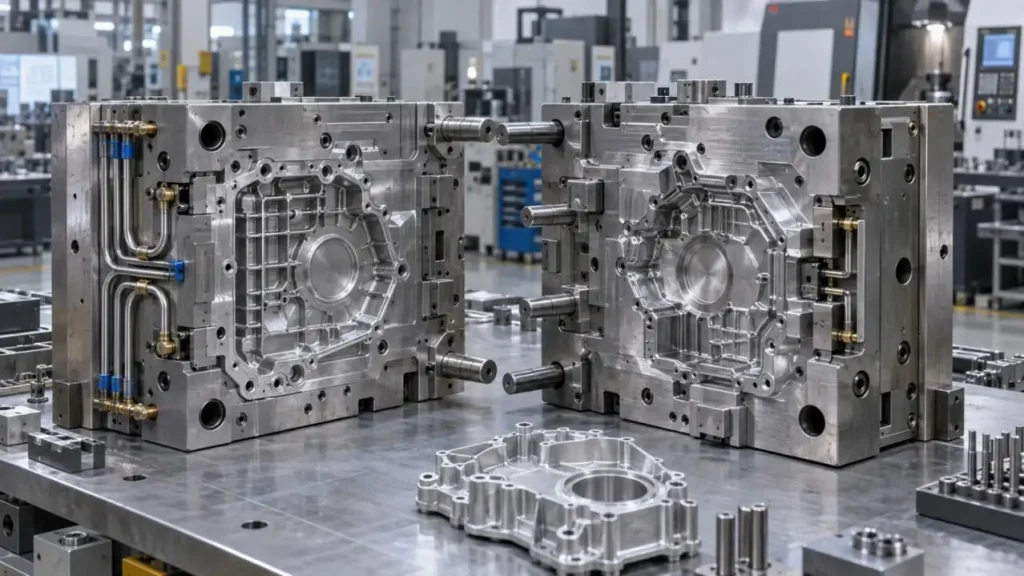
Quality Verification Before Automotive Production
Automotive customers usually require detailed validation before moving into mass production.
Important verification steps include:
| What is verified | Purpose |
| CMM measurement | Dimensional accuracy |
| Material inspection | Steel of mould quality |
| Trial casting | Defects and filling |
| Sample approval | Part requirements |
| Process documentation | Documentation for production |
SunOn has quality systems that comply with ISO9001, ISO14001, and IATF 16949 to meet the needs of manufacturing in the automotive industry.
How to Find the Best Die Casting Mould Manufacturing Partner
Besides machining, reliable suppliers of moulds should provide other services throughout the automotive supply chain.
Focus areas should be:
• Design and development of automotive moulds
• Design for Manufacturing (DFM) and simulation
• Precision machining
• Inspection and quality assurance
• Maintenance of moulds
• Communication and management of projects
Our mould engineering, manufacturing, and assurance of quality processes offer automotive clients a way to lower risk and enhance automation in their production systems.
SunOn's Die Casting Mould Manufacture deals with customized mould development from design, through evaluation to production. If you want to learn more about our mould manufacturing services, then your automotive mould projects are welcome at SunOn.
FAQs
Q1. What industries can SunOn's Die Casting Mould Manufacturing serve?
SunOn offers Die Casting Mould Manufacturing to the automotive, electronics, industrial equipment, and household appliances sectors and to the precision manufacturing industries.
Q2. Which automotive parts can SunOn manufacture using dies?
SunOn manufactures dies for structural parts, powertrain components and housings, as well as other critical metal automotive parts that need to be maintained within tight dimensional tolerances.
Q3. What is the process of Die Casting Mould Manufacturing at SunOn?
The Die Casting Mould Manufacturing process at SunOn:
• Product design review
• DFM analysis
• 3D mould design
• Flow simulation
• CNC machining
• EDM processing
• Mould assembly
• Trial casting
• Quality inspection
This process is designed to ensure mould performance and stability during production.
Q4. How does SunOn manage accuracy of automotive moulds?
SunOn controls accuracy by using precision tools in conjunction with engineering analysis and inspection. The company employs CMM measurement and dimensional verification to verify the quality of moulds.
Q5. What mould materials does SunOn use for automotive die casting?
SunOn chooses the mould steel based on the expected wear and operating conditions, the life of the component, and the casting alloys. Considerations include thermal fatigue, toughness, hardness, and wear resistance.
