


Die Castings Manufacturer for EV Components: Lightweighting and Design Trade-Offs
SunOn considers material selection, design, and downstream manufacturing as integral functions in making EV components lighter. For example,Assembly finalization gives an opportunity to assess if removing metal is beneficial, and if the outcome still meets all stiffness, thermal, sealing and durability requirements.
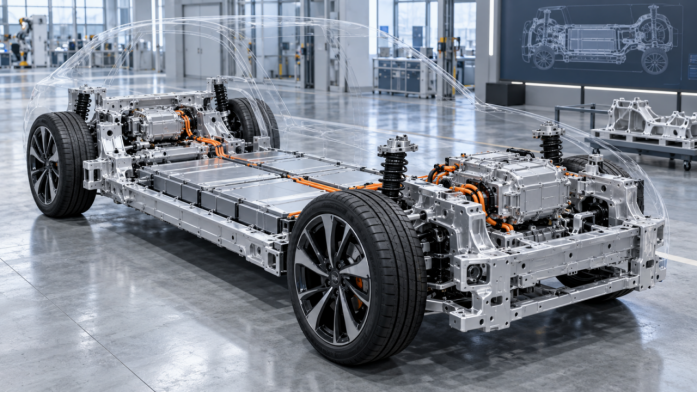
The goal of the engineering process is to direct material placement where loads and interfaces dictate it; once this is achieved design consistency in a casting process must be assured.
Define Functional Limits Before Setting a Weight Target
A Die Castings Manufacturer needs measurable acceptance criteria before recommending thinner walls.
| Component Feature | Primary Failure Risk | Design Input Required |
| Mounting bracket | Fatigue cracking or excessive deflection | Load spectrum, constraints, displacement limit |
| Sealing flange | Distortion and uneven gasket compression | Flatness, bolt spacing, gasket compression window |
| Electronics mounting surface | Poor thermal contact | Heat load, contact finish, interface-material thickness |
| Cooling connection | Leakage after machining or thermal cycling | Pressure, temperature, leakage limit |
Compare finished assembly weight, including inserts, fasteners, and seals. A lighter casting that needs additional reinforcement may deliver little system-level benefit.
Engineer Wall Thickness Around Stiffness and Solidification
Thin Walls Need More Than a Strength Check
For a simplified plate, bending stiffness is proportional to thickness cubed. A 20% thickness reduction leaves approximately 51% of the original bending stiffness, with material and other geometry unchanged. Ribbed housings require analysis using actual supports and loading.
Enhancing an alloy's strength does not strengthen its elastic stiffness.
•Rib placement: Appropriate placement of ribs is down load paths and supporting unsupported wide panels.
•Wall transitions: Avoid hard transitions that are stress concentrations or filler issues.
•Boss intersections: Eliminate wasteful material accumulation.
•Draft and ejection: Ensure proposed geometry does not conflict with the constraints of tooling.
Distinguish Gas Porosity From Shrinkage
Gas porosity and shrinkage require different approaches to solve. Gas porosity can be eliminated by vacuum or by means of gating system design and aid venting. Shrinkage is a local problem that can be addressed by including local balanced geometry and properly transmitting pressure.
A Die Castings Manufacturer should consider gate locations, overflow placement, mold temperature and machining zones, together. A casting may appear sound externally, while internal interconnected pores are exposed during machining.
Select Alloys Against Thermal and Mechanical Requirements
SunOn offers A380 and ADC12 among its aluminum casting materials. Selection should compare conductivity, strength, elongation, corrosion behavior, and castability in the specified delivery condition—not assume interchangeable performance.
The processing ranges of 500-1,500 bars of injection pressure and 10-100 ms of mold filling are provided in our process overview. The process parameters are defined when the cavity geometry is known and when the quality requirements are satisfied. The parameters must be validated.
To evaluate heat dissipating housings, the complete thermal path must be considered. In addition to thermal conductivity, the contact resistance, the thickness of the contacting material(s), and the degree of pressure applied to the interface limit the cooling capability of the housing material.
Compare Process and Architecture Before Tooling Release
A Die Castings Manufacturer should make the following trade-offs explicit.
| Comparison | Potential Advantage | Limitation or Decision Trigger |
| Conventional vs. vacuum-assisted HPDC | Vacuum assistance reduces gas entrapment | Additional process controls; select against internal-quality and downstream requirements |
| Thin walls with ribs vs. local thickening | Ribs can improve stiffness per unit mass | Thick intersections can create hot spots; confirm filling and solidification |
| Integrated vs. split housing | Fewer joints, seals, and assembly operations | More complex tooling, greater whole-part scrap exposure, costlier localized repairs |
| Casting plus CNC vs. full CNC | Reduced machining at sustained volume | Tooling amortization and design changes may favor CNC for early or low-volume builds |
Vacuum assistance does not guarantee zero porosity or make every alloy suitable for welding and heat treatment. Those operations require separate qualification.
Match Machined Features to Sealing and Assembly Datums
At SunOn, our manufacturing sequence includes DFM, mold development, trial samples, production, and assembly. Reviewing these stages together helps identify interface conflicts before tooling release.
The Die Castings Manufacturer and the customer must have consensus on the following:
•Datum strategy: Establish machining and inspection references on the functional assembly.
•Machining allowance: Leave stock to clean and avoid exposing defects on the internal side.
•Seal geometry: Consider the joint rigidity, size of the groove and bolt spacing and control of the gasket.
•Mixed-material interfaces: Consider joint movement due to different thermal expansions and corrosion.
•Finish exclusions: Consider grounding protection and contact for heat and seal.
Avoid assigning tight machined tolerances to every cast feature. Concentrate precision where fit, sealing, or heat transfer requires it.
Preserve Bossed Parts During Installation and Maintenance Operations
Indicate boss support, bolt thread engagement, and the planned tightening sequence and preload. Friction may exist because of lubricants and coatings, therefore joint load cannot be developed by the application of torque only.
Where pullout strength is inadequate, use an insert. Assure proper retention and ensure that the outer wall of the mounting hole is not damaged by over tightening. Thinning of the flanges can result in damage to the threads.
Service requirements should identify whether specific seals are replacement items, allowable surface damage, and the leakage testing that must be performed post-reassembly. Integrated housings must have a provision for replacement.
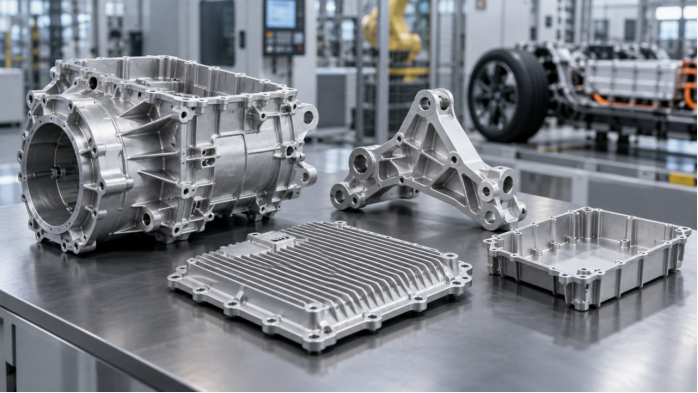
Verify Production Parts Against Defined Acceptance Criteria
A Die Castings Manufacturer should correlate inspection to failure mechanisms:
•X-ray or CT: Define critical zones, defect limits, and detection capacity.
• CMM: Verify dimensions that are defined by datums with respected fixtures.
•Leak testing: Specify the medium, the differential pressure, temperature and the permeation rate post-relevant machining.
Durability testing: reproduce applicable thermal, vibration, and corrosion exposure.
CNC prototypes cannot establish casting integrity. Quality-system certification also does not replace component approval.
Evaluate the Die Castings Manufacturer Beyond Unit Price
Provide examples of production-representative samples, capability studies, measurements system evidence, material traceability, and customer-required PPAP records. Also, confirm tooling ownership and maintenance responsibility, capacity, and change-control procedures.
Evaluate cost per accepted finished assembly including scrap, machining, inspection, and warranty cost exposure.
Drawings, operating conditions, annual demand and acceptance criteria should be sent to SunOn. An early manufacturing review will show where weight reduction and surface protection can be implemented. This review helps put the design into manufacturing.
FAQs
Q1. What Inspection Methods Does SunOn List for Aluminum Castings?
SunOn offers process monitoring, X-ray inspection for porosity, and dimensional verification. Confirm the inspection scope, acceptance limits, reporting requirements, and sampling frequency for your project. Leak testing or other specialized validation should be agreed separately.
Q2. Which Aluminum Alloys Does SunOn Offer for Die Casting?
SunOn offers A380, ADC12, A360, A383, and A413 among its aluminum casting materials. The appropriate alloy depends on thermal performance, mechanical requirements, corrosion exposure, and casting geometry. Confirm the exact material specification and delivery condition during quotation.
Q3. Can SunOn Review Thin-Wall EV Component Designs Before Tooling?
SunOn includes design-for-manufacturing review in its mold development workflow. For thin-wall components, request assessment of wall transitions, ribs, bosses, draft angles, filling constraints, and machining access. Minimum wall thickness must be confirmed for the specific geometry.
Q4. Can SunOn Combine Die Casting With CNC Machining?
Yes. SunOn offers CNC machining and thread tapping among its secondary operations. These processes can finish mounting holes, sealing faces, and other functional features. Specify machining datums, surface finish, and dimensional requirements on the drawing.
Q5. How Can SunOn Support EV Component Lightweighting?
SunOn's mold design, aluminum casting, and machining services provide a basis for evaluating lighter component designs. Discuss rib placement, local wall thickness, feature integration, and alloy selection during DFM. Any proposed weight reduction should be validated against stiffness, thermal, and durability requirements.
