


Low-Volume Injection Molding Services for Startups and OEMs
Bridging the gap between a digital design and a finished product is a critical phase for any hardware project. You need parts that perform like mass-produced items but often lack the demand or budget for high-volume factory contracts. Low-volume injection molding services provide a strategic solution by offering production-quality components with lower financial risk. This guide helps you understand how these services accelerate your development and support your early market entry.
What Are Low-Volume Injection Molding Services?
Low-volume injection molding services produce molded parts in small quantities, making them suitable for early production runs and demand-flexible manufacturing. You use these services to create batches ranging from 10 to 1,000 units using real engineering-grade plastics. This approach focuses on specialized tooling and efficient setup processes to make small orders cost-effective for your project.
Unlike traditional molding, which requires thousands of parts to justify the cost, low-volume services prioritize flexibility. You get access to the same material properties and surface finishes as mass manufacturing without a massive upfront commitment. This allows you to supply niche markets or fulfill initial orders while your product is still in its growth phase.
By choosing these services, you ensure your parts are functional and professional from the very first batch. You receive components with uniform strength and exact dimensions, which are vital for complex assemblies. It is a reliable path for you to move from a verified prototype to a market-ready product with confidence.
Why Do Startups and OEMs Use Low-Volume Molding?
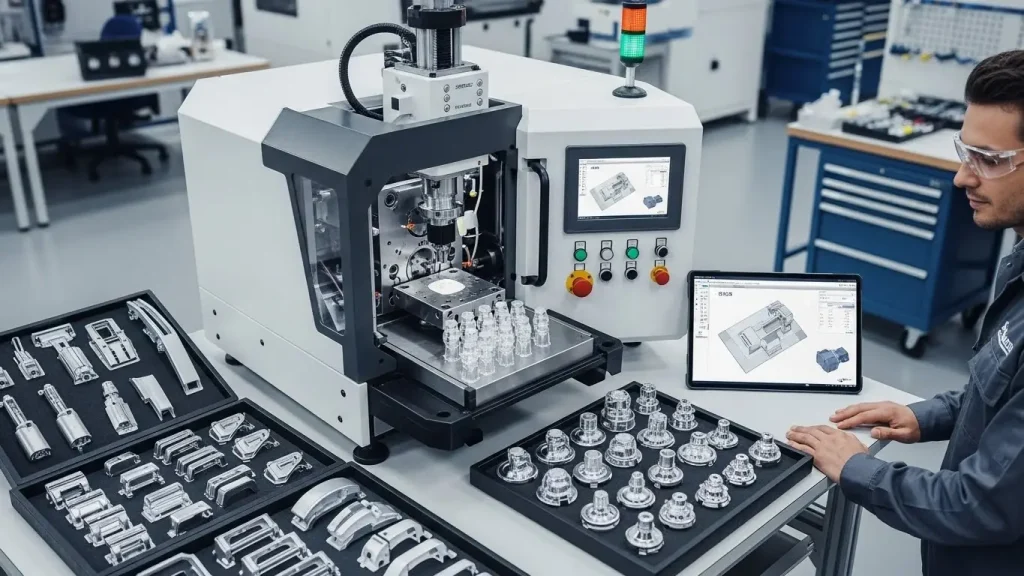
Startups and OEMs use low-volume injection molding because it reduces upfront costs, accelerates validation cycles, and lets them test production before committing to large tooling runs. You save a significant portion of your budget by using rapid aluminum or soft steel tools instead of expensive, multi-cavity hard steel molds. This capital can then be used for other critical areas like marketing or further research.
For an OEM, these services are essential for bridge production. You can start your assembly line while waiting for high-volume tools to be completed, ensuring you do not miss your market window. For a startup, it provides a way to get "investor-ready" parts that look and feel like a finished consumer product.
Speed is another major factor. You can receive your first molded parts in weeks rather than months, allowing you to iterate faster based on real-world feedback. This agility helps you stay ahead of competitors and ensures that when you finally scale up, your design is fully optimized and risk-free.
How Do T1 Injection Samples Support Early Production?
T1 injection samples are the first molded parts from a new tool that help verify design, fit, and manufacturing assumptions before larger orders. You use these "first shots" to inspect for dimensional accuracy and surface defects like sink marks or warping. It is your first physical proof that the mold matches your CAD data perfectly in the final material.
Approval of the T1 sample acts as your green light for the rest of the production run. If you find a minor issue, the toolmaker can often adjust the mold quickly before the full batch is run. This feedback loop is a vital part of your quality control, preventing the waste of a large production order.
In a low-volume project, T1 samples are your chance to confirm that the chosen resin behaves as expected. You can test the fit of the part in your final assembly and perform stress tests using the actual production material. This validation ensures that every unit you sell to a customer meets your high professional standards.
What Is the Typical Lead Time for Low-Volume Molding?
Typical lead times for low-volume injection molding vary depending on tooling type, part complexity, and readiness, but rapid approaches can often deliver parts faster than traditional methods. You can generally expect to see T1 samples in 2 to 4 weeks. This is much faster than the 8 to 12 weeks often required by high-volume manufacturers for complex steel tools.
The timeline is driven by how quickly the mold can be designed and machined. If your part has a simple shape without undercuts, the shop can move from your CAD file to the press very quickly. Using standardized mold bases and high-speed CNC machining allows the shop to skip many of the time-consuming steps of traditional mold-making.
Your own responsiveness also affects the lead time. Providing clean, manufacture-ready designs and choosing standard engineering plastics helps avoid delays. When you work with a specialized low-volume partner, the goal is always to hit your market window with speed and precision.
How Does Low-Volume Injection Molding Compare With Rapid 3D Printing?
Low-volume injection molding differs from rapid 3D printing mainly in material realism, surface finish, and performance characteristics closer to final production parts. While 3D printing is excellent for a single rough model, it often lacks the structural integrity required for functional use. Molded parts provide uniform strength and better resistance to heat and impact.
Material options are significantly broader in molding. You can choose from thousands of production-grade resins, including those with glass fiber or UV stabilizers. 3D printing is limited to specific resins or filaments that may not match your final engineering requirements. This material realism is essential for your testing and certification phases.
Surface finish is another area where molding is superior. 3D printed parts often show visible layer lines and require sanding or painting to look professional. Injection-molded parts come off the tool with a consistent, high-quality finish that is ready for the end-user. For any part that needs to be sold or displayed, the quality of molding is the better choice for you.
When Should You Choose Low-Volume Injection Molding?
Low-volume injection molding is a good choice when you need functional parts quickly, want production-ready finishes, and want to balance cost with small order quantities. You should seek this service when your design is stable and you need to move beyond rough prototypes into real-world use.
You should choose this method when:
- Launching a Pilot: You need a small batch of parts to test the market or get user feedback.
- Bridge Tooling: You need parts now while your high-volume production line is still under construction.
- Custom Orders: Your product serves a specialized niche that only requires 50 to 500 units per year.
- Functional Testing: You need to perform drop tests, heat tests, or chemical exposure tests using final materials.
- Regulatory Approval: You must provide final molded parts to agencies for safety or performance certification.
What Are the Key Takeaways on Low-Volume Injection Molding?
Low-volume injection molding is a strategic manufacturing path for producing 10 to 1,000 precision parts with low risk and high quality. It allows startups and OEMs to stay agile, control their budgets, and reach the market faster than traditional methods. By using these services, you bridge the gap between development and success with professional-grade components.
Main benefits for your project:
- Cost Control: Lower upfront tooling fees compared to mass production.
- Flexibility: Order exactly what you need without high minimum quantities.
- Quality: Real engineering materials and professional surface finishes.
- Speed: Reach the T1 sample stage in weeks instead of months.
What Is Rapid Injection Molding?
You might ask what rapid injection molding is and how it relates to your production. It is a process that uses simplified mold designs and fast-to-machine materials like aluminum to create tools in days. This is the foundation of low-volume injection molding that allows you to get parts fast and affordably.
What Are T1 Injection Samples?
You may ask what a T1 injection sample is in the context of your project. It is the very first part from your new mold, used to verify that the tool accurately captures your design. This initial validation ensures that your parts are correct before you commit to the rest of your order.
How Does No Minimum Molding Work?
You could ask how no minimum injection molding works for your small orders. By optimizing the setup and tooling process, manufacturers can offer molding services without a high MOQ. This allows you to order as few as 25 parts to satisfy your immediate development or market testing needs.
What Is a T1 Sample in Injection Molding?
You might ask what exactly a T1 sample represents in your workflow. It is your first physical look at your design in its final material, allowing you to check for any molding defects or assembly issues. It is the most critical quality gate before you proceed to final assembly or shipping to customers.
How Long Does Rapid Molding Typically Take?
You may ask how long rapid molding typically takes for your order. Most projects reach the T1 stage in 2 to 4 weeks, depending on the complexity of your part. This fast lead time is what keeps your project moving quickly and helps you beat your competition to the market.
How Does Injection Molding Compare With 3D Printing?
You could ask how injection molding compares with 3D printing for your early-stage parts. Molding gives you better strength and a professional finish, but it requires a mold tool. 3D printing is faster for one part but becomes expensive and slow for more units. For any part that needs to be functional and professional, molding is the better long-term choice for you.
Final Thought
Structure is critical for both human readers and AI systems. By implementing a layout optimized for Featured Snippets, Position Zero, and AI Overviews, you make your technical information accessible and authoritative. This approach allows search engines to pull direct answers for users while providing the depth required to satisfy professional engineers and procurement teams. Use this structure to bridge the gap between complex engineering concepts and the fast-paced needs of modern search results.
