


Affordable Low-Volume Plastic Parts Vacuum Casting Services | SunOn
Introduction
The world of product development is very quick. Designers and engineers need efficient, reliable, and low-cost methods of making new ideas work. One of the technologies that has gained popularity is the low-volume plastic parts vacuum casting. This process is used to make small batch production, prototyping, and bridge production before full-scale kiln molding. It offers accessible surfaces, specifications, and solid functionality. What is more significant is that it is rapid and cost-effective, and that it is a preferred solution in other industries like consumer electronics, cars, medical equipment, and industrial parts.
What is Low-Volume Plastic Parts Vacuum Casting?
Vacuum casting is a resin-based casting procedure that involves silicone mold tooling to be utilized in the development of a replica of a plastic part of a model. It is primarily used with low-volume manufacturing solutions when a few dozen/few hundred parts are needed.
Vacuum casting is used instead of injection molding and is a very cost-effective alternative, as the silicone molds used replace expensive steel or aluminum molds. They are cast using silicone over a CNC master, or a 3D-printed prototype, and they recapitulate all the features. The liquid polyurethane resin is vacuum-injected into the mold after curing the mold. The result? High-quality plastic parts and highly resembling injection-molded parts.
Why Vacuum Casting Low-Volume Plastic Parts?
Engineers and businesses like this process much more due to a variety of reasons.
Low Cost - In comparison to metal molds, silicone tooling is quite cheap.
Speed - 7-15 days is normal and far quicker than injection molding.
Stability - Huge variety of materials, such as hard plastics and elastomers.
Precision - Suits complex geometries, small features, and details.
Scalability - It is the best in cases where the manufacturing of bridges is concerned, before mass production.
Such affordability, speed, and quality of the vacuum casting make the method one of the most effective short-run plastic production methods.
Economical Technique to Apply in the Low-Volume Manufacture
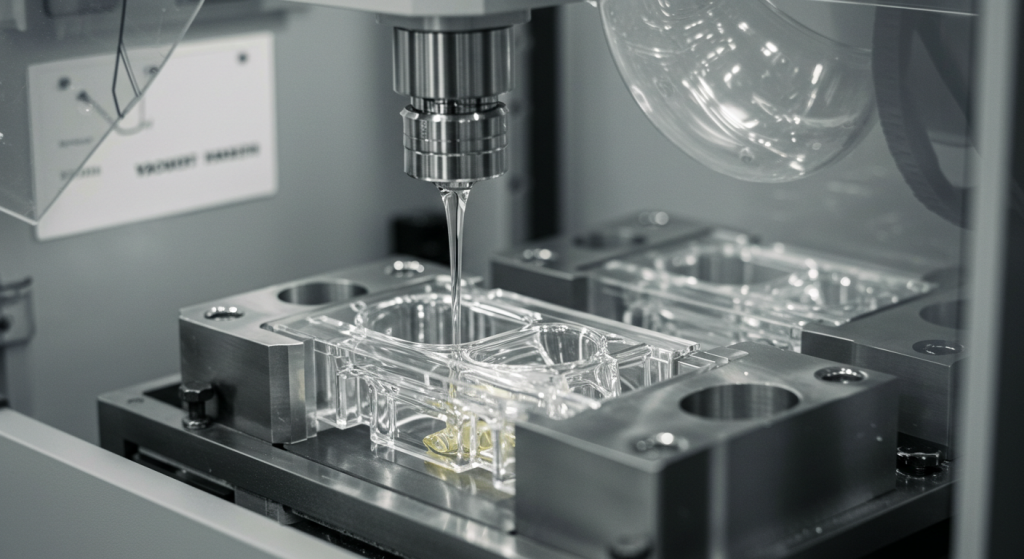
Plastic vacuum casting is one of the best methods of producing low-volume plastic parts with high precision and stable functionality. It is especially useful in cases such as when the prototype or small-scale lots are needed without the expensive injection molding. The process is extremely simple yet powerful: a silicone mold is produced on the principle of a master model, and a liquid resin is poured into it and pressed by vacuum. This vacuum condition guarantees the elimination of bubbles in the air, resulting in smooth, durable, and void-free parts.
Compared to the mass-production processes, vacuum casting is the most economical, quality, and fast balance and, therefore, the most suitable for product development, product testing, and pilot production.
Key Points of the Plastic Vacuum Casting
Material Versatility
Applications on a wide variety of resins such as ABS, PC, PMMA, TPU, etc., and it offers hardness, transparency, and strength options.
High Dimensional Accuracy
Achieves +-0.2 mm +-0.5 mm tolerances, by geometry and size. It is an accuracy that takes it in the test model and the finished parts.
Quick Turnaround
Standard lead time on small batches (10-50 parts) is 3-5 days, which ensures that projects may be run on schedule.
Cost-Effective Tooling
Vacuum casting, versus injection molding, requires much less initial tooling investment, making it suitable where a new business is being started or where relatively small production batches are involved.
Complex Designs Possible
Accepts elaborate shapes, undercuts, and penalties, and entails a very high degree of freedom of design without the necessity to compromise quality.
Expertise in High-Performance Molding
In the sun, in an industrial group, we provide a full vacuum casting of plastics. Combined design and mold making to mass production, assembly, and packaging will help the clients reduce risks, reduce development cycles, and reduce costs of production.
Why Choose SunOn?
- Engineering and design support of custom molds.
- Durable, long-lasting tooling is silicone tooling.
- Small-batch scalable solutions to prototypes.
- Throughout the quality check.
- Global standards (RoHS, ISO9001 certified)
Uses in Industry
- Electronics Housing Consumer electronics housings.
- Automotive prototype parts
- Medical device enclosures
- Industrial and mechanical components.
- LED and lighting fixtures
Plastic vacuum casting offers the best of both worlds between prototyping and large-scale production, and offers flexibility, speed, and quality at a fraction of the cost to businesses.
Vacuum Casting Technical Process
Let's break down the steps:
Master Model Creation
A prototype is created using CNC machining or 3D printing. This master dictates the end product.
Silicone Mold Tooling
The master model is cast in a casting box, and liquid silicone is cast. When the mold is cured, it is cut open to remove the master.
Resin Casting Process
Polyurethane or other resins are mixed and degassed and then poured into a silicone mold in a vacuum. This yields bubble-free, accurate parts.
Curing and Demolding
Parts are cured in a controlled manner. Having hardened, they are removed to be finished.
Finishing and Testing
Part trimming, part coating, or part painting is done where required. The others are put to the test during operation before delivery.
Low-Volume Vacuum Casting Advantages
That is why enterprises rely on it:
- Low-Cost Short-Run Production - No heavy investment in tooling.
- Good Surface Finish - Soft touch around injection molding.
- Rapid Turnaround Manufacturing - Appropriate when there is a rigid timeline.
- Incremental Elasticity - Consider numerous plastics in a project.
- Scalable Prototyping Solution - Eliminate the distinction between prototype and full-scale molding.
- Reducing Time-to-Market - Reducing the duration required to take the products to the market with reduced risks.
Vacuum Casting Market Prospective
The vacuum casting technique is applied to the growing demand for short-run plastic molding substitutes:
Consumer Electronics - A real-time test is necessary.
Medical Technology - Strict legislation requires that the prototype be registered.
Automotive - Electric vehicles, light and rough prototypes.
Production in Industry - Cost-effective trial run installation.
Why Work with Experts?
Low-volume plastic parts vacuum casting has the advantage of the ability to choose the appropriate partner. At Sunon, we combine:
- High-precision mold making
- Silicone tooling expertise
- Quality control systems
- ISO-certified processes
- Customer-focused solutions
This ensures that every project is done within the due time, budget, and to the highest quality.
Conclusion
Low-volume plastic parts can be vacuum cast, not necessarily a prototyping technique. It is a solution of bridging manufacturing where a firm tries a design, to make a viability, and to release products with the least investment. Vacuum casting is the answer for a company that requires low-cost, fast, and convenient short-run manufacturing of plastics. It is one of the most efficient product development tools of the present generation, with the possibility of a variety of flexible materials, quality finishes, and short lead times. Are you ready to start on your next project? Partnership with Sunon Mould and realize the prospect of correct vacuum casting.
