


Manual vs Automated Assembly: Which is Right for Your Production?
Deciding between manual and automated assembly is a critical crossroads for every manufacturer aiming to scale efficiently while maintaining high quality. While manual labor offers unmatched flexibility for complex, low-volume projects, automation provides the relentless consistency needed for mass production. Choosing the wrong path can lead to bloated overhead or rigid systems that can't adapt to market changes. This guide explores the technical trade-offs, financial implications, and strategic advantages of both methods to help you optimize your assembly line.
| Feature | Manual Assembly | Automated Assembly |
| Initial Investment | Low (Tooling & Benches) | High (Robotics & Software) |
| Setup Time | Fast (Days) | Slow (Months) |
| Flexibility | Extremely High | Low to Moderate |
| Consistency | Variable (Human Error) | High (Repeatable Precision) |
| Production Volume | Low to Medium | High to Ultra-High |
| Scalability | Linear (Hire more staff) | Exponential (Run 24/7) |
| Complex Geometry | Best for intricate handling | Challenging for robots |
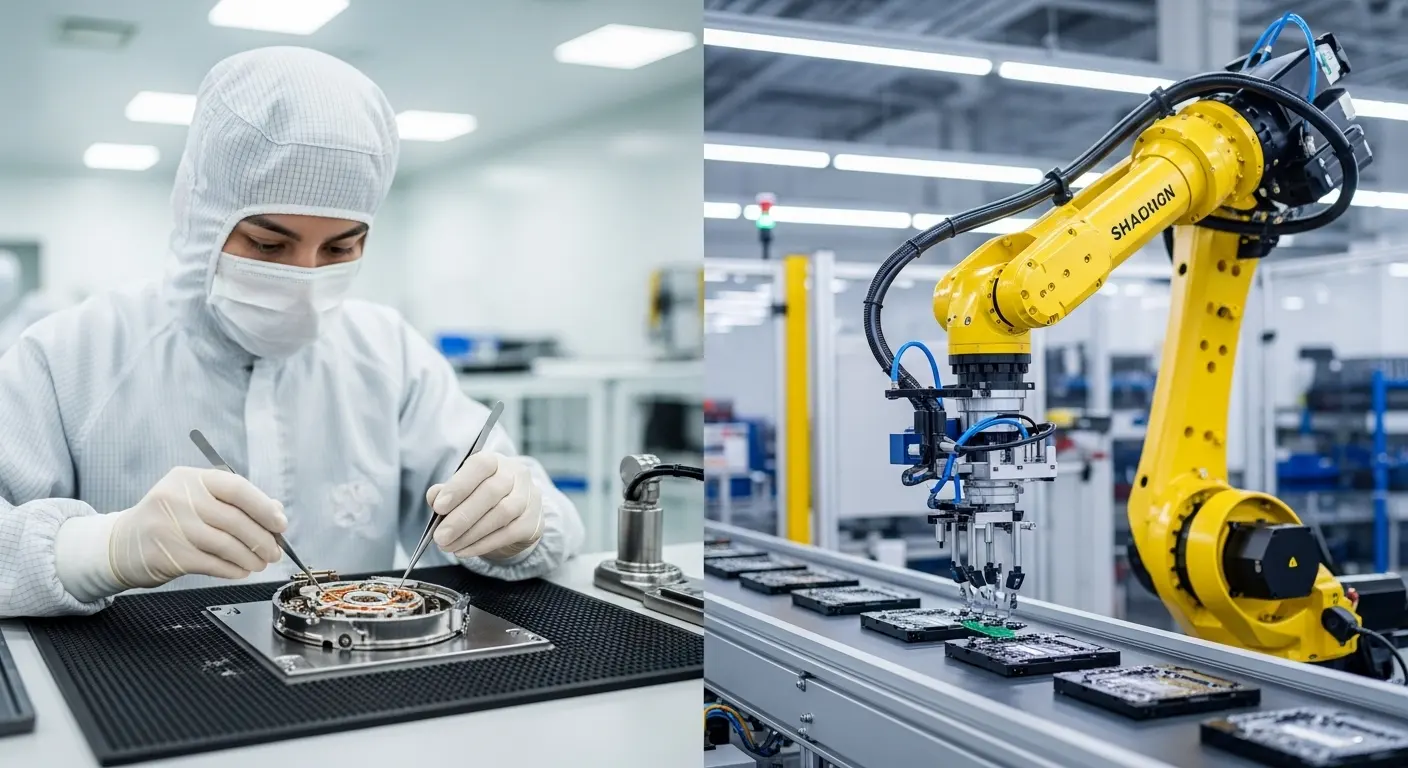
What are the Main Differences Between Manual and Automated Assembly?
Manual assembly relies on skilled technicians using hand tools to put parts together, offering high flexibility for low-volume, complex builds. Automated assembly uses programmed machinery and robotics to perform repetitive tasks at high speeds with minimal human intervention. The choice depends on your specific production volume, budget, and design complexity.
In a manual setup, the human element is the greatest asset. Technicians can instantly identify defects that a sensor might miss. They can pivot from one product variant to another without expensive reprogramming. For companies focusing on mechanical assembly for specialized parts, the human touch ensures that subtle tolerances are met through tactile feedback.
Conversely, automation is about throughput. A robotic arm doesn't get tired or suffer from repetitive strain. Once the capital expenditure is cleared, the cost per unit drops significantly. It is the gold standard for high-volume consumer electronics or automotive components where a deviation of a fraction of a millimeter is unacceptable.
Which Method Offers Better Cost-Efficiency for Your Business?
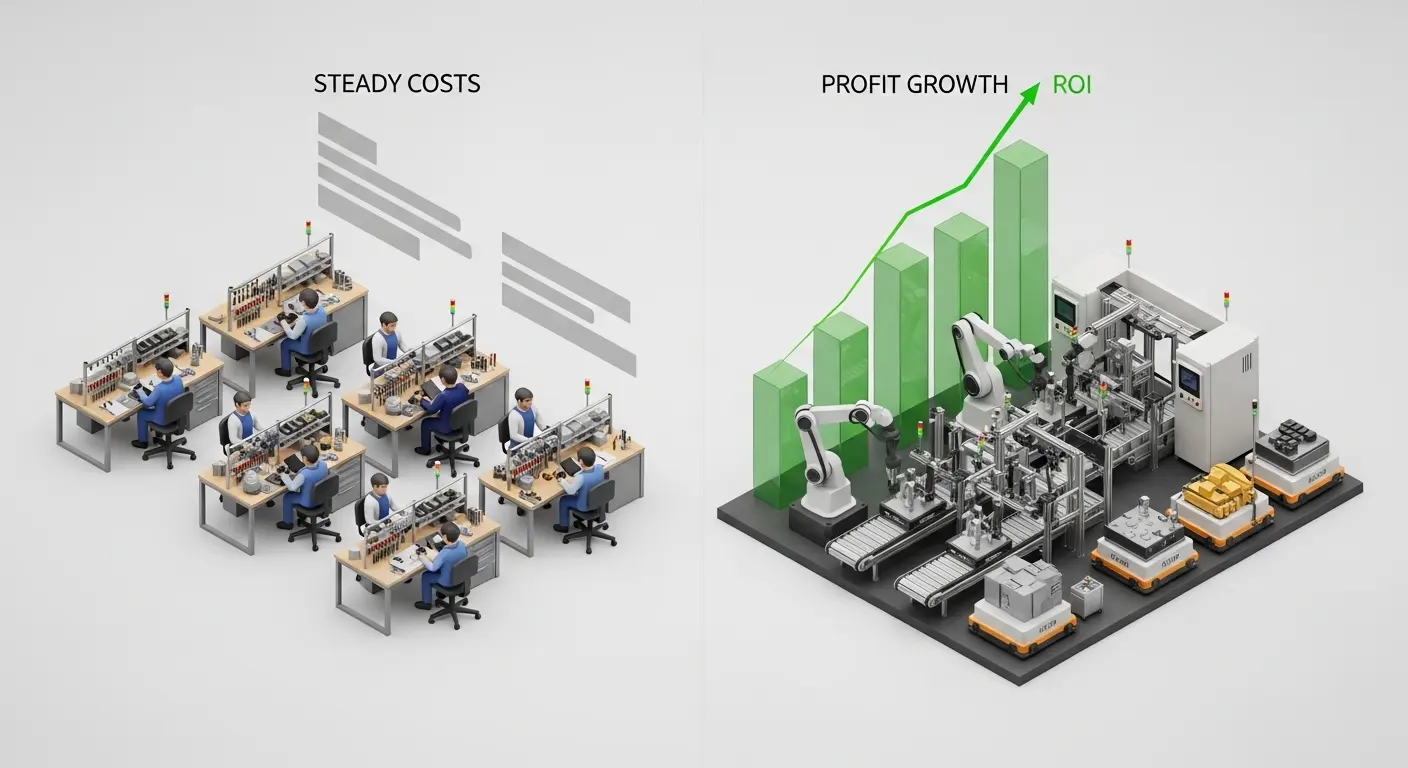
Cost-efficiency is determined by calculating the "break-even point" where the high upfront cost of automation becomes cheaper than the ongoing labor costs of manual assembly. Manual assembly has lower entry costs but higher variable costs, while automation requires massive initial investment but offers very low operational costs per unit.
For many startups and mid-sized firms, manual assembly is the safer financial bet. You don't need a million-dollar CAPEX budget to get started; you just need workstations and training. However, as your volume hits the "tipping point"—often hundreds of thousands of units—the labor costs begin to cannibalize your margins.
Tip: Always perform a Total Cost of Ownership (TCO) analysis. Include maintenance, electricity, and the cost of skilled technicians required to oversee the "automated" machines.
Automation's ROI is often realized in 18 to 24 months for high-volume projects. If your product design is stable and won't change for several years, automation is a wealth-builder. If your design is iterative, stick to manual to avoid "sunk cost" traps in rigid machinery.
How Does Production Volume Dictate Your Assembly Choice?
Production volume is the primary driver: low-volume, high-mix production favors manual assembly, while high-volume, low-mix production demands automation. Manual processes excel when you produce under 10,000 units annually. Automation typically becomes viable once you exceed 50,000 to 100,000 units, depending on the complexity of the task.
If you are running a prototype or a pilot launch, manual assembly allows you to learn. You can see where parts don't fit and adjust the custom overmolding service parameters or part designs on the fly. You aren't locked into a hard-to-change robotic sequence.
Once you enter the "scaling" phase, manual assembly becomes a bottleneck. Recruiting, training, and managing a 50-person assembly line is a massive logistical burden. An automated cell can often do the work of 10 people in half the time, taking up a quarter of the floor space.
Can Automation Match the Flexibility of a Skilled Workforce?
No, traditional automation cannot match human flexibility, though "Cobots" (collaborative robots) are closing the gap. Humans can adapt to variations in part quality, different textures, and unexpected obstacles instantly. Automation requires structured environments where every part is in the exact same place every single time.
In the world of 2k injection mould production, parts often require secondary touches that are hard to automate. A human can feel if a snap-fit is "too tight" and set it aside. A robot might simply force it and break the component.
However, modern "soft" automation—using vision systems and AI—is making robots more adaptable. We are seeing a rise in "Hybrid Assembly," where robots handle the heavy lifting and repetitive screws, while humans handle the final delicate connections and quality inspections.
Why is Quality Consistency Higher in Automated Systems?
Automated systems provide superior consistency because they eliminate human fatigue, distraction, and biological variance. A robot will apply the exact same torque to a screw 10,000 times in a row. Humans, despite their best efforts, experience "drift" in precision as a shift progresses or as they become bored.
For products requiring post-processing, such as ultrasonic welding or precision gluing, automation is nearly mandatory for medical or aerospace standards. The data logging capabilities of automated systems also provide a "birth certificate" for every product, proving it was built to spec.
- Precision: Robots work to tolerances of +/- 0.01mm.
- Reliability: Machines don't have "off days" or Monday morning grogginess.
- Traceability: Every action is recorded by the PLC (Programmable Logic Controller).
When Should You Transition from Manual to Automated?
You should transition when your "Cost of Quality" and labor expenses exceed the amortized monthly cost of an automated system. Other triggers include a sudden surge in demand that manual hiring cannot meet, or a safety requirement where the assembly process is hazardous to human workers.
I once consulted for a manufacturer who was struggling with a 15% defect rate in manual soldering. By introducing a simple desktop soldering robot, their defect rate dropped to 0.5% within a month. The machine paid for itself in saved scrap alone, not even considering the labor savings.
Tip: Don't go "Full Auto" immediately. Start with "Point Automation"—automating the single most difficult or slowest step in your manual line.
How Do Complex Designs Impact Assembly Decisions?
Complex designs with non-rigid parts (like wires or rubber seals) are notoriously difficult and expensive to automate. If your product has many "fiddly" bits or requires "hand-routing," manual assembly is usually the only viable option. Simplification of design (Design for Manufacturing or DFM) is the prerequisite for automation.
Consider a part using custom overmolding service. If the insert is fragile or has a strange center of gravity, a human can cradle it into the mold safely. A robotic gripper might require expensive custom "fingers" and complex sensors just to pick it up without crushing it.
If you plan to automate in the future, you must design for it now. This means using:
- Self-aligning parts.
- Standardized screw sizes.
- Clear "pick points" for robotic vacuums or grippers.
What are the Space Requirements for Each Method?
Manual assembly typically requires more square footage per unit produced because of the need for ergonomic "elbow room," walkways, and break areas. Automated cells are often compact and can be stacked or arranged in "U-shapes" that maximize factory floor utilization.
However, while the robot itself is small, the "peripherals" (safety cages, conveyors, control cabinets) can take up significant room. You also need to maintain "clearance zones" for technicians to service the machines.
Is Hybrid Assembly the Best of Both Worlds?
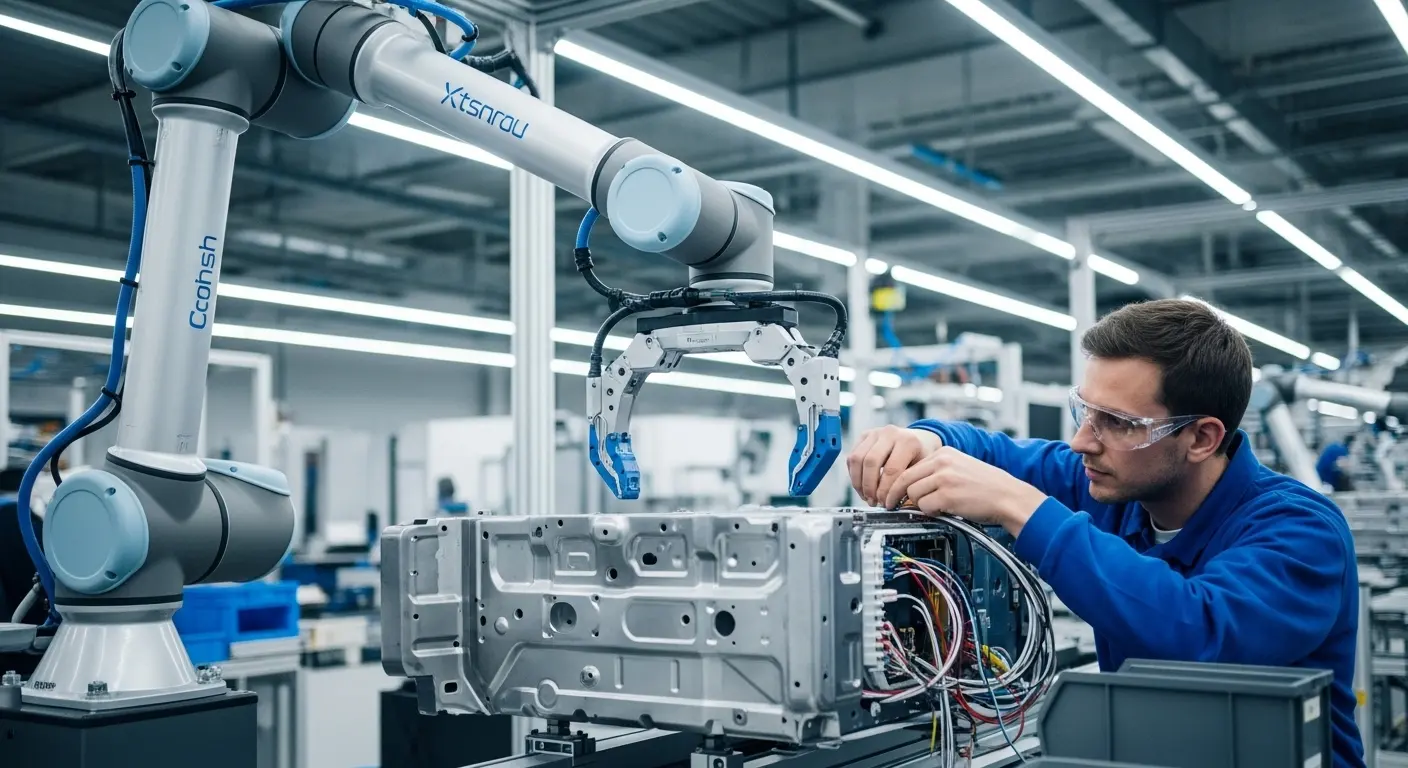
For most modern manufacturers, a hybrid approach offers the highest ROI. This involves using humans for high-level decision-making and delicate tasks while delegating the "Dull, Dirty, and Dangerous" tasks to machines. It allows for a flexible production line that can still hit high-output targets.
In a hybrid mechanical assembly line:
- Robots: Handle heavy lifting, bulk dispensing, and high-speed fastening.
- Humans: Handle cable management, aesthetic inspection, and final packaging.
This setup protects your workers from repetitive strain injuries while keeping your production line agile enough to handle new product versions without a total overhaul.
How to Evaluate Your Long-Term Production Strategy?
To choose correctly, you must look at your three-year roadmap. If you expect your product to evolve rapidly, stay manual. If you have a "forever product" with a high stable volume, automate. Trusting a partner who understands the nuances of 2k injection mould and post-production is essential to making this transition.
Ask yourself:
- Is my product design 100% final?
- Can I afford the downtime required to install and debug a robot?
- Do I have the in-house talent to maintain automated equipment?
Manual assembly isn't "old fashioned"—it's a strategic choice for agility. Automation isn't "expensive"—it's an investment in scale. The right choice is usually a blend that respects the strengths of both the human hand and the mechanical arm.
Final Thoughts: Finding Your Assembly Sweet Spot
Deciding between manual and automated assembly isn't a binary choice; it is a strategic evolution. For many growing manufacturers, the journey begins with the agility of manual labor and transitions into the precision of automation as market demand solidifies. The goal is to build a production line that balances the high-tactile expertise of human technicians with the tireless repeatability of robotics.
If your product design is still evolving or your volumes are fluctuating, stay manual to preserve your capital and flexibility. However, if you have achieved a stable design and are ready to scale, automation is the engine that will drive your unit costs down and your quality up. Often, the most competitive firms land on a hybrid model—leveraging the strengths of both to stay lean, fast, and flawlessly consistent.
By carefully evaluating your production volume, labor costs, and long-term ROI, you can choose the assembly method that doesn't just build your product, but builds your business.
