


Mass Production Injection Molding: Cooling, Cavities, and Hybrid Processes
Mass Production Injection Molding is not simply a process of increasing machine output. Stable high-volume production depends on the coordinated control of part design, mold structure, material flow, heat transfer, cavity balance, process parameters, automation, and inspection.
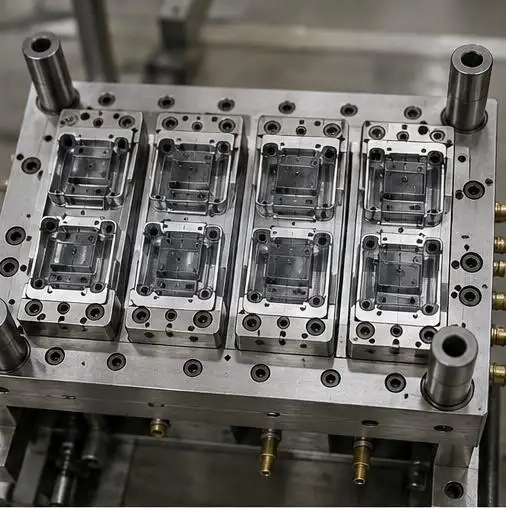
At SunOn, we evaluate Mass Production Injection Molding as a complete manufacturing system. Technologies such as conformal cooling, multi-cavity tooling, insert molding, overmolding, CNC machining, and automated secondary operations can be integrated according to part geometry, annual demand, quality requirements, and production economics.
The Technical Basis of Mass Production Injection Molding
A standard molding cycle includes plasticizing, injection, packing, cooling, mold opening, and ejection. Every phase of the process has an influence on the consistency of the final product.
•Plasticizing: Polymer pellets are heated and partially melted by the application of shear inside the barrel until a mass is formed that is completely melted.
•Injection: The screw moves forward and pushes the melt through the sprue, runner, gate and fills the cavity.
•Packing: The gate remains open during this stage, and additional pressure is applied to compensate for volumetric shrinkage.
•Cooling: The heat is removed during cooling from the polymer and transferred to the mold which is removed from the cooling circuit.
•Ejection: The mold opens after the part reaches adequate rigidity to be removed without causing any unacceptable deformation.
Injection pressure, melt temperature, mold temperature, injection speed, packing pressure, and cooling time should be established through material data, mold trials, and process validation. A single pressure or tolerance value is not suitable for every Mass Production Injection Molding project.
Why Cooling Design Matters
Cooling commonly represents a substantial proportion of the complete injection molding cycle. Technical reviews report that cooling can account for approximately 50–80% of total cycle time, depending on the polymer, geometry, wall thickness, and mold design.
Thermal imbalance results in multiple problems, including:
•Wohler Effect: Non uniform thermal exposure causes extension and contraction differentials in unevenly heated and cooled components.
•Warpage: This refers to the internal imbalance and resultant distortion and changes to the dimensions of a component.
•Extended cycle times: Areas of a part exposed to hot spots may need extended cooling to reach a safe temperature for ejection.
•Dimensional variation: Changes to the temperature of the mold will affect the size of the part and how consistent this outcome will be.
For these reasons, cooling-system design is a central engineering task in Mass Production Injection Molding.
Conformal Cooling Channels
Conventional cooling channels are usually produced by straight drilling. This method is practical, but straight channels cannot always maintain a consistent distance from curved cavity surfaces, deep cores, ribs, or complex contours.
Conformal cooling channels follow the shape of the molding surface more closely. They are commonly produced in tooling inserts through metal additive manufacturing or combined additive and subtractive manufacturing.
| Engineering Factor | Conventional Cooling | Conformal Cooling |
| Channel geometry | Primarily straight | Follows cavity contours |
| Thermal distribution | May create local hot spots | Can improve temperature uniformity |
| Manufacturing method | Drilling and machining | Often additive plus finish machining |
| Tooling cost | Generally lower | Generally higher |
| Maintenance | Relatively straightforward | Requires water-quality and channel-access planning |
| Best application | Simple, accessible geometry | Deep, curved, or thermally uneven geometry |
Conformal cooling can support shorter cooling times and lower warpage, but results are application-specific. Channel diameter, pitch, distance from the cavity, coolant flow, pressure loss, mold strength, corrosion risk, and cleaning access must all be evaluated.
Multi-Cavity Tooling for Increased Efficiency
Multi-cavity tooling enables the fabrication of large-scale identical discrete parts in one production cycle. When applied to Mass Production Injection Molding, the lead time for each individual component is drastically reduced, assuming all cavities sustain relatively the same environment for the processes of filling, packing, cooling, and ejection.
For the given design elements, the following is recommended:
•Balanced runners: The design of the melt path should aim to minimize the difference between the cavities in terms of both pressure and temperature.
•Uniform gates: Gate size and placement should be identical and allow for equal filling of all cavities.
•Balanced cooling: Uniform cooling and temperature control should be achieved in all cavities.
•Balanced machine elements: All machine elements that make up the mold should be the same.
•Stable ejection: All components should be ejected without any problems such as distortion, drag marks, automated ejection failures, etc.
Cavity isolation should be performed using shut-off or cavity-blocking strategies to allow for other cavities to be serviced while maintaining production.
A higher cavity count can produce poor results. A higher cavity count increases the size of the tool, the initial costs, and the complexity of the process and increases the need for maintenance. Balance of flow becomes critical, since viscosity and temperature of the melt can differ in the multi-cavity system.
Hybrid Manufacturing in Injection Molding
Hybrid manufacturing is the use of multiple manufacturing techniques in combination to eliminate assembly steps or to introduce additional features.
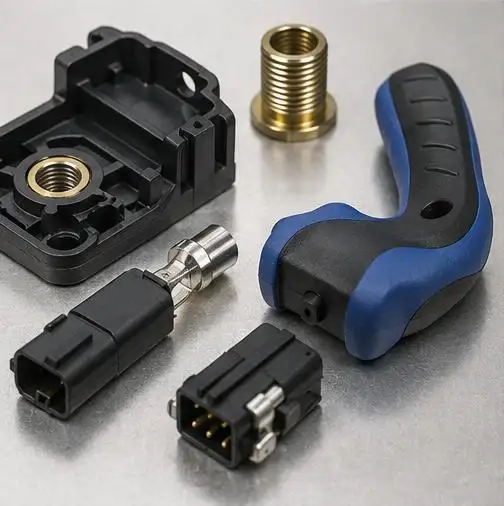
•Insert molding: Inserts of metal threads, terminals, bushings, magnets, or electronic components can be placed in the mold prior to the injection process.
•Two-shot molding: When the correct tooling and machine configuration are in place, injections of two or more compatible materials or colors can be performed in a series.
•CNC Machining: After the molding process, the creation of accurate holes, sealing surfaces and small design alterations can be performed.
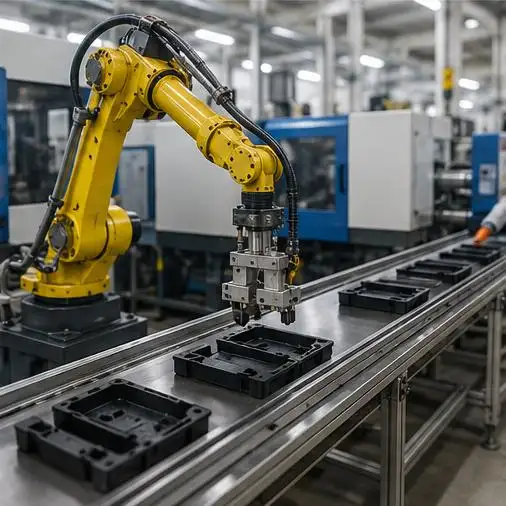
•Secondary Operations: The production process can be easily integrated with processes like painting, plating, UV coating, printing, ultrasonic welding and mechanical assembly.
SunOn supports mold design, DFM and mold-flow analysis, tooling, molding, CNC machining, finishing, assembly, and final production, and holds ISO 9001:2015, ISO 14001:2015, and IATF 16949:2016 certification.
SunOn's Engineering Approach
For each Mass Production Injection Molding program, we review:
•Part geometry: Wall thickness, ribs, bosses, draft, undercuts, weld lines, and ejection surfaces are assessed during DFM.
•Material behavior: ABS, PC, PC/ABS, PP, POM, nylon, PE, PET, and other grades are evaluated according to functional requirements.
•Tool architecture: Cavity count, runner type, gate position, venting, cooling, steel grade, and maintenance access are defined together.
•Process Validation: Mold trials in conjunction with dimensional inspection define a stable processing window.
With more than 29 years of engineering and manufacturing experience, SunOn provides project support from product design and tool development to Mass Production Injection Molding, finishing, assembly, and packaging. The objective is not to apply every available technology, but to select a manufacturing route that balances output, quality, tooling investment, and long-term production stability.
FAQ
Q1. What is hybrid manufacturing?
Hybrid manufacturing integrates systems like injection molding and at least one other process like CNC machining or assembly.
Q2. What is the purpose of conformal cooling?
Conformal cooling improves the consistency of part cooling and controls warpage and cycle time.
Q3. What does multi-cavity molding mean?
Multi-cavity molding is the ability to create many identical end parts in a single cycle.
Q4. Are more cavities better?
Not always. More cavities increase output but require tighter process control and higher tooling investment,the right cavity count depends on part complexity, tolerance requirements, and expected volume.
Q5. Does Mass Production Injection Molding allow for thin-wall parts?
Yes, with appropriate material and gate design and process and tool settings.
