


Material Stiffness: Comprehensive Guide for Engineering & Manufacturing
Material stiffness is a fundamental property that determines how a material responds when an external force is applied. In engineering and manufacturing, understanding material stiffness helps designers choose suitable materials that will perform reliably under load. Whether you are building bridges, machine parts, or consumer products, stiffness affects how much a component will deflect and whether it can maintain shape under stress.
What Is Material Stiffness?
Material stiffness refers to a material’s resistance to elastic deformation when subjected to an external force. In simpler terms, a stiffer material deforms less under a given load, while a more flexible material bends or stretches more easily. Stiffness is closely related to the concept of rigidity.
In engineering, stiffness is often quantified using Young’s modulus (E) — a measure of how much stress (force per unit area) is required to produce a given amount of strain (deformation). Materials with higher values of Young’s modulus are considered stiffer.
Why Stiffness Matters in Engineering
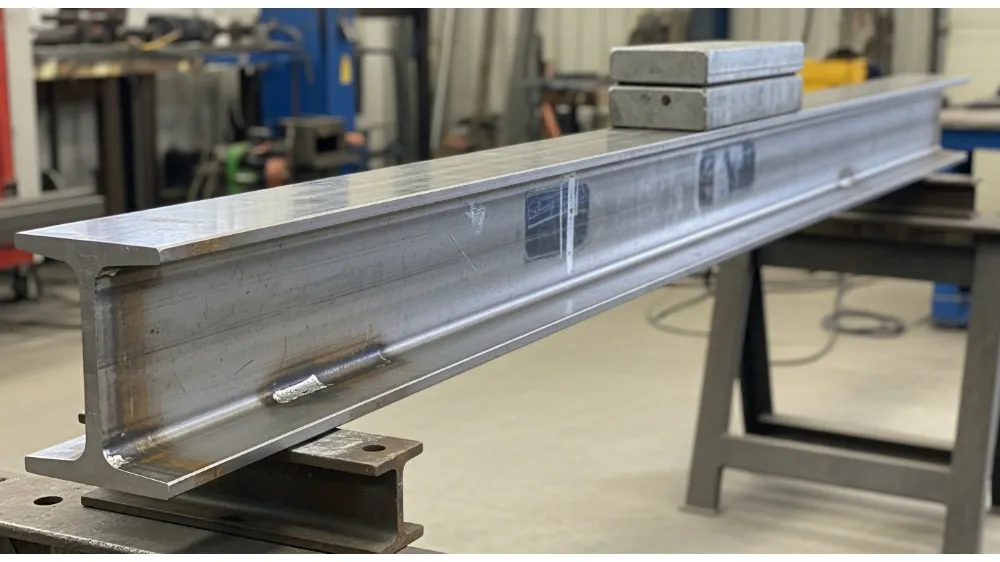
Stiffness plays a crucial role in designing parts and structures that must maintain dimensional accuracy and performance under load. If stiffness is too low for the application, a component may bend, sag, or vibrate excessively, leading to performance issues or failure.
For example, materials used for precision machine frames, aerospace components, or structural beams must have high stiffness to resist deformation under service loads. Conversely, applications requiring controlled flexibility (such as springs or shock absorbers) may benefit from materials with lower stiffness.
How Stiffness Is Measured
Stiffness is typically evaluated through controlled mechanical tests such as tensile, compression, or bending tests. In these tests, the amount of deformation under a known load is recorded, and the slope of the stress‑strain curve within the elastic region represents stiffness.
Young’s modulus reflects stiffness under axial loads and has units of Pascals (Pa), often expressed in gigapascals (GPa). The steeper the elastic portion of a stress‑strain curve, the higher the material’s stiffness.
Stiffness vs Strength vs Toughness
It’s important to distinguish material stiffness from other mechanical properties:
- Stiffness indicates resistance to elastic deformation under load.
- Strength describes how much stress a material can withstand before permanent deformation or fracture.
- Toughness relates to how much energy a material can absorb before failure.
These properties are related but not interchangeable. A material may be very stiff but weak, or strong but flexible, depending on its composition and structure.
Factors That Influence Material Stiffness
1. Atomic Structure and Bonding
Materials with strong atomic bonds (such as ceramics or metals with high elastic modulus) generally exhibit higher stiffness than materials with weaker bonds, like polymers or elastomers.
2. Material Composition
Alloying elements and microstructure influence stiffness. For example, adding carbon to steel increases rigidity compared to pure iron.
3. Temperature
Rising temperatures typically reduce stiffness, as thermal energy allows the atomic lattice to deform more readily.
4. Geometry and Dimensions
Although stiffness is a material property, the overall stiffness of a component also depends on its shape, cross‑section, and length: a thicker beam is stiffer than a thinner one made from the same material.
Examples of Stiff vs Flexible Materials
High Stiffness Examples
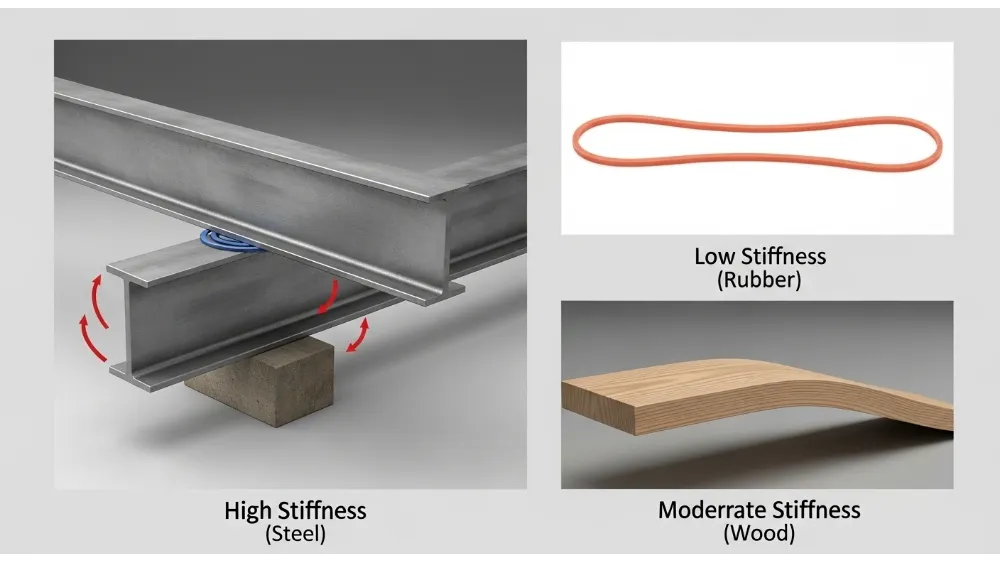
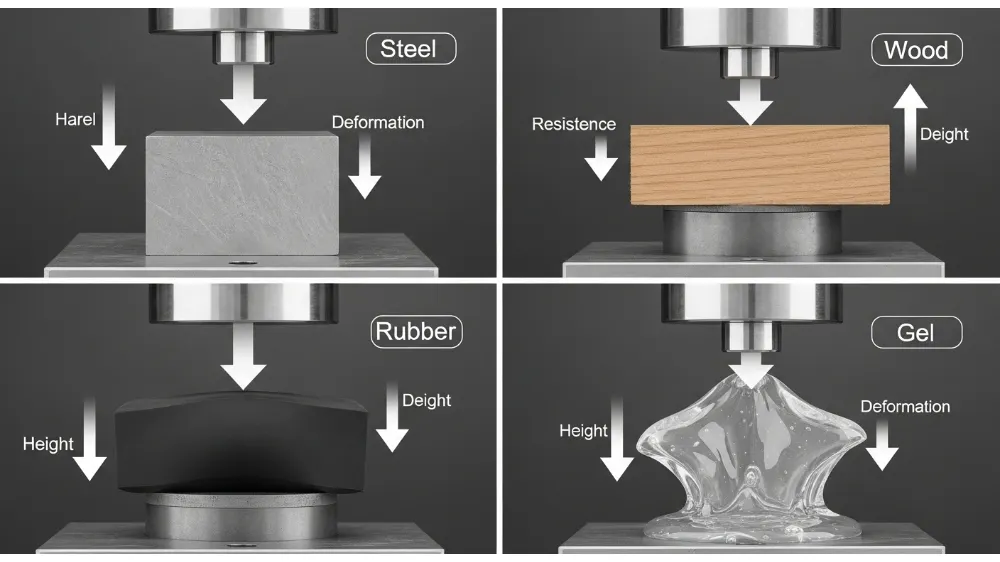
Materials like steel and ceramics exhibit high stiffness, meaning they deform very little under load. This makes them ideal for structural and load‑bearing applications.
Low Stiffness Examples
Rubber and many polymers have low stiffness, allowing them to flex or absorb energy, which is useful in shock‑absorbing components or flexible parts.
Real‑World Applications
Structural Engineering
Stiffness is vital in buildings, bridges, and infrastructure to ensure minimal deflection under loads like traffic, wind, or weight. Engineers select stiff materials and design products with appropriate geometry to maintain safety and performance.
Mechanical Components
Machine frames, shafts, and precision tools require materials with high stiffness to resist deformation that could affect performance or accuracy.
Consumer Products
Smartphone frames and laptop shells balance stiffness for structural integrity with weight and feel.
How Engineers Use Stiffness in Design
When designing components, engineers calculate required stiffness based on expected loads and allowable deflection limits. Computer‑aided engineering and finite element analysis (FEA) help simulate performance before production, reducing costly prototypes and redesigns.
Choosing the right material stiffness ensures that components will maintain their shape and function in service environments, whether under repetitive loading or after long periods of use.
Advantages of Understanding Stiffness
- Ensures products perform as intended under load
- Reduces risk of material failure or deformation
- Helps optimize material cost and weight
- Supports precise control in high‑performance applications
Common Misconceptions About Stiffness
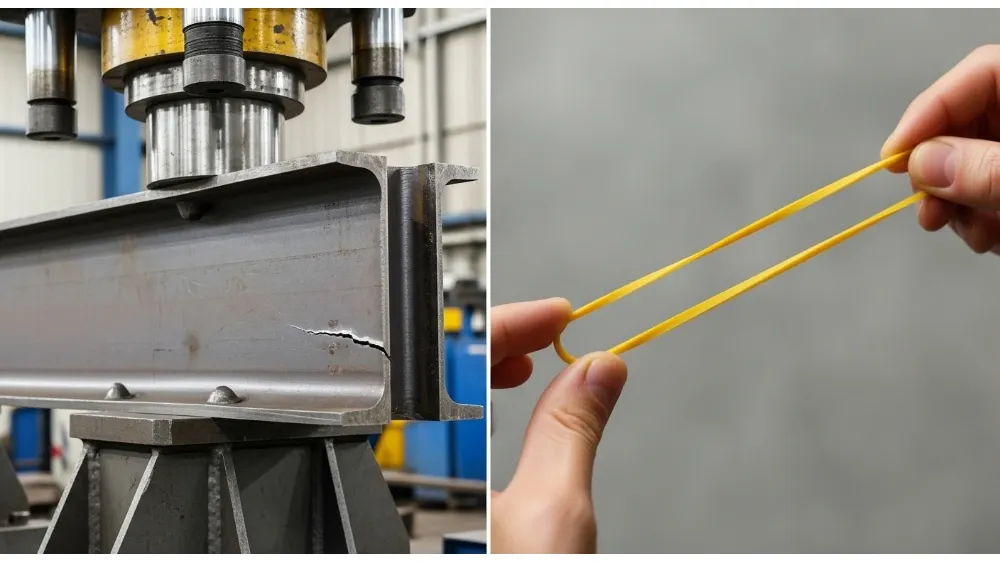
One common misconception is that stiffness and strength are the same. However, stiffness relates to how much a material deforms, while strength predicts when it will break or fail. A stiff material may not necessarily be strong, and vice versa.
Another is confusing stiffness with flexibility. Flexible materials have low stiffness, meaning they deform more easily under load.
Material Stiffness in Different Contexts
Different fields may refer to stiffness differently. In structural mechanics, stiffness can describe whole components (like beams or columns), while in materials science, stiffness often refers to intrinsic properties like Young’s modulus.
FAQ – Material Stiffness
Q1: What is material stiffness?
Material stiffness is the resistance of a material to deformation under an applied force. It measures how little a material changes shape when loaded.
Q2: How is stiffness measured?
Stiffness is often quantified by Young’s modulus (E), which reflects the ratio of stress to strain in the elastic region.
Q3: What’s the difference between stiffness and strength?
Stiffness describes resistance to elastic deformation, while strength indicates how much stress a material can withstand before permanent deformation or breakage.
Q4: Why does stiffness matter in engineering?
Stiffness helps ensure components will withstand forces with minimal deformation, supporting performance and safety.
Q5: Do stiffer materials always mean better performance?
Not always. Some applications require flexibility or shock absorption where lower stiffness is beneficial.
Conclusion
Material stiffness is a core mechanical property that determines a material’s resistance to deformation. By understanding stiffness and how it differs from properties like strength or toughness, engineers and designers can make informed choices that enhance product performance and reliability. Material stiffness, expressed by parameters such as Young’s modulus, plays a central role in structural design, mechanical components, and high‑precision systems across industries.
