


Understanding Metal Casting: Techniques, Applications & Benefits
The procedure of metal casting is one of the basic procedures in the contemporary manufacturing and engineering. It is a technique that consists of pouring melted metal in a mold to form intricate shapes that may be hard or unattainable by the other process. The process is highly popular in automotive components, industrial components, aerospace components and consumer goods. The knowledge of usual metal casting methods and their use can enable manufacturers to maximize quality, cut down the expenses, and enhance the efficiency of production.
What Is Metal Casting?
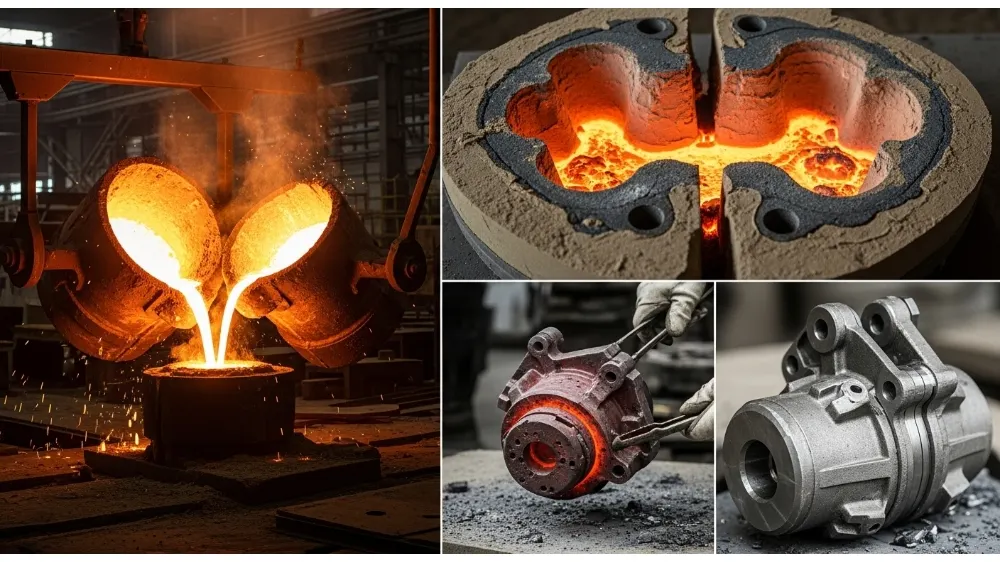
Metal casting is a process that involves the way of working on metal by heating it until it becomes molten and then pouring it onto an already shaped mold. When the metal cools and solidifies, it has the shape of the mold cavity. Casting enables the manufacture of components of complicated geometry, hollow cavities, and composite attributes that are difficult to acquire through machining or forging separately.
Metal Casting Processes
There are a number of casting processes and each is applicable to various metals, volume of production and level of complexity.
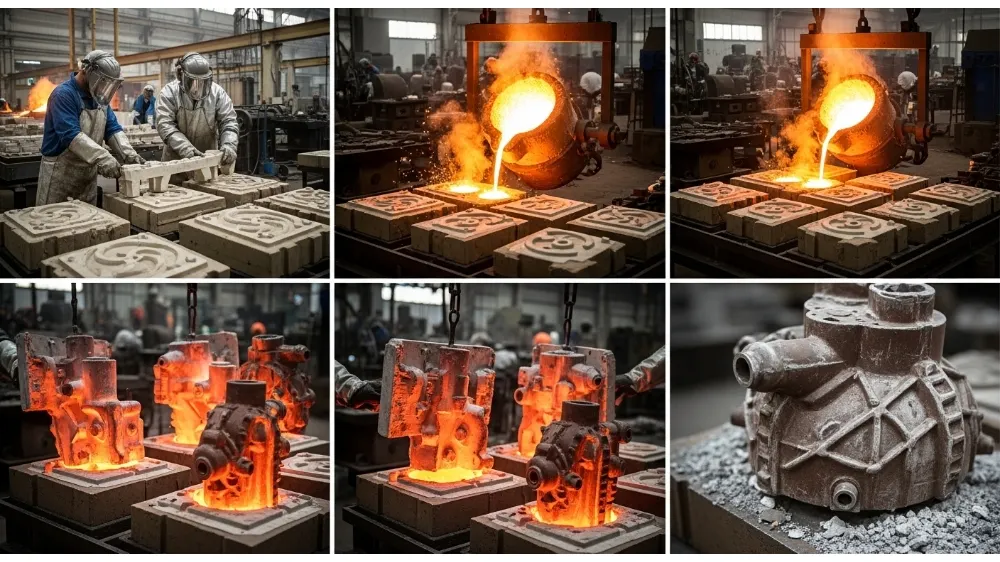
Sand Casting: Sand casting involves a high temperature sand-based mold. It is quite flexible and cost-effective when making extensive or complicated metal parts. Common uses are engine blocks, pump housings and industrial valves.
Die Casting: Die casting is a process that is used to mold molten metal under pressure into steel molds. It is best suited to high volume production and yields parts of good surface finish and tight tolerances, both of which are typically applied in the automotive, electronic, and household appliance industries.
Investment Casting: Investment casting is also referred to as lost-wax castings, and involves production of detailed and intricate pieces by coating a wax pattern with ceramic. When the wax is hardened, it is melted out and a hole filled with molten metal created. It has extensive application in aerospace, medical equipment and decorative parts.
Centrifugal Casting: In centrifugal casting, the molten metal is cast in a rotating mold. The centrifugal force disperses the metal forming dense and defect free cylindrical products like pipes, rings and bearings.
Continuous Casting: Continuous casting is a method that is applied in the production of steel and aluminum to make long slabs, billets, or tubes. The process minimizes waste and offers homogenous mechanical characteristics, which is a perfect fit in the production of high volumes in industries.
Raw Materials Castable
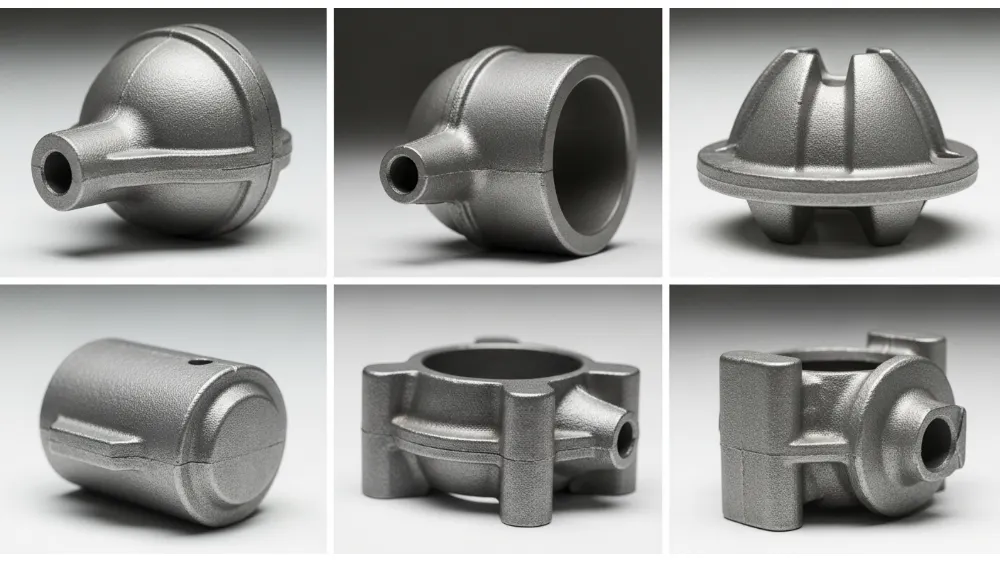
Metals may be cast and include different metals with various properties and uses:
Aluminum: Aluminum is lightweight, corrosion resistant and castable. Uses It is commonly used in automotive components, heat sinks, and aerospace parts.
Steel: For use in structural components, machinery parts, and tools, it is very tough and strong.
Copper Alloys: The alloys have high conductivity and corrosion resistance and are used in electrical parts and plumbing fittings.
Cast Iron: This has high compressive strength and vibration absorption, which is suitable in engine blocks, machine bases, and brake parts.
Magnesium: Lightweight and has high strength to weight ratio and it is usually applied in the aerospace and automotive sectors.
Advantages of Metal Casting
Metal casting also has a number of advantages that render it an important part in the production:
Complex Geometry: This option enables one to create complex shapes with hollows and fine details.
Material Efficiency: It minimizes waste like near-net-shape parts that need minimal machining.
Economical with huge volumes: Operations such as die cast allow high volumes of production at reduced prices per-part.
Flexibility: Can be used on a variety of metals and alloys with various mechanical and thermal needs.
Structural Integrity: Properly designed castings offer strength, durability and consistent material characteristics.
Limitations and Challenges
Although metal casting is very versatile, it is limited in the following ways:
Dimensional Accuracy: Sand casting can result in parts that are not as accurate in dimensions as CNC machining.
Surface Finish: Finishing may need further work on smooth surfaces.
Porosity: The wrong design of the mould or manipulation of metal may develop internal cavities and defects.
Initial Equipment Costs: Die casting or investment casting may need a substantial investment in molds of quality.
Metal Casting Applications
Casting has a wide range of application in industries:
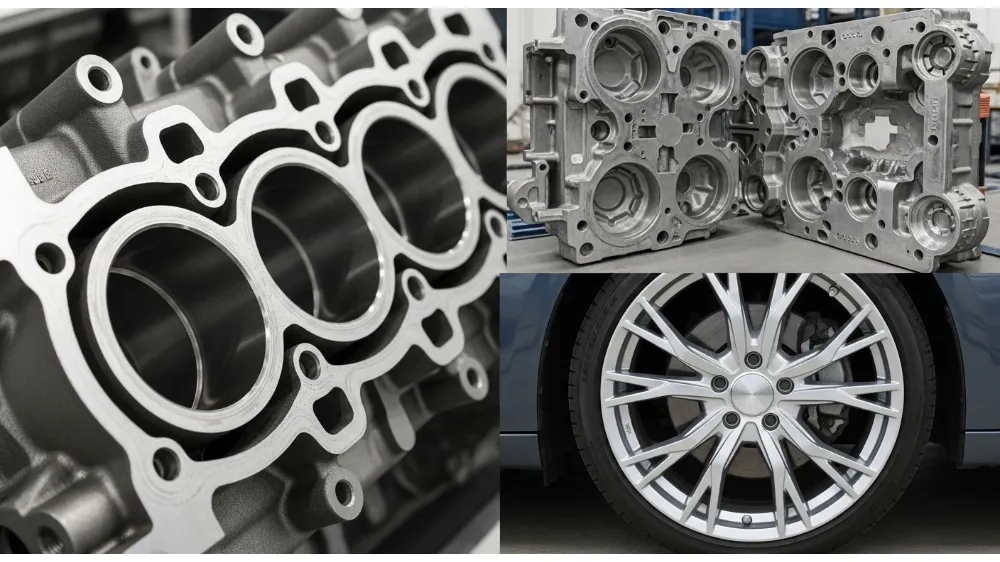
Automobile: Engine blocks, transmission casings, brake parts, and suspension parts.
Aerospace: Turbine blades, structural supports and landing gear.
Industrial Machinery: Pump housings, gear housings and valve bodies.
Consumer Products: Cookwares, ornamental hardware and electronics enclosures.
Medical Equipment: Surgical equipments, prostheses, and implants that are produced by investment casting.
The Best Practices in Metal Casting
Optimization of casting operations guarantees quality, efficiency and repeatability:
Choose the Correct Material: Select metals that match the strength, thermal and corrosion needs of that application.
Mold Design: To reduce defects, the thickness of the wall should be uniform, flow lines smooth, and venting provided.
Regulated Cooling: Do not cool quickly or unevenly to minimize internal stresses and deformations.
Quality Control: To detect defects, adopt techniques of inspection like X-ray, ultrasonic, and visual inspection.
Post-Processing: Mechanical grinding or surface finishing processes may be used to obtain tight tolerances and desired finishes.
State-of-the-Art Casting Technologies
Contemporary production is becoming more automated, simulated and controlled:
Computer-Aided Design (CAD): Enables the design of mold and optimization of flow and cooling of metal.
Computer Simulation: The defects, flow patterns, and thermal stresses are predicted prior to real casting.
Robotics and Automation: Improve consistency, labour expense, and safety when handling molten metals.
Pattern 3D-Printing: 3D-patterns are used to accelerate the development of a mold of low volume or intricate parts.
Common Mistakes During Metal Casting
Selecting an inappropriate material or alloy to be used.
Failure to design molds properly resulting in uneven metal flow.
Incorrect temperature regulation causing porosity or contraction.
Skipping quality checks or ignoring faults.
Ignoring finishing of functional or aesthetic surfaces.
Frequently Asked Questions (FAQ)
Q1: What is metal casting?
A: Metal casting refers to the act of pouring molten metal into a mold to form parts of the required shape and characteristics.
Q2: What are the principal casting techniques?
A: Some of the common ones are sand casting, die casting, investment casting, centrifugal casting, and continuous casting.
Q3: Which metals can be cast?
A: Common materials in a casting process include aluminum, steel, copper alloys, cast iron and magnesium.
Q4: What is the significance of metal casting in manufacturing?
A: It enables complicated geometries, material efficiency, and large-scale production at consistent quality.
Q5: What are the weaknesses of metal casting?
A: Potential constraints include dimensional inaccuracies, surface finish issues, porosity, and high initial mold costs.
Q6: How can defects be minimized during casting?
A: Proper mold design, controlled cooling, thorough quality inspection, and post-processing reduce defects.
Q7: Is modern casting automated?
A: Yes, contemporary casting often utilizes CAD, simulation, robotics, and additive manufacturing to improve precision and efficiency.
Conclusion
Metal casting remains a pillar of modern manufacturing, offering flexibility, efficiency, and reliability. Understanding different metal casting techniques, materials, advantages, and limitations helps manufacturers produce high-quality components efficiently. By selecting the appropriate casting process, material, and post-processing method, engineers can ensure durability, performance, and economic feasibility in a wide range of industrial applications.
