


Horizontal vs Vertical Milling: Choose the Best CNC Strategy
Milling is one of the most versatile material removal processes in modern manufacturing. Whether used for aerospace components, automotive parts, or precision tooling, milling machines transform raw stock into high‑value parts through controlled cutting actions. Two fundamental milling configurations — horizontal and vertical milling — determine how the cutting tool engages the workpiece and heavily influence productivity, stability, and part accuracy.
Understanding the nuances of these approaches — not just in terms of machine geometry but how they affect tool performance, chip evacuation, surface finish, and production logistics — helps engineers and machinists choose the most efficient strategy for each application.
This article explains both milling formats, highlights the differences and strengths of each, and offers practical guidance for real‑world manufacturing scenarios.
What Is Vertical Milling?
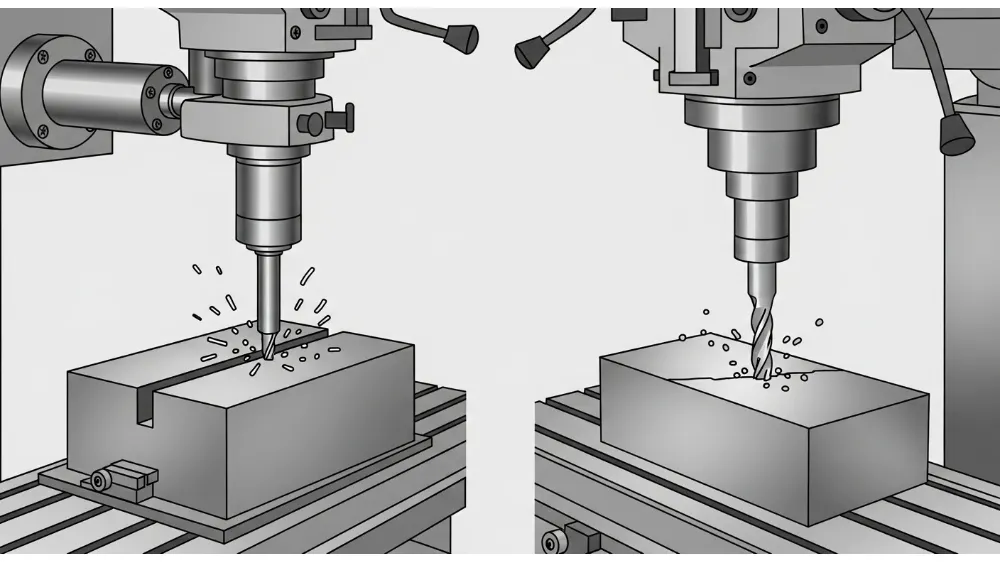
Vertical milling machines feature a spindle that descends vertically onto the workpiece. The cutting tool rotates on an axis perpendicular to the table, making vertical setups especially suited to face milling, slotting, drilling, and contouring operations.
In a typical vertical mill, the spindle may be fixed or adjustable, enabling the operator to tilt or swivel the head for angled cuts. Modern vertical machining centers (VMCs) integrate multi‑axis control, allowing complex surface machining with high repeatability.
Vertical milling provides excellent visibility of the cutting zone, making it ideal for operations requiring high precision and detailed features.
Key Advantages of Vertical Milling
Vertical milling holds several distinct benefits:
- Accessibility: Easier tool setup and part loading due to open spindle access.
- Accuracy: Tight control over depth of cut and dimensional fidelity.
- Simple Fixturing: Part holding is straightforward, reducing setup time for small to medium parts.
- Multi‑Axis Integration: Horizontal and vertical axes can be combined for 3D contouring.
Vertical milling is frequently used for tasks such as drilling holes, profiling edges, face milling flat surfaces, and producing fine features on precision parts.
What Is Horizontal Milling?
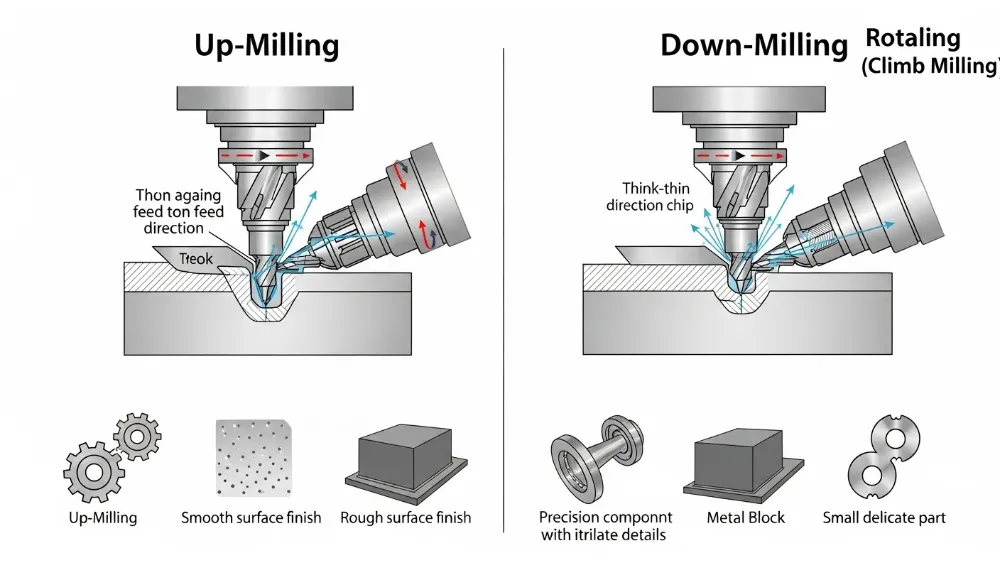
Horizontal milling machines orient the spindle parallel to the workpiece surface. The cutter protrudes sideways, allowing multiple cutting edges to engage simultaneously. These machines are especially effective for handling heavy cuts and producing deep slots or gear teeth.
The classic horizontal mill typically includes a horizontal arbor that supports large cutters, contributing extra rigidity and enabling greater material removal per pass.
Horizontal machining centers (HMCs) expand on this geometry by integrating automated pallet changers and enclosures for high‑volume production.
Key Advantages of Horizontal Milling
Horizontal configurations excel in environments where:
- Higher Material Removal Rates Are Required: Multiple teeth engage material simultaneously.
- Large Parts Are Machined: The setup provides more stability for tall or heavy workpieces.
- Deep Slotting and Complex Cavity Work Is Needed: Side cutting action improves chip flow.
- Automated Production Runs: Pallet changers support minimal operator intervention.
Horizontal mills are often favored in industries such as heavy fabrication, die/mold machining, aerospace structures, and large automotive components.
Comparing Milling Orientation: Head‑to‑Head
Here are the most impactful differences between these two prominent milling setups:
Cutting Force Distribution
In vertical milling, cutting forces are mainly directed downward. Gravity contributes to stabilizing the cut, which benefits delicate materials and fine features.
In horizontal machining, forces act laterally on the workpiece, supported by the table and fixtures. This allows higher cutting loads and makes the process more robust for aggressive material removal.
Chip Evacuation and Surface Quality
Because chips naturally fall away from the cut in vertical milling, coolant flow and evacuation tend to be simpler. However, long chips can still wrap around vertical tools, potentially affecting surface finish if not managed correctly.
Horizontal milling promotes more efficient chip removal due to the sideways action of the cutters. Combined with adequate coolant and chip conveyors, this reduces heat buildup and improves tool life.
Rigidity and Machine Stability
Horizontal machines often have higher rigidity because of the ways that forces distribute across column, saddle, and table. This rigidity supports heavier cuts and prolonged cycles with less chatter.
Vertical mills tend to carry more flexibility for smaller parts and quick‑change applications, but may require additional bracing or fixturing when machining hard or thick materials.
Setup and Accessibility
Vertical setups usually allow easier operator access for loading, inspection, and drilling operations, which can reduce overall setup time for small batches.
Horizontal setups may involve longer fixturing procedures, especially when the workpiece must remain stable under lateral forces. Yet once set, horizontal machines shine in consistent batch production.
Tooling and Cutter Options
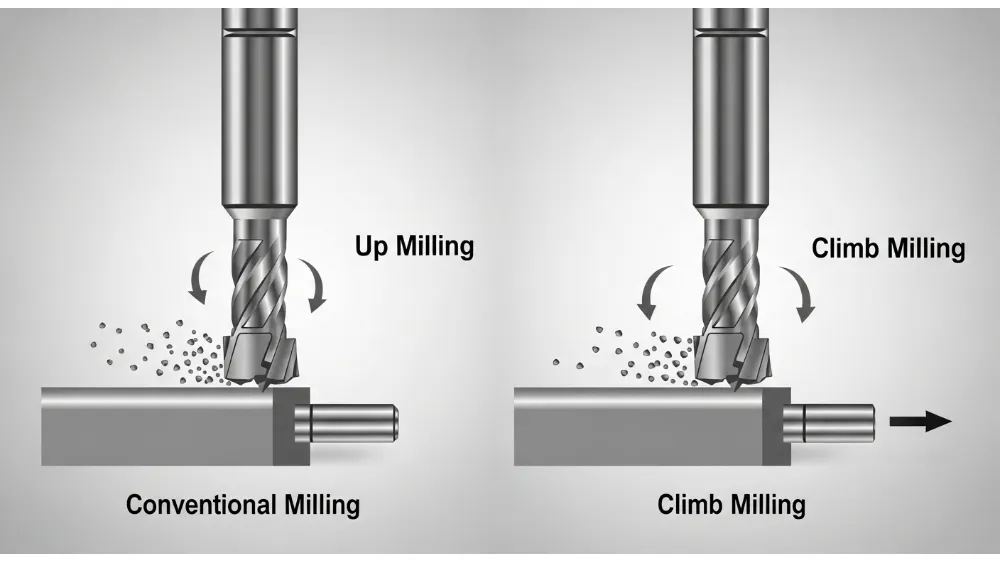
Most vertical mills use end mills, face mills, and drill bits, often requiring fewer specialized attachments. Tool change systems in modern VMCs support rapid swapping and multi‑tool operations.
Horizontal mills rely more on arbor supported cutters such as slab mills and side‑and‑face cutters. These tools maximize engagement and cut deep section profiles efficiently. Use of advanced indexable inserts and coated tooling further enhances performance in horizontal configurations.
When to Choose Vertical Milling
Vertical milling is your best choice when the priority is precision and complexity on smaller parts. Examples include:
- Machining flanges and features on CNC fixtures
- Drilling and pocketing operations on smaller components
- Prototyping work where quick changes are needed
- Operations requiring close tolerances and fine surface finishes
Vertical milling suits industries like electronics, precision tooling, medical devices, and any application requiring agile part changeovers.
When to Choose Horizontal Milling
Horizontal milling is ideal when production efficiency and material removal rate is the main focus. Typical applications include:
- Deep cavity machining and large slots
- Heavy parts with large surface areas
- High volume runs where automation reduces cycle time
- Gear cutting and structural parts with aggressive feeds
Heavy fabrication, aerospace structural machining, automotive engine blocks, and die/mold machining frequently use horizontal configurations.
Cost and Operational Considerations
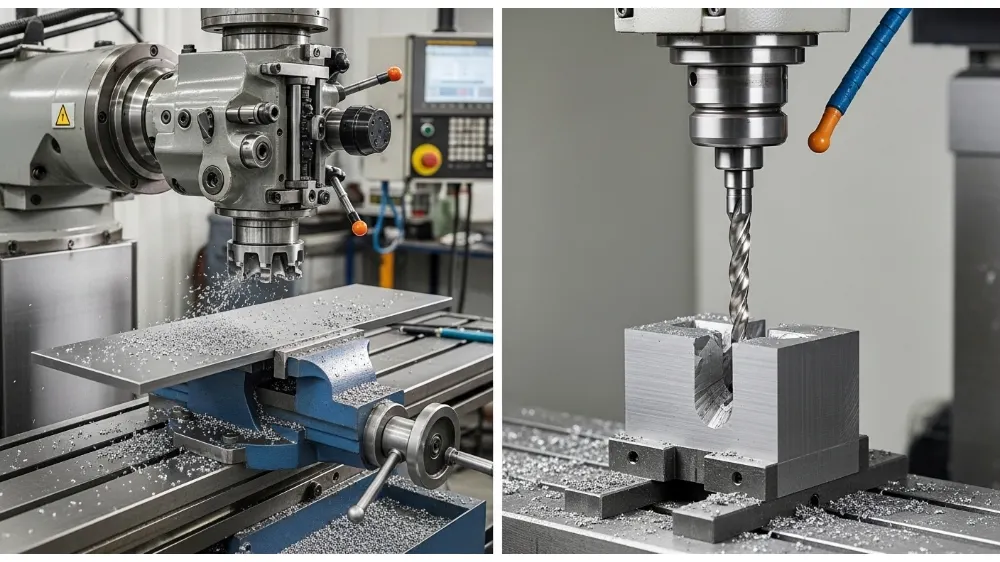
Vertical machines often cost less upfront and require smaller floor space, making them attractive for shops with varied workloads. Their tooling costs may also be lower due to simpler cutters and smaller tool inventories.
Horizontal machines tend to be larger and more expensive, yet they offset cost with production efficiency and higher throughput. Automated pallet systems further enhance value by reducing downtime between setups.
Advanced Milling Centers and Hybrid Approaches
Modern manufacturing increasingly blends vertical and horizontal features using 5‑axis milling centers. These machines rotate the workpiece or cutter to achieve complex geometries traditionally requiring multiple fixtures or operations.
Hybrid systems reduce handling, consolidate setups, and produce parts with intricate contours and hard‑to‑reach features without sacrificing rigidity or speed.
Maintaining Performance: Best Practices
No matter the orientation, observe these best practices:
- Use proper fixturing to minimize vibration and maintain alignment.
- Select tooling based on part geometry, material hardness, and feed‑speed requirements.
- Ensure coolant delivery and chip management to protect tool life.
- Monitor spindle loads and tool wear in real time to avoid unexpected breakage.
Frequently Asked Questions (FAQ)
Q1: What is the main structural difference between horizontal and vertical milling machines?
Vertical mills have spindles oriented perpendicular to the table; horizontal mills have spindles parallel to the table surface.
Q2: Which milling orientation is better for deep cavities and slots?
Horizontal milling generally performs better for deep cavities and wide slots due to side‑cutting capability and improved chip evacuation.
Q3: Are vertical mills easier to operate for beginners?
Yes, vertical mills are usually more accessible for tooling and setup, making them suitable for smaller shops and varied part runs.
Q4: Can 5‑axis machining replace traditional horizontal and vertical mills?
5‑axis machines can perform many functions of both orientations, especially when complex contours and multi‑sided milling are required.
Q5: Which configuration offers higher material removal rates?
Horizontal milling typically provides higher material removal rates due to better force distribution and multiple cutter engagement.
Q6: Do horizontal machines take more floor space?
Yes, they are usually larger and may require conveyors or pallet systems, contributing to greater footprint compared to vertical mills.
Conclusion
Both horizontal and vertical milling machines have distinct advantages, and choosing the right orientation depends on your machining goals, part size, required precision, and production volume. A milling orientation comparison — looking at machine geometry, force distribution, tooling, setup time, and production efficiency — enables manufacturers to optimize their CNC strategies for excellence in performance, quality, and cost effectiveness.
Whether you prioritize fine detail and flexible setup with vertical milling or seek high‑throughput performance with horizontal machining, mastering each approach improves your shop’s versatility and competitive edge.
