


Multi-Cavity Injection Mould | High-Volume Plastic Moulding Solutions
The Introduction
The pressure on manufacturers in the world of plastic injection moulding is that manufacturers are always required to produce high-quality parts in large quantities at low production cost and short cycle time. The multi-cavity injection mould comes into play here. A multi-cavity injection mould will allow production of more than one similar, or family part per cycle, as compared to single-cavity moulds, resulting in much higher efficiency, consistency, and profitability.
A multi-cavity plastic injection mould can be utilised in the manufacture of automotive parts, packaging solutions, medical plastics, or consumer electronics, but in any case, it is the key to the contemporary manufacturing industry. We shall discuss all of that in this design: the tooling technologies, the cost implications, the applications, and the recent developments in the multi-cavity mould manufacturing.
What is a Multi-Cavity Injection Mould?
Multi-cavity injection mould is a special tool that is used to make over one part with each injection. They can contain these moulds, which are 2, 4, 8, 16, 32, or 128 cavities according to the demand of production.
Key Features Include:
- Mould structure, which defines the quantity of parts moulded in a shot.
- Balanced runner construction to have even filling along all the cavities.
- Positioning of core and cavity to ensure dimensional accuracy.
- Parting line design determines the quality of part separation.
- Ejection system performance to ensure part removal.
This setup will enable manufacturers to scale up high-volume moulding and attain mass production moulded plastic components of consistent quality.
Benefits of Multi-Cavity Moulds
Efficiency in Production: Multiple parts per cycle are hugely enhanced by this.
Cycle Time Reduction - Reduced cooling channel design minimises cooling time.
Cost Efficiency in Injection Moulding- It is a more expensive initial tooling, but a less expensive part.
Part Consistency Injection Moulding - The same parts are guaranteed by balanced filling.
High-Volume Manufacturing - Perfect for such industries that need millions of parts in a year.
Mould Cost Reduction (Long-Term) - Diffuses tooling investment in greater amounts.
Dimensional Accuracy - Higher-order level of mould flow analysis enhances uniformity.
Multi-cavity tooling brings unprecedented productivity and its investment payoff to mass production compared to single-cavity moulds.
Design-Injection Moulding Multi-Cavity
The creation of a multi-cavity mould must be properly engineered to create balance, stability, and repeatability. Key elements include:
Multi-Cavity Mould Gate Design - Direct, submarine, or pin gates will be chosen depending on the flow of materials and geometry of the part.
Optimisation of Cooling Channels - Efficient cooling minimises the cycle time and eliminates warpage.
Family Mould Setup - When needed, different parts can be moulded together.
Selection of Tools: steel - H13 or P20 steel is typically used due to its longevity.
Injection Mould Cooling System - This is necessary in designing with high cavities to deal with the thermal loads.
Balanced Runner System- It eliminates short shots and guarantees that parts are filled uniformly.
With CAD/CAM mould design and injection mould simulation software, engineers are able to simulate and examine the part flow to optimise part performance before physical tooling.
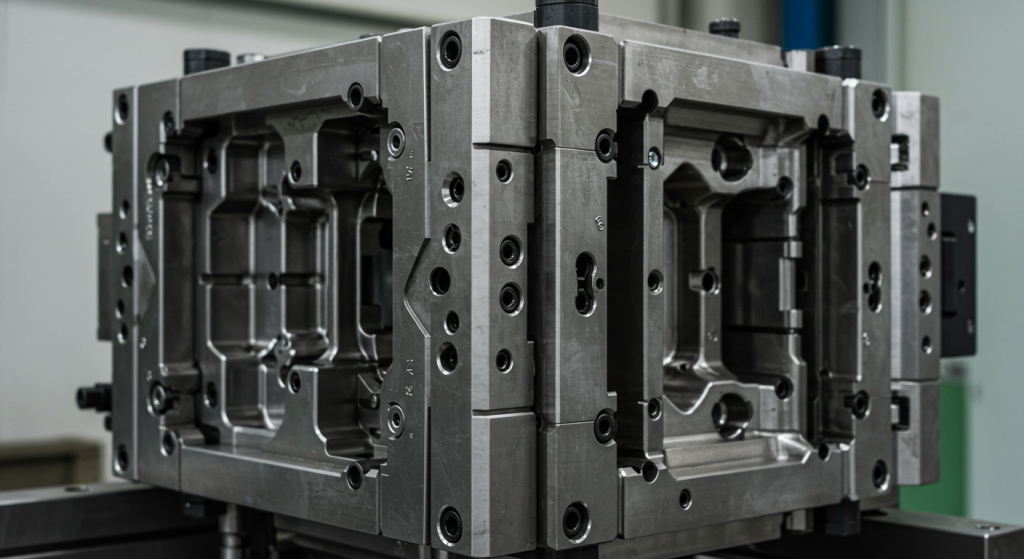
Multi-Cavity Injection Moulds
- Multi-Cavity Injection Mould Cold Runner.
- Uses conventional runners, which harden after each cycle.
- Reduced the cost of tooling and increased material wastage.
- Appropriate for low volumes of production.
Hot Runner System on Multi-Cavity Mould
- Keeps liquidity runners, lowering waste.
- Offers increased flow balance between cavities.
- More expensive initial tooling, and great for mass production of moulds.
Family Moulds
- It was created to make various varieties of parts during a single cycle.
- Applicable in assemblies that demand several components in one.
Multi-Cavity Tooling, Material Savings, and Efficiency
Multi-cavity mould tooling is an indispensable aspect of most industries because of its versatility. Injection Moulds are applied in areas such as:
Medical Devices- Syringes, IV connectors, and precision plastic parts require a multi-cavity mould of medical plastics, which requires strict dimensional accuracy.
Automotive Parts - Automotive injection moulding tools with high repeatability are needed to manufacture automotive interior clips, dashboards, and safety parts.
Packaging Industry - Bottle caps, closures, and containers are dependent on high-speed production, which uses moulds from the packaging industry.
Consumer Electronics - Multi-cavity mould is useful in making precision parts in the form of casings, connectors, and precision housings.
Household Goods - Massive manufacturing of daily plastic goods.
Bottle cap injection moulding is one of the most iconic applications that has high-cavity moulds (up to 96 cavities) that provide massive throughput with consistent quality.
Multi-Cavity Moulds Manufacturing Process
The multi-cavity injection mould is a complicated technology that requires sophisticated technologies and toolmaking:
- Mould tooling is done using CNC machining, which makes it accurate.
- EDM in mould production produces complicated geometries.
- Mould engineering provides uniform cavities.
- Multi-cavity moulds may be tooled with aluminium in some instances to allow prototyping or low-volume production.
- Injection moulds are very important in terms of their maintenance, which is vital to their longevity and performance.
- In injection moulding, lean manufacturing helps firms to maximise tool life, minimise downtime, and improve productivity.
Multi-Cavity Moulding Performance and Productivity
The main parameters to be used to achieve optimal performance include:
- Balanced runner design efficiency of production.
- Part weight consistency was ensured through accuracy toolmaking.
- Hot runner system scrap reduction.
- Maximised throughput in injection moulding through reduction in cycle time.
- Uniformity of plastic parts improved through the use of the mould flow.
It is also expected that companies that adopt mould manufacturing will have high ROI because they will have a low cost per part and enhance the consistency of their products.
Difficulties and Solutions in Multi-Cavity Moulding
Cavity Imbalance - Advanced mould filling simulation solved.
Cooling Problems - Regulated by the design of the cooling channels.
Ejection Problems - Enhanced through new-fangled ejection system efficiency mechanisms.
Maintenance Expenses - Decreased through preventive maintenance plans.
Tight collaboration between high-normal mould engineering and simulation software makes sure that these difficulties are reduced to a minimum.
Conclusion
The multi-cavity injection mould has altered the contemporary plastic injection moulding, in that it allows mass production, cost-effectiveness, and high precision. Mediated to medical equipment, automotive materials, and packaging products, this type of mould is needed by the industries that need plastic components in large volumes with uniform quality. To businesses that have a desire to remain competitive in the current rapid manufacturing environment. To know more about professional solutions, SunOn Mould can be visited to acquire improved services in the production of multi-cavity moulds.
