


Why Choose Injection Molding for Plastic Bracket Molding? 7 Irreplaceable Advantages
For engineers and product developers looking for cost-effective plastic brackets that can be manufactured at scale, their options are almost infinite. Each manufacturing process offers its own advantages and disadvantages, but when looking for brackets that can be produced consistently and that have the capability of being produced at scale and have complex geometries, Plastic Injection Molding is the most versatile choice. This article provides an overview of the seven key advantages of Injection Molding when producing Plastic Brackets and how SunOn's experience and expertise make these advantages applicable in real production.
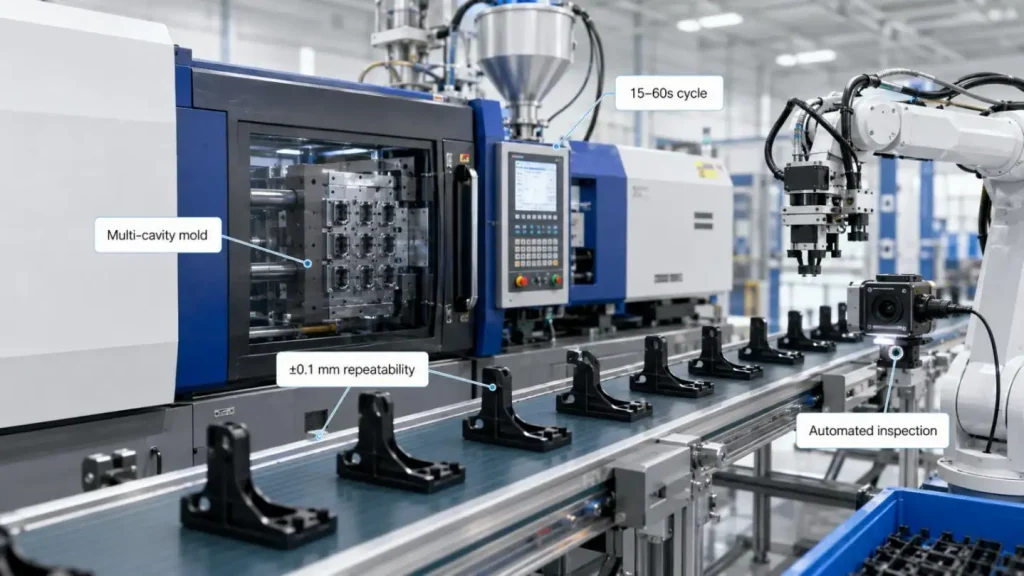
Advantage 1: High Volume Production with Incomparable Consistency
Injection Molding was designed to be a process that is repeated for the purpose of creating the same piece over and over again with the least amount of deviation.
•Cycle time of 15 to 60 seconds per shot: Results in an incredibly high output from a single mold, often producing thousands to tens of thousands of brackets in a single business day.
•Excellent repeatability with tight tolerances (±0.1mm or better): Every bracket in a million-part run matches the first, eliminating assembly fit issues.
•High cavity / multi cavity molds for mass production: Multi-cavity molds (4, 8, 16, etc), for example, are crafted to minimize cycle times to maximize production output with no additional machine times.
•Automated part handling and inspection: Robotic part take-out with a vision system for inspection continues to guarantee a high level of quality.
Advantage 2: Capability of Advanced Design with Thin Walls
Brackets often require features such as ribs and undercuts, which are easy to mold and incorporate with Injection Molding.
•Thin-walled designs can now be as little as 0.5mm. This means that less material can still make strong brackets for electronics or drone frames.
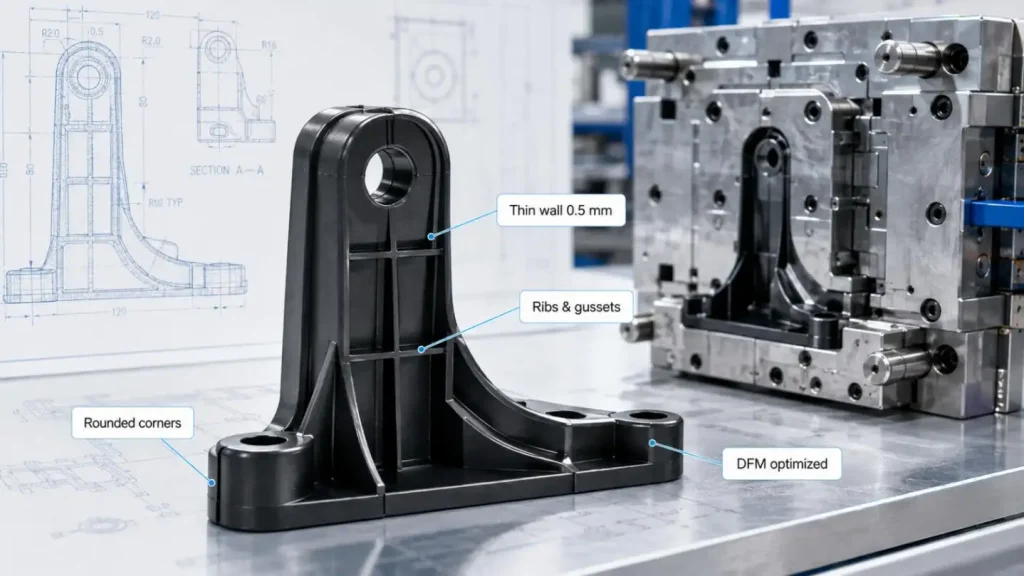
•Stress relieving can be done with thin gussets and rounded corners with constant cross section frames and good design practices.
SunOn's DFM (Design for Manufacturing) service: our design engineers can perfect draft angles, rib thickness and gate locations so the first iteration of the design becomes the final design.
Advantage 3: Flexible Materials for Bracket Design
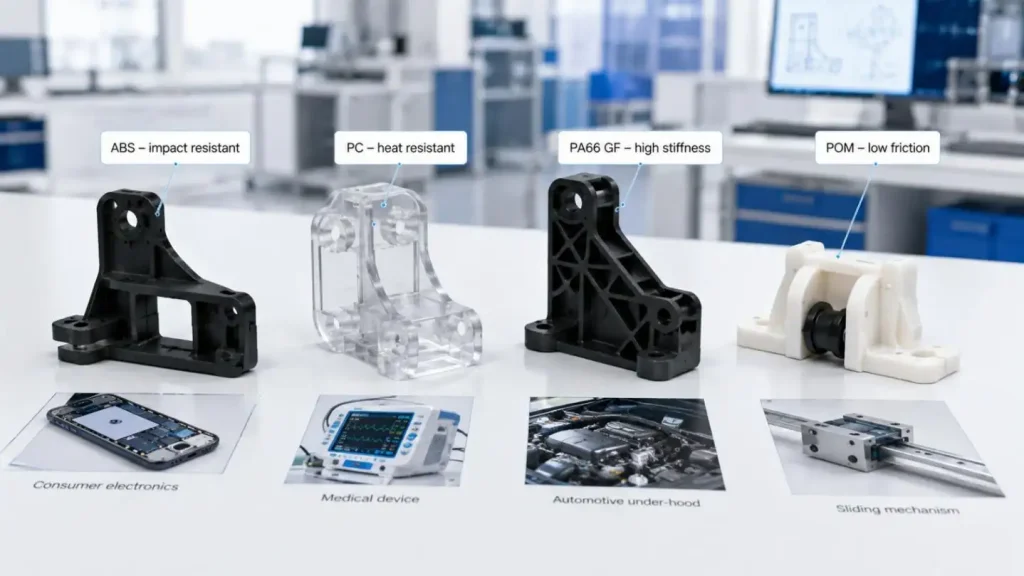
3D Printing is CNC is limited to sheet metals and certain rapid prototyping resins. However, Injection Molding can utilize a range of thermoplastics.
•Consumer electronics or appliance housing brackets / ABS (Acrylonitrile Butadiene Styrene): Brackets that provide strong impact resistance and easy processing.
•Medical device brackets / Polycarbonate (PC) clear plastics that support high heat and clear brackets.
•Automobile under-hood brackets / PA6, PA66 (Nylon) reinforced with glass fibers: excellent stiffness and low creep.
•Brackets sliding latch or gear mount brackets / POM (Acetal): low friction and high dimensional stability.
SunOn is fully backed by an extensive library of materials: as well listed, custom and specialty materials such as flame-retardant PC/ABS and UV stable PP.
Advantage 4: Precision and Consistency
Brackets must be precisely injection molded and remain consistent since they will interface with metal inserts and/or circuit boards.
•Validated molds must meet standards of statistical process validation: Enhanced molds provide a 99.99% conformance rate.
•With new improved machine controllers, SunOn can reduce variability. Improved controllers allow SunOn to have better control of melt viscosity and packing pressure.
•With mold flow simulation, shrinkage prediction resulting in a variance of 0.2% allows early identification of warpage and acts to minimize it.
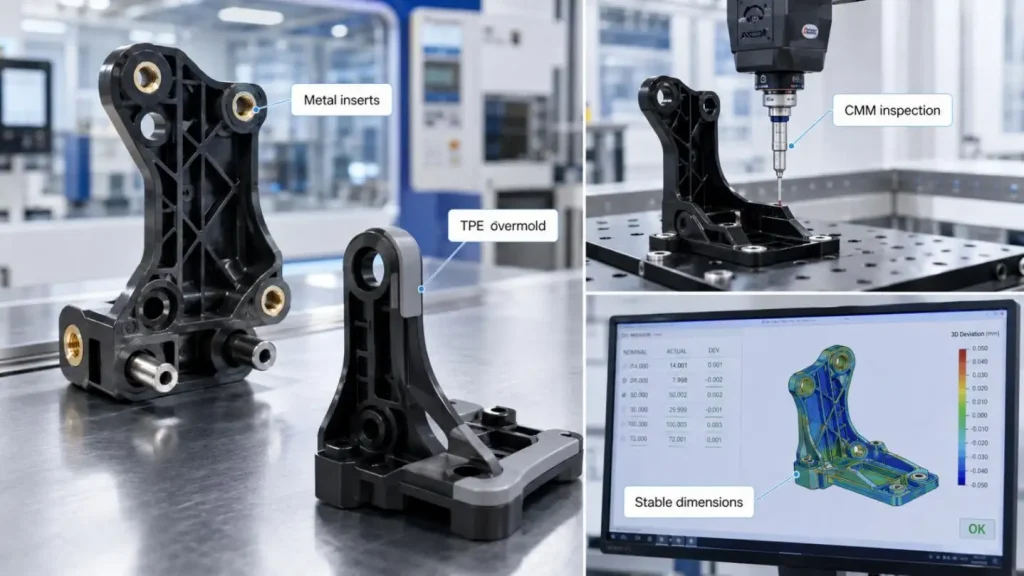
•Adopted CMM, Optical Comparator and functional gauge standards: All components are fully inspected to the required dimensions.
Advantage 5: Overmolding & Insert Molding of Multi-Material Brackets
Some brackets require either molded rubber grips, threaded metal inserts, or a soft touch surface. All of these features can be incorporated using injection molding.
•Overmolding bonds a second material, like TPE, to a rigid molded part: This is commonly used for vibration dampening pads, sealing lips, and handles on brackets.
•Insert molding is used to incorporate metal nuts, pins, or bushings to brackets: This aids in eliminating assembly of fasteners and increases the pull-out strength.
•Two-shot (2K) injection molding allows parts to have two materials of varying color or durometer: This greatly improves efficiency and reliability of the fit and inter-material alignment.
•SunOn has significant expertise in automated insert molding: Our systems can handle brass inserts, magnets, and even printed circuit boards.
Advantage 6: Wide Variety of Surface Finishes and Post Processing
For brackets located in more visible areas (Ex. medical device panels or consumer electronics) a more refined aesthetic is required. Injection molding allows for many surface finish options.
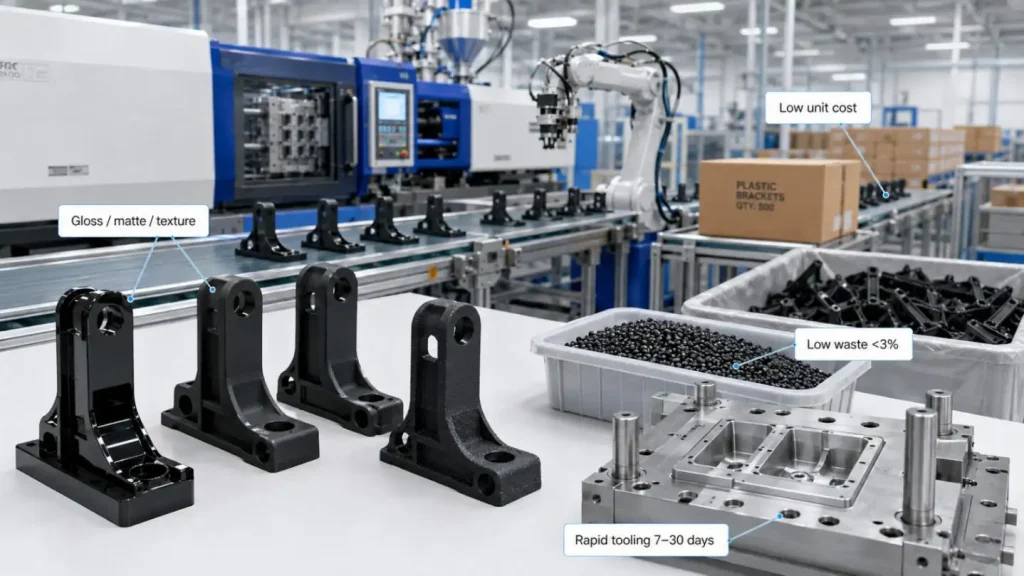
•Varieties of glossy, matte, or textured directly from the mold: SunOn can offer VDI 3400, SPI, or custom grain textures without requiring secondary processing.
•UV coating for UV protection and scratch resistant surfaces: Needed for outdoor brackets or equipment exposed to the sun.
•Plating or painting for metallic look or color matched design: This is done in connection with certified platers for ABS or PC brackets.
•Laser engraving for permanent traceability of part numbers, logos, or marks left by assembly: No need for labels.
Advantage 7: Low Per-Unit Cost at Scale with Minimal Waste
For large production runs (> 1,000) injection molding is the least expensive process.
•Material waste is less than 3%: Sprues and runners can be ground down and reused (for most thermoplastics) so the costs of raw materials are lowered.
•The energy costs for production drop as the number of cavities in a mold increases: Producing 8 or 16 brackets may require the same energy as a single bracket in a single cavity mold.
•Labor costs also drop due to the high level of automation: Robots, conveyor belts, and automated packaging systems reduce the need for people.
•SunOn's rapid tooling (7-30 days) for go to market strategy: For quantities between 1,000 - 50,000 employ aluminum bridge tooling. For 500,000+ quantities use hardened steel.
No need to deal with multiple companies at different production stages. SunOn offers rapid tooling, injection molding, and packaging.
What to Expect with SunOn Plastic Bracket Molding
More than 25 years of Plastic Bracket Molding makes SunOn Industrial Group Limited a leader in the industry. Our company is certified in ISO 9001, IATF 16949, and ISO 14001. Some of the benefits of working with SunOn are:
•Improved Design and Engineering: Our skilled engineers work with your design and improve it, decreasing production times and waste.
•Rapid Tough Molding: We use a combination of high-speed CNC and EDM which offers tough molds with ±0.01mm.
•Molding Runs of Any Size: from 1,000 to over 1,000,000 parts is not a problem either way.
•Worldwide Operations: We work in 27 different cities and can offer the support you need.
•Environmentally Aware: We offer a range of options that include biobased and recycled materials and we recycle process water and clean runners.
We have experience creating injection molded components across a multitude of industries from automotive to medical. We have produced millions of high-quality components.
Conclusion
There are seven primary benefits of using injection molded plastic brackets. These include the ability to repeat high volumes, fabricate complex geometries, choose from a wide variety of materials, achieve close tolerances, incorporate multiple materials, produce varying surface finishes, and the lowered cost per unit when produced in bulk. By using SunOn, you will fully realize these benefits in the form of cost savings and brackets that meet you design specifications.
Would you like to take your plastic bracket designs from the drawing board to the production line? We would be happy to provide you with a complimentary DFM report and quote.
FAQs
Q1. What's the lead time to get a plastic bracket mold from SunOn?
SunOn lead times for brass molds are as quick as 7 days up to 30 days. Plastic injection molds take from 30 days up to 45 days. SunOn uses aluminum injection molds for rapid tooling.
Q2: Is it possible to make brackets with metal inserts via injection molding?
Yes, this is the case with insert molding. At SunOn, brass inserts are automated to achieve a consistent pull-out strength.
Q3: What is the best technique to select a material for a plastic bracket?
Depending on the criteria of mechanical load, temperature, chemical exposure, and cost, our engineers will make a recommendation.
Q4. Does SunOn do low-volume production, between 1,000 to 10,000?
Yes, to economically accommodate low volumes, we provide aluminum molding and actively do the rapid prototyping.
Q5. What are SunOn's options for surface finish on brackets?
Brackets may be finished as glossy, matte, or have a VDI texture; may be UV coated, painted, plated, or finished by laser engraving.
