


Plastic Housing Manufacturer: Overmolding Expertise for Multi-Material Designs
As a Plastic Housing Manufacturer, SunOn utilizes overmolding and insert molding by making housings that incorporate rigid structures and soft touch surfaces or metal components. SunOn's multi-material housings help meet requirements for better product grip, improved product housing seal, and less time spent on product assembly. Made with the help of plastic injection molding, these housings help meet the needs with tolerances of ±0.1mm and high volumes with a range from 1,000 items to 1,000,000 items or more. This article discusses a Plastic Housing Manufacturer's overmolding capabilities, the benefits of working with such a manufacturer, and is provides a glimpse into the ways a Plastic Housing Manufacturer with multi-shot capabilities can help optimize your supply chain.
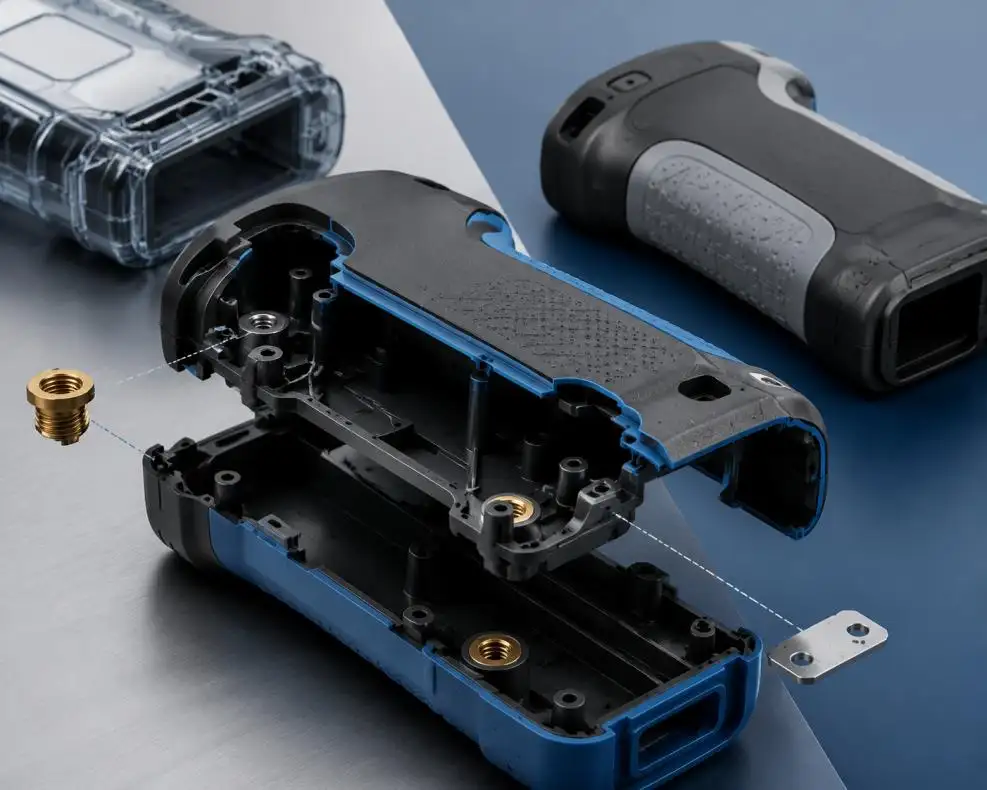
Overmolding Process and Benefits
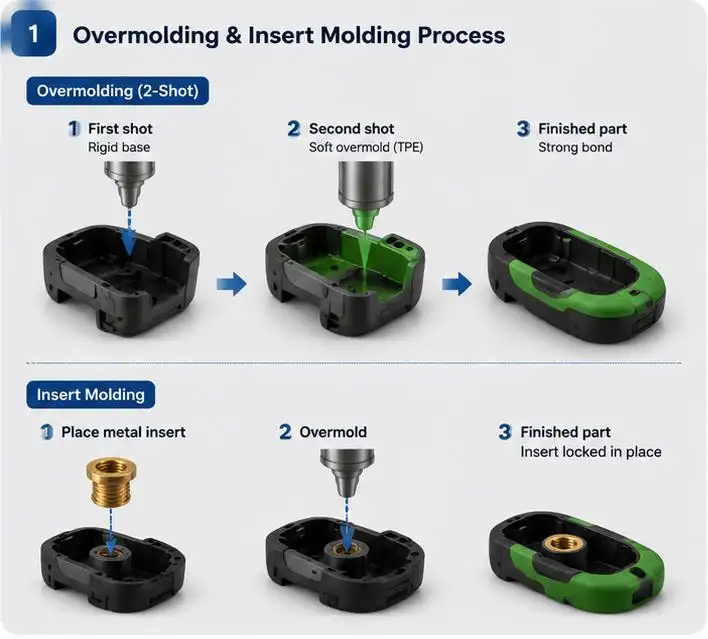
Overmolding consists of a rigid base which is covered with a flexible plastic layer. This flexible plastic layer is usually a thermoplastic elastomer and is bonded to the rigid part of the plastic during the injection molding. Insert molding is a little more advanced as it involves the addition of metal components like threads or bushings to the plastic part being made. With both methods, the use of secondary adhesives or snap-fit is eliminated.
•The advantage of overmolding for multi-material parts is that it highlights soft and hard zones and as a result, enhances the ergonomics of the product while also improving its overall durability.
•When hardware is embedded into a housing, it especially helps in lessening the assembly time and can be done by insert molding.
•Lastly, Two-shot (2K) injection molding is an innovative method of producing parts with dual colors or materials in a fully automated molding cycle, which removes the need for any additional handling after the molding is done.
The integration of these techniques by a Plastic Housing Manufacturer helps lower part count while improving the reliability of the parts. Many industries, including medical equipment, power tools, and consumer electronics, utilize housings that are built to be consistently high performing and ergonomic.
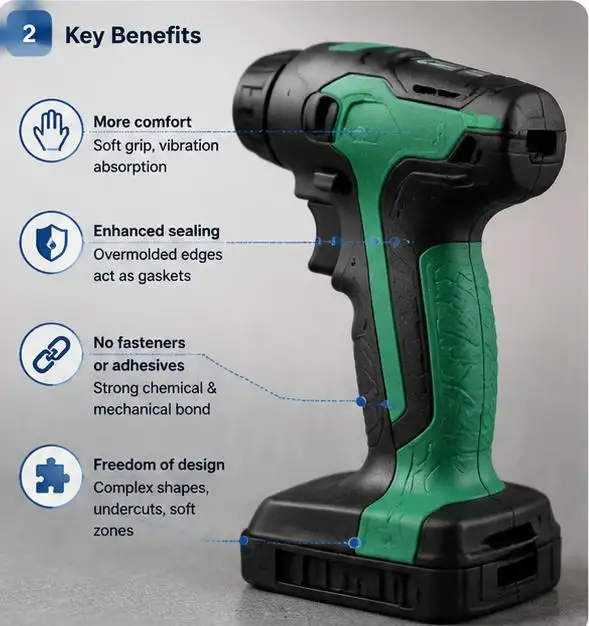
Key Benefits of Overmolded Housings
There are many advantages to choosing overmolding for plastic housings. Below are the principal advantages which have been noticed in selecting this process.
•More comfort: The pressure of the strap is dispersed by soft elastomer layers which also aid in vibration absorption and secure grip. This is advantageous to all hand-held devices and control handles.
•Enhanced Sealing: Overmolded edges act as gaskets which seal the assembly and keep moisture and dust from coming in contact with the electronics.
•No fasteners or adhesives needed: chemical and mechanical bonds remain intact over the range of temperatures and mechanical stresses.
•Freedom of design: multi-shot molds allow for the inclusion of living hinges and undercuts, as well as soft curved zones, which are geometries that are difficult or impossible with assembled components.
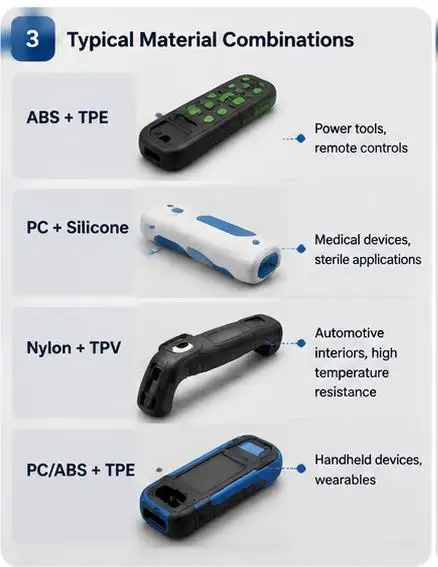
Typical Material Combinations for Overmolded Housings
The choice of material is important for the success of overmolding projects. The hard substrate must have good bonding with the overmolding. SunOn combines many different thermoplastics and elastomers, which enhances compatibility and improves overmolded products.
•ABS with TPE: an excellent combination for colorable and easily bonded housings of power tools and remote controls.
•Polycarbonate (PC) with silicone: excellent for non-slip surface and the sterility of a medical device overmolding.
•Nylon with TPV (thermoplastic vulcanizate): a strong and heat resistant combination excellent for automotive interiors.
•PC/ABS alloy with TPE: an excellent balance of touch and impact resistance for handheld devices and wearables.
The engineers at SunOn conduct tests to determine bond strength and environmental conditions to check if the mold products stay bonded under the expected use conditions.
Insert Molding for Functionality Addition to Plastic Housing
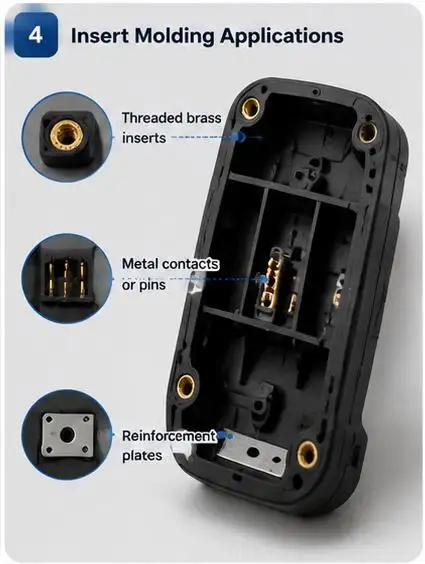
Insert molding allows for the combination of metal components with plastic housing. It allows for the integration of threaded inserts, electrical contacts, and structural supports. For a Plastic Housing Manufacturer, insert molding results in a reduction in the number of assembly steps, while improving alignment.
•Threaded brass inserts: Provide strong, reusable screw threads for the attachment of covers or for the mounting of PCBs within the housing.
•Metal contacts or pins: Are incorporated into the housing and therefore provide the required electrical interconnections, eliminating the need for soldering or press-fit operations.
•Reinforcement plates: Are metal inserts of a thin cross-section that serve to add ribs or stiffener to the sections of the housing without thickening the walls.
SunOn utilizes either robotic placement or manual fixtures, dependent on the quantity of the order, to ensure the metal components are accurately placed for insert molding.
Broad Ranging Application
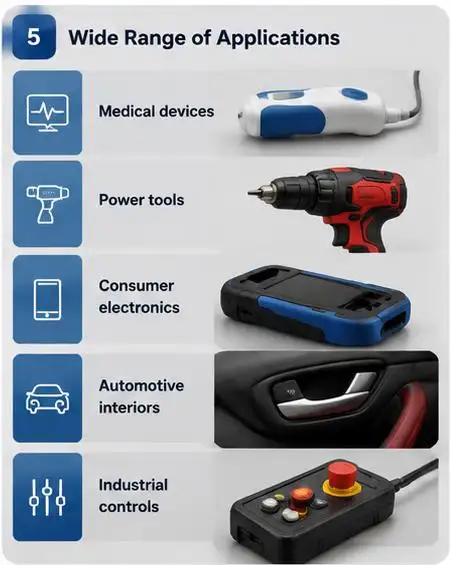
Overmold and insert molded housings are utilized in almost all industries. A Plastic Housing Manufacturer, like SunOn, has the following examples to show their capability to meet the diverse needs of the market.
•Medical devices: Overmolded handles on surgical tools provide easy to clean grips, and patient monitors. Insert molding provides metal fittings for tube connections.
•Power tools: Overmolded grips are an ergonomic design, while insert molded nuts serve to attach the mounting of the motor.
•Consumer electronics: Two shot molding provides a dual color design while achieving waterproofed housings.
•Automotive interiors: Overmolded handles and controls combine rigid and soft touch components.
•Industrial controls: Insert molding of metal contacts and indicator lenses simplifies assembly.
How SunOn Achieves Excellence in Overmolding
SunOn uses custom mold design, state-of-the-art equipment, and stringent quality control measures to manufacture housings with overmolding, efficiently, and within a lead time of 7 to 30 days, with the aid of high-cavity and multi-cavity molds. SunOn's expertise and knowledge in elastomers and thermoplastic polymers (ABS, PC, Nylon, etc.) allows the company to assess the compatibility of the materials and the stability of the processes.
With custom designs and two-shot molds, the SunOn team controls design and placement of the mold gates, as well as fills the first-shot mold and the second-shot cavity with the overmold, to avoid flash and incomplete fills.
SunOn customizes the bonding process by controlling the barrel (180-300°C), injection pressures (700-1500 bar), and cooling times, which all vary per material pairs to ensure optimal bonding.
SunOn employs automated systems to check the integrity of the bond lines, and the presence of flash or defects, while maintaining tolerances to ±0.1mm.
After molding, SunOn has the capability to provide custom surface finishes ranging from gloss to matte and textured, as well as UV coatings or metal plating.
Quality Assurance for Multi-Material Housings
SunOn carries out extra validation on overmolded components. This is part of the standard procedure of validation testing on all housings to verify both adhesion and functionality.
•During peel strength testing, overmold-substrate adhesion for the entire production lot is validated.
•SunOn also assesses the impacts of differential thermal expansion of the overmold and the substrate by exposing the assemblies to multiple high/low temperature cycling.
•Also, SunOn executes an insert pull-out test to assess the pull-out strength of the metal inserts compared to the design criteria for housings with molded inserts.
SunOn's dedication to quality and environmental service for all prototyping to the final assembly is evidenced by certifications such as ISO 9001, IATF 16949, and ISO 14001 as well as a 27-city global service network.
Conclusion
For a Plastic Housing Manufacturer, Overmolding and Insert molding offer smarter, more advanced options for the functionality of housings. Combining rigid Thermoplastics with either soft Elastomers or metal components helps reduce assembly steps, enhances the user experience, and promotes innovative designs. SunOn offers the experience and capability to select materials, custom design, and facilitate round the clock production (with typical lead times of 7 days) of housings. SunOn's Overmolding can support both a comfort grip for a medical device and a rugged, hardware integrated, Overmolded industrial housing.
To develop your multi-material housing design, please either contact SunOn directly or complete the inquiry form. To receive a customized proposal, please identify your materials (ABS, PC, Nylon, or others), and approximate annual volume.
FAQs
Q1: What is meant by Overmolding and Insert molding?
A: Overmolding is a soft outer layer of a molded part, while Insert molding is placing metal into the molded part.
Q2: Which materials work best for Overmolding?
A: Common, and proven, pairs are ABS/TPE, and PC/Silicone.
Q3: Can SunOn make two-color housings without a paint finish?
A: Yes, two-shot or 2K injection molding, offers the capability to produce dual-color components in one cycle.
Q4: Is Overmolding a feasible option for large volume production?
A: Yes, multi-cavity molds are capable of a production run of a 1,000 parts to 1,000,000 parts and beyond.
Q5: Which industries make the most use of overmolded housings?
A: Medical devices, tools, electronics, automotive, and industrial controls.
