


Precision Aluminum Die Cast Parts | High-Quality Castings
What are Cast Parts of Precision Aluminum?
Metal components produced by injecting high-pressure die casting (HPDC) molten aluminum into steel dies constitute precision aluminum die cast components. It creates complex geometries with tight tolerances, smooth surfaces, and high repeatability, and is therefore used in high-volume production.
The Major Features are:
- Aluminum alloys are lightweight but high-strength.
- Stability (dimensionally) and accuracy in engineering.
- Economical production in large-scale production.
- Finishing, such as powder coating, electroplating, anodizing, or polishing.
Precision Aluminum Die Cast Parts: Quality Solutions to Industrial Use
- In contemporary production, precision aluminum die-cast parts are an essential element to industries in search of lightweight, high-strength, and dimensionally accurate components. With applications in automotive and aerospace, electronics, and consumer products, aluminum die castings are incomparable in durability, thermal capability, and design flexibility.
- We are SunOn Mould, and we are engaged in the supply of high-performance aluminum die casting solutions of high performance, which convert raw ingots of aluminum into custom, precision-engineered parts for different industrial applications.
Aluminum Alloys and Materials
The alloy of aluminum die-cast components will determine the performance of the components. Common choices include:
- A380 Alloy: This alloy has an excellent ability to resist corrosion, mechanical strength, and thermal conductivity, highly used in the automobile and industry sectors.
- ADC12 Alloy: Common in electronics and consumer products, it is highly thermally stable, and it casts well.
- Aluminum Blends: Customized to meet high-performance needs that require particular mechanical properties or conductivity.
These materials ensure long-lasting aluminum die cast pieces with close tolerances and long-life operations.
Die Casting Process of Aluminum
Design & Tooling
3D CAD design is the initial stage in the manufacture of precision aluminum die-cast components. Part geometry is optimized by engineers to:
- Dimensional accuracy
- Wall thickness lightweight designs.
- Complicated shapes such as ribs, bosses, or undercuts.
Molds are then created by high-precision tooling and CNC-machining to guarantee that multi-cavity molds are capable of processing high-volume production.
High-Pressure Die Casting
HPDC entails high-pressure injection of molten aluminum in steel dies, whereby:
- Standardized and recurring production.
- Accurate copying of complex designs.
- A smooth surface finish can be used in the second operation.
The result of this step is precision aluminum die-cast parts that can be used in the automotive, aerospace, and electronic industries.
Post-Processing & Finishing
After casting, parts undergo:
- Cropping and deburring of superfluous material.
- Surface finishing: powder coating, anodizing, polishing, or electroplating.
- Dimensional and mechanical inspection.
This guarantees the production of durable die-cast products with close tolerances to be use in industries.
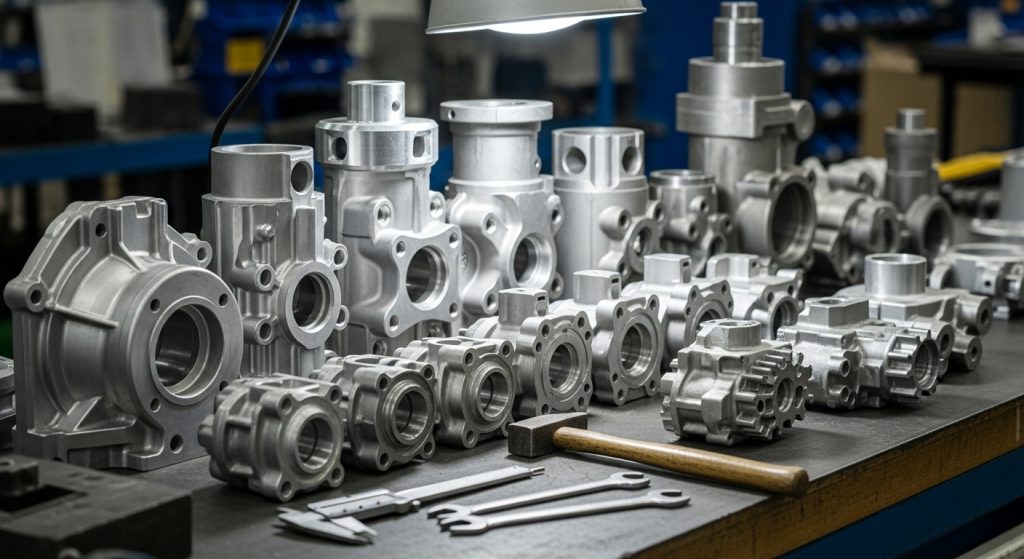
Benefits of Precision Aluminum Die Cast Parts
- Strength-to-Weight Ratio is High
Aluminum die-cast parts are light but strong, which is best suited for automotive and aerospace applications where weight saving is essential.
- Complex Geometry
CNC aluminum die casting also makes it possible to cast complex designs and multi-cavity molds at reduced costs in order to improve the performance of products.
- Repeatable Accuracy
Consistent quality of high-accuracy aluminum die castings ensures that there are no defects and waste in the production runs because of high accuracy.
- Conductivity of Thermal and Electricity
Aluminum alloy is excellent in thermal conductivity and electrical conductivity, which makes it suitable for electronic cases and thermal control elements.
- Cost Efficiency
Die casting of aluminum is a very cost-effective option due to the low per-unit costs of high-volume production, the speed with which a tooling cycle and a production cycle can be completed.
Uses in Industrial Applications
Automotive
Some automotive die-cast aluminum products consist of engine parts, transmission housings, brackets, and structural parts. With high-precision castings made of aluminum, manufacturers attain:
- Low-weight vehicles to achieve better fuel efficiency.
- Improved engine and chassis components' durability.
- Competent parts in a tight form to enhance assembly and performance.
Aerospace
Lightweight die-cast parts made of aluminum alloy are necessary in aerospace:
- Planes' structural elements.
- Development of heat-resistant housings and casings.
- Mechanical assemblies and high-performance landing gear.
Electronics
Electronic CNC aluminum die castings are used to make:
- Housings for power supplies
- Thermal management heat sinks.
- Consumer electronic enclosures of the exact size.
Industrial Machinery
Industrial equipment: Custom die-cast components of aluminum are commonly used in industrial equipment:
- Gear housings
- Pump casings
- High-strength parts are needed on machine tools that are durable.
Accuracy Die Casting Technologies in Aluminum
High-Pressure Die Casting (HPDC)
HPDC is best suited to thin-walled constructions and complicated shapes, as it allows manufacturing with high precision and tight tolerances in a short period.
Multi-Cavity Die Casting of Aluminum
Multi-cavity molds enable multiple parts to be manufactured at once, reducing the cycle time and the price per unit but maintaining repeatable quality.
CNC-Assisted Die Casting of Aluminum
The CNC-machined molds enhance the precision of dimensions, reproduce complicated geometries, and facilitate assembly of prototypes and production molds.
Finishing the Surface After Casting
Surface finishing methods make improvements:
- Corrosion resistance
- Aesthetic appeal
- Wear resistance
These are powder coating, electroplating, anodizing, and polishing.
Standard and Control in Quality
At SunOn Mould, we have very high standards of quality control during the process of aluminum die casting:
- Tight tolerance dimensional inspection.
- Strength and durability testing: mechanical.
- Optimization of the processes aimed at uniform thermal and electrical properties.
- Manufacturing of industrial-grade components, which are ISO certified.
These are precautionary steps taken to guarantee consistency in the production of die-cast aluminum parts of high accuracy for the challenging industries.
Why SunOn Mould is the Best Choice for Aluminum Die Casting?
- Aluminum castings: Custom industrial grade.
- Molds: High-precision automotive and electronics molds.
- Quick tooling and large volume production capacities.
- Die casting with complex die castings using CNC.
Conclusion
Modern manufacturing relies on precision aluminum die-cast parts, through which it provides lightweight strength, high precision, and long durability in a variety of industries. Prominent CNC-enabled die cast, multi-cavity moulds, high pressure die cast processes enable manufacturers to obtain tight tolerances, high volume, and complex geometries with ease. The collaboration with a proven provider such as SunOn Mould ensures production-ready components that meet the requirements of the most challenging specifications.
