


Understanding 4-Axis and 5-Axis CNC Machining: Comprehensive Guide
Precision CNC machining has transformed the world of production of complex parts by ensuring that production is carried out with precision and efficiency. The 4-axis and 5-axis CNC machining are some of these technologies; they find use in dealing with geometrically complex components. Although two approaches build the capabilities of the conventional 3-axis machines, they vary in terms of motion, flexibility, and application. These differences are essential to the engineers, manufacturers, and designers because they need to understand the production processes in order to optimize them.
This manual covers the concepts of the 4-axis and 5-axis CNC machining, their benefits, drawbacks, real-life use, and the underlying factors in choosing the most appropriate process in the contemporary manufacturing set ups.
Basics of 4-Axis CNC Machining
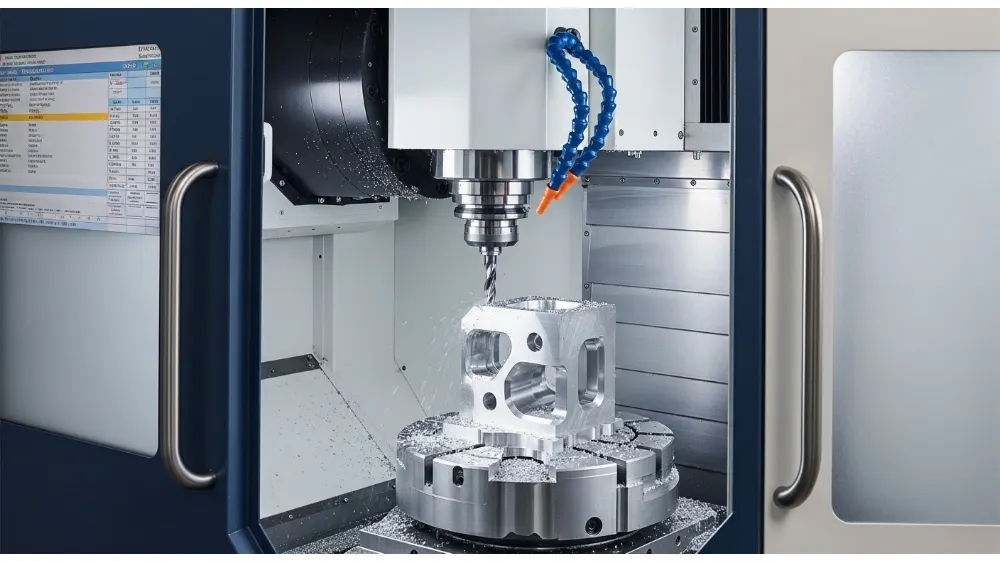
CNC 4-axis systems are an upgrade of the conventional 3-axis machines, which involves an addition of rotation on one more axis commonly the A-axis. Using this axis, the workpiece is allowed to spin with the cutting tool completing specific operations in the X, Y and Z axes.
With the fourth axis, the manufacturing possibilities are greatly increased. It is also applicable in those parts that have angular features, slots or holes that are around cylindrical surfaces. The typical ones are gears, camshafts, and cylindrical housings.
A 4-axis machine needs more toolpaths and rotational commands to be known in order to be programmed. It is still however not as complicated as 5-axis programming, so it is good option in mid-complexity components and high-volume production runs.
The benefits of 4-Axis Machining
There are a number of operational advantages with 4-axis CNC machining. It saves on the requirement of numerous setups enhancing precision of parts. Symmetrical and rotational machining of parts can be done in one clamping by manufacturers, reducing errors and time savings.
Moreover, 4-axis machines can accommodate large work pieces as compared with 5-axis equipment and thus are applicable in medium size work. Moderate programming complexity, coupled with efficiency, has made 4-axis machining the best choice of company that is cost-efficient.
Disadvantages of a 4-Axis CNC Machining
Although 4-axis machining is beneficial, it has limitations. It is unable to access some undercuts and complicated angles as a 5-axis machine can do. Components that need multi-directional cuts or complex surface contours can cause parts that need more setups, and therefore, they can consume more production time and may cause misalignments.
Moreover, 4-axis machining is not usually as flexible in the tool orientation. The resulting limitation can affect the attainable surface finish and feature complexity relative to more sophisticated systems based on 5 axes.
Concepts of 5-axis CNC Machining
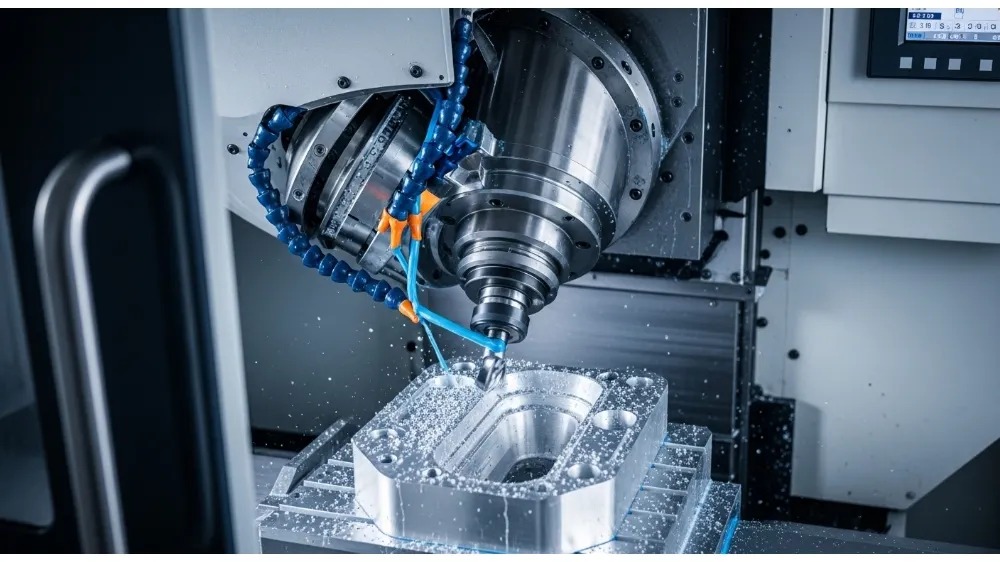
The 5-axis CNC machines provide an additional rotational plane, usually the B-axis with which the cutting tool can approach the workpiece at literally any angle. The ability allows machining of very complicated geometries, such as contoured surfaces, deep cavities, and undercuts, in one configuration.
The five-axis movement at the same time minimizes the repositioning of the part on various axes, leading to accuracy and uniformity. It is especially useful in aerospace, medical device and automotive processes that need complex details and tight runs.
The Pros of 5-Axis Machining
Flexibility and productivity is maximized by 5-axis CNC machining. It enables shorter cycle times, less complicated fixtures and enhanced surface finishes. Optimal tool life is achieved through the capability to maintain tool angles to minimize tool wastage, which increases the overall tool life and also decreases the overall cost of production.
Also, the 5-axis machines have the ability to create parts of complex and curved surfaces, which cannot be created using the 3-axis or 4-axis machines. They are features that render it essential in industries that require high-precision and multi-dimensional parts.
Shortcomings of 5-Axis CNC Machining
Although 5-axis machining is the most versatile, its upfront investment is more costly, its programming more complex and the learning curve is steep. The machines are sensitive to calibration and need to have skilled operators to make the full use of them.
Also, the size of the workpiece of a 5-axis can be restricted as compared to certain 4-axis machines. It should put this factor into consideration in case of planning production of bigger components.
The Major differences between 5-axis and 4-axis CNC
The main dissimilarities are flexibility, complexity, and scope of application:
- Axes of Movement -4 axis: This introduces rotational axis; -5 axis: This introduces two rotational axes.
- Complexity: 5-axis programming is more complex and enables machining of complex parts in a single set up.
- Applications: 4-axis is suitable to cylindrical or moderately-complex shapes. 5-axis is used to shape contoured and multi-sided forms.
- Tool Orientation: The 5-axis machines are kept at optimum cutting angles to provide excellent surface finish and minimized tool wear.
This knowledge of these differences guarantees that manufacturers do not use the most effective process when it comes to this or that project.
The Modern Manufacturing Applications
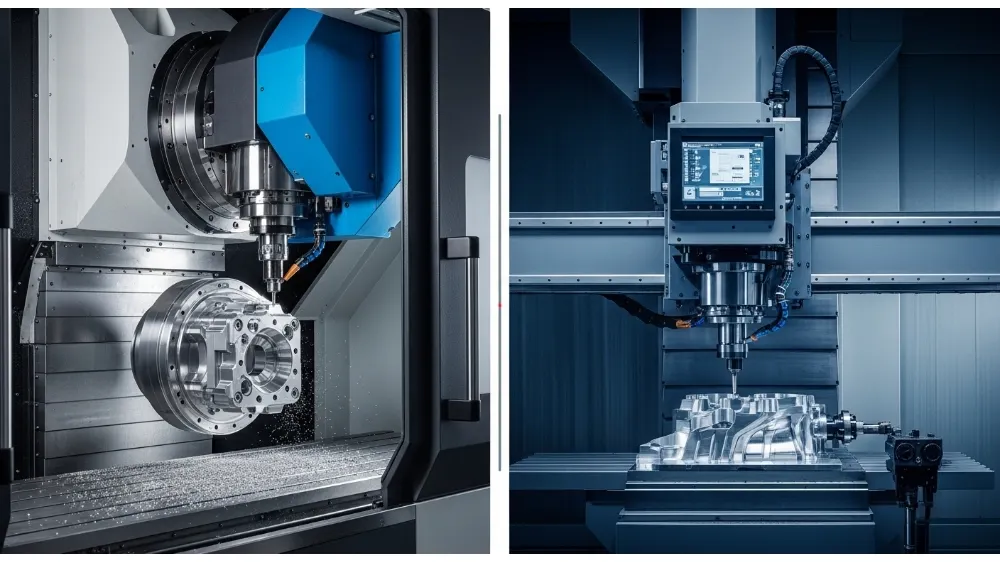
4-Axis CNC: optimal when it comes to rotational parts such as gears, pulleys and the cylindrical housings. It is commonly applied to medium complexity parts where productivity and flexibility are needed.
5-axis CNC: It is mandatory in aerospace turbine blades, medical implants, automotive mouldings, and other highly shaped parts. The technique is also desirable when there is a high level of precision, low volume, or prototype.
Programming Considerations
The 4-axis machine entails rotational indexing and sequencing. CAM software helps to create toolpaths and provides the correct geometry of parts.
The 5-axis programming is more advanced and it demands synchronization of multi-axis and optimization of tool orientation. The preparation of 5-axis toolpaths requires engineers to take into account collision detection, machine kinematics, and surface finish requirements.
Machine Requirements and Tooling
The choice of tools differs depending on the two systems as 4-axis machines tend to utilize common end mills and drills whereas a 5-axis system would require specific cutters so as to ensure constant contact with the multi-angle surface.
The two systems are sensitive to machine rigidity, spindle power and the supply of coolant delivery, yet the 5-axis machining requires more precision and consistency because of the complicated simultaneous movements.
Considerations in Cost and Efficiency
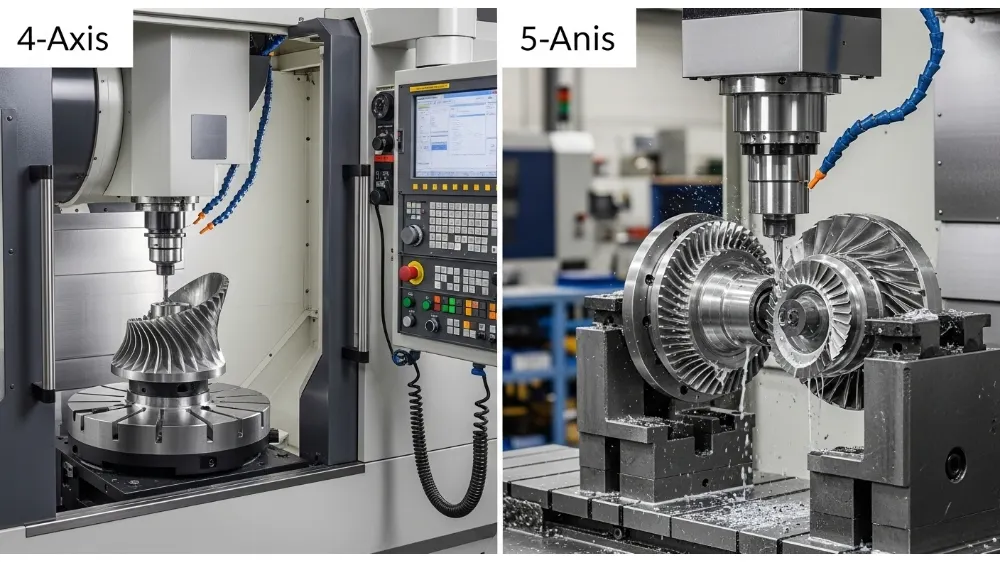
The 4-axis machines are also less costly to acquire and run and are appropriate in medium complexity parts or high run production.
5-axis machines are more expensive, but they lessen the setups and enhance accuracy in the case of intricate geometries, and may compensate the high initial cost with fewer setups, fewer errors, and less rework.
Occupational Safety and Operational Good Practices
Both 4-axis and 5-axis operations require proper set up, a secure fixturing, and frequent maintenance. Multi-axis kinematics, toolpath checking and collision avoidance should be trained to the operator so that it can be safe as well as part quality.
Frequently Asked Questions (FAQ)
Q1: What is the biggest distinction between 4-axis and 5-axis CNC machining?
A: 4-axis includes an additional rotational axis, which is appropriate to a cylindrically shaped part, whereas 5-axis includes two rotational axes to address contoured geometries.
Q2: Which is the best machine that can be used to prototype complex parts?
A: 5-axis CNC is a perfect choice because it can perform multi-dimensional surfaces using one set-up.
Q3: Would 4-axis machines process undercuts?
A: Undercuts can be limited, however, 5 axis machines are needed in cases of complex, multi-angle undercuts.
Q4: Does 5-axis prove to be harder than 4-axis to program?
A: Yes, 5-axis programming needs higher level CAM software and operators to avoid collisions and optimal tool paths.
Q5: What machine is more cost-effective?
A: 4-axis machines are lower in initial cost and easier to operate, which are adequate to medium complexity parts.
Q6: Is there an improvement in the tool life of both machines?
A: The cutting angles are kept in better condition with 5-axis machining avoiding more wearing of the tools whereas 4-axis is more restricted in making tool adjustments.
Q7: What are the industries of 5-axis CNC machining?
A: 5-axis capabilities are best applied in aerospace, medical devices, automotive, and mold-making industries.
Conclusion
The 4-axis and 5-axis CNC machining have their benefits. The choice of the right system is determined by the complexity of the parts, volume of production, material and precision needs. When compared to 4-axis, 5-axis allows machining of complex components with high level of surface finish with high efficiency when rotating and moderately complex components are involved. Knowledge of these differences makes machining processes optimized, productive and manufacturing results are high.
