


PVC Melting Point Explained: What Really Happens When Polyvinyl Chloride Heats Up
PVC (polyvinyl chloride) is everywhere—pipes, window profiles, cable insulation, flooring, medical tubing—and it earns that popularity by being tough, corrosion-resistant, and cost-effective. But when you start processing, welding, bending, machining, or heat-forming PVC, one question quickly becomes important:
What is the melting point of PVC?
Here’s the twist: PVC doesn’t behave like a “clean-melting” plastic. Instead of switching from solid to liquid at one tidy temperature, PVC softens across a broad range, and it can start degrading before it fully flows if you push heat too far.
This guide breaks down PVC’s thermal behavior in plain terms—what temperatures matter, why additives change everything, and how to avoid the most common heat-related failures.
1) Does PVC Have a True Melting Point?
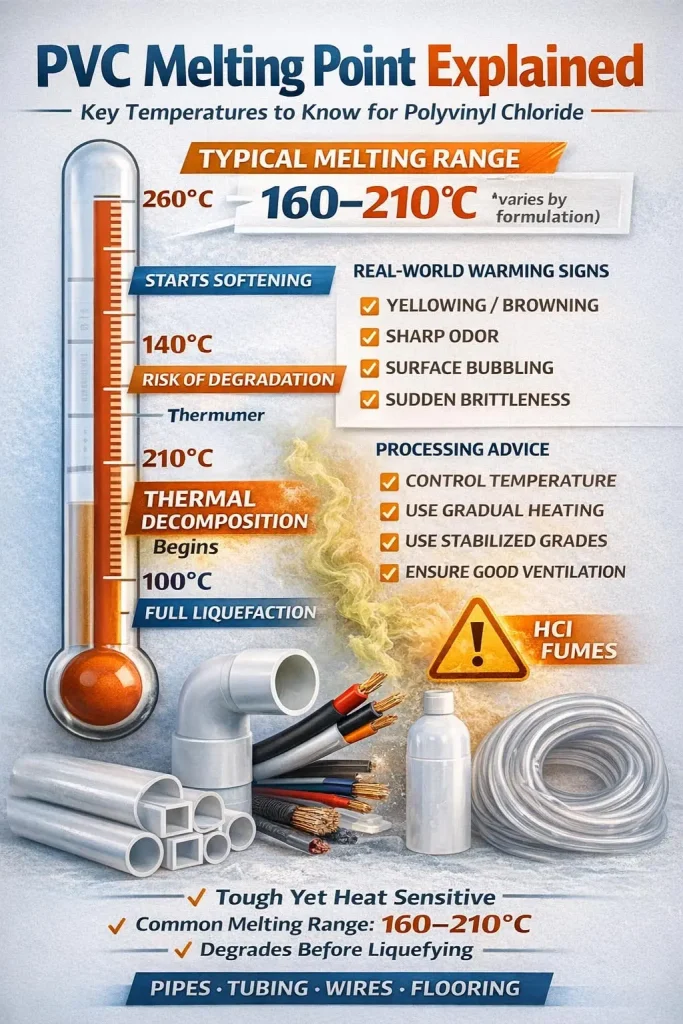
Unlike many semi-crystalline plastics, PVC does not have a sharply defined melting point. In practical terms, it becomes pliable gradually, typically across a wide temperature window—commonly cited as roughly 100°C to 260°C, depending on the formulation and additives.
Even more important: PVC is known for thermal decomposition that can begin in the same general temperature neighborhood as processing temperatures. Some references describe decomposition behavior starting around ~210°C, which is “more characteristic of PVC than an actual melting process.”
What this means for real work:
- You can soften PVC for forming and joining,
- but you must control temperature tightly to avoid chemical breakdown.
2) How PVC “Melting” Is Measured in the Lab
Because PVC transitions gradually, engineers often evaluate its softening and thermal events using Differential Scanning Calorimetry (DSC). DSC tracks heat flow as the material warms, helping identify the boundaries where PVC softens and where it begins to break down.
In manufacturing, you usually don’t need lab equipment to make good decisions, but it’s useful to know this: reported “melting points” for PVC often reflect softening behavior + test conditions, not a single universal value.
3) What Controls PVC’s Softening and Decomposition Temperatures?
PVC is not “one material.” It’s a base resin plus a recipe of additives. That recipe can shift how PVC behaves under heat.
Key factors include:
- Molecular weight: Higher molecular weight can improve thermal stability and raise softening/decomposition boundaries.
- Additives (plasticizers, stabilizers, fillers): These can lower softening temperature for flexibility, or improve heat stability for processing.
- Crystallinity/amorphous structure: More amorphous PVC tends to soften over a broader range.
- Processing conditions: Heating rate and pressure can change observed thermal behavior.
- Purity and formulation consistency: Variations and impurities can make thermal response less predictable.
If your PVC parts behave inconsistently during bending, welding, or thermoforming, the root cause is often formulation variation, not the machine.
4) Temperature Effects: When PVC Starts to Break Down
PVC’s heat sensitivity is closely tied to dehydrochlorination—a degradation reaction that releases hydrogen chloride (HCl) gas and triggers further breakdown.
One practical reference point: without stabilizers, PVC may begin to deteriorate around ~140°C, and stabilizers (like calcium-zinc or lead-based compounds) are used to extend thermal stability.
So the story is:
✅ Soften PVC carefully
⚠️ Overheat and you can cause permanent chemical damage (discoloration, brittleness, loss of strength, fumes)
That’s why temperature management matters even if your goal isn’t “melting” at all—like when you’re simply heating for bending, solvent welding assistance, or local forming.
5) Rigid vs. Flexible PVC: Why “Same PVC” Can Act Very Different
PVC commonly appears in two broad families:
Rigid PVC (uPVC)
Rigid PVC is widely used in pipes, window frames, and structural profiles because it provides strong, stable performance for static parts. It offers high integrity but becomes more brittle in cold environments.
Flexible PVC (plasticized PVC)
Flexible PVC contains plasticizers that increase elasticity and bend performance—great for hoses, cables, and medical tubing—but it generally has lower tensile strength than rigid PVC and can degrade faster under UV and excessive heat.
Also, plasticizers typically lower the effective softening / melting range, helping processing and flexibility.
6) Typical PVC Properties (and Why Heat Limits Matter)
PVC is valued because it hits a useful balance of durability and cost:
- Tensile strength: roughly 34–62 MPa, depending on formulation
- Working temperature range: commonly cited around -25°C to 70°C
- Flame behavior: PVC is often described as self-extinguishing/flame-retardant due to chlorine content
- Impact: rigid PVC can handle impact, but becomes more brittle at low temperatures
That working range is a huge clue: if your application sees continuous high heat, PVC may not be the best material—unless you choose a modified grade (or a different polymer).
7) What About CPVC (Chlorinated PVC)?
Chlorinated PVC (CPVC) is used when higher temperature tolerance is needed. One common takeaway is that CPVC can handle higher temperature environments than standard PVC due to increased stability.
If you’re designing hot-water plumbing or higher-temp chemical service, CPVC is often brought into the conversation for exactly this reason.
8) Practical Tips for Processing PVC Without Ruining It
If you’re cutting, machining, bending, welding, or heat-forming PVC, the goal is not “hit the melting point.” The goal is controlled softening without degradation.
Here are shop-floor rules of thumb:
- ✅ Use gradual heating rather than sudden high heat (reduces scorching and local breakdown).
- ✅ Ventilation matters—PVC can release irritating fumes if overheated (especially during welding/heating).
- ✅ Choose the right grade (rigid, flexible, stabilized, CPVC) based on the real temperature exposure.
- ✅ Watch for early warning signs: yellowing/browning, sharp odor, surface bubbling, sudden brittleness—these often signal degradation, not normal softening.
9) Where PVC Shows Up (And Why Thermal Knowledge Helps)
PVC’s versatility is why it’s found in both industrial and daily-use products: piping, frames, flooring, cards, hoses, curtains, packaging, and cable insulation are commonly cited examples.
Across all these uses, knowing the “PVC melting point” isn’t just trivia—it helps you:
- set safe forming temperatures,
- prevent overheating during joining,
- select the right PVC type,
- and avoid failures caused by heat cycling.
FAQ Quick Answers
Is there a typical melting point range for PVC?
Many references describe PVC as a range rather than a point, often around 160–210°C depending on formulation.
Do plasticizers change PVC melting behavior?
Yes—plasticizers generally lower the effective softening/melting behavior to create soft PVC.
Why can PVC degrade before it “melts”?
Because PVC can undergo thermal degradation (dehydrochlorination) during heating, especially without stabilizers, with deterioration described around ~140°C in some contexts.
Closing Thought
PVC is incredibly practical—but it’s also thermally sensitive compared with many other plastics. Treat its “melting point” as a process window, not a single number. When you choose the right formulation and keep temperature under control, PVC performs reliably across a wide range of real products.
