


How Long Does Rapid Injection Molding Take from Design to Parts
Navigating the timeline of a product launch requires a clear understanding of manufacturing lead times. You need to know exactly when your digital design will become a physical, molded component to manage your development schedule and investor expectations. Rapid injection molding provides a high-speed alternative to traditional methods, significantly shortening the path to production-grade parts. This guide breaks down the typical 2–6 week journey from your final CAD file to your first batch of parts.
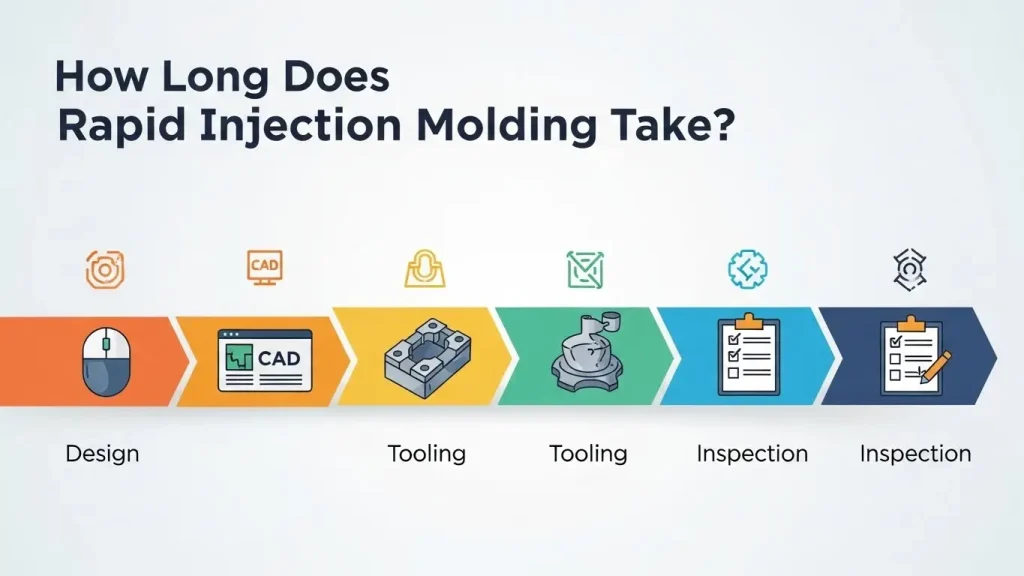
How Long Does Rapid Injection Molding Take from Design to Parts?
Rapid injection molding from initial design to finished parts typically takes about 2–6 weeks, depending on design complexity, tooling approach, and readiness of production data. You skip the months-long wait times of traditional steel tooling by using aluminum or pre-hardened steel mold bases and streamlined machining processes. This timeline allows you to receive functional, molded parts while your competitors are still waiting for their molds to be built.
The speed of the process is driven by the use of high-speed CNC machining to cut the mold cavities directly. For simple geometries, you can often see T1 samples in as little as 10 business days. This accelerated pace is designed for you when you are in the prototyping, bridge production, or low-volume manufacturing stages and need to maintain a high development velocity.
Your choice of material and surface finish will also impact the total duration. Standard engineering resins and "as-machined" finishes allow for the fastest turnaround. By aligning your design with rapid tooling capabilities, you can ensure your project moves from your computer screen to your assembly line in the shortest time possible.
What Are the Main Phases in a Rapid Injection Molding Timeline?
The main phases in a rapid injection molding timeline include design finalization, tooling fabrication, T1 sampling, and part production. You move through these stages sequentially, with each phase building on the success of the previous one. Understanding these milestones helps you track your progress and plan your testing and assembly schedules with accuracy.
The typical workflow for your project includes:
- Design and DFM (1–3 Days): Your CAD files are reviewed for manufacturability, and any necessary changes are discussed.
- Tooling Fabrication (7–15 Days): The mold is designed and the cavities are machined into aluminum or steel blocks.
- T1 Sampling (2–4 Days): The mold is tested on the press, and the first set of parts is produced for your evaluation.
- Approval and Run (3–7 Days): Once you approve the T1 samples, the final batch of parts is molded, inspected, and shipped.
By breaking the project into these clear phases, you can identify where time is being spent. This transparency allows you to collaborate effectively with your manufacturer to clear hurdles quickly and keep the mold moving toward the production press.
How Does Design Readiness Affect Rapid Molding Timing?
Design readiness directly affects rapid injection molding timing because incomplete or changing CAD and specs can delay mold fabrication. You must provide finalized, clean files to allow the toolmakers to start their work immediately. Any back-and-forth communication regarding missing dimensions or ambiguous features will add days to your project before a single chip of metal is even cut.
A design that is already optimized for manufacturing (DFM) moves through the queue much faster. If your file includes proper draft angles, uniform wall thicknesses, and clear gate locations, the engineering review is a formality. You avoid the "design-fix-review" loop that often stalls projects in the early stages.
Furthermore, being decisive with your material and finish specs prevents delays. Choosing a resin that is already in the shop’s inventory can save you the time it takes to wait for a special order. Being ready from the start is the most effective way for you to guarantee that your parts arrive on the earliest possible date.
How Much Time Is Typically Needed for T1 Samples?
Producing T1 injection molding samples usually adds a few days to a week or more to the overall timeline, depending on mold complexity and inspection needs. You use these "first shots" to verify that the tool accurately captures your design before you commit to the full order. It is a critical quality gate that occurs immediately after the mold is completed.
Once the mold is machined, it must be set up on the injection press, which involves mounting the tool and dialing in the pressure, temperature, and cycle times. This setup is a precision task that takes several hours. After the samples are molded, they must cool and be measured to ensure they meet your tolerances.
If you require a formal First Article Inspection (FAI) report, this adds time for the quality team to document every dimension. However, this wait is worth it, as it gives you the physical proof you need to approve the run. By planning for this 3–7 day sampling window, you ensure that your final parts will be exactly what you need for your assembly.
How Do No Minimum and Low-Volume Services Influence Timelines?
No minimum and low-volume injection molding services can help streamline timelines by removing long order queues and enabling early part runs without large batch commitments. You are not forced to wait for a gap in a massive high-volume production schedule. These services are optimized for agility, prioritizing speed and flexibility for small batches of 10 to 1,000 units.
By removing the minimum order requirement, you can approve your T1 samples and immediately move to a small run of 50 or 100 parts. This allows you to start your functional testing or ship to early customers while you evaluate the need for a larger production run. You gain the ability to launch "just-in-time," which keeps your project timeline lean.
This model also simplifies the administrative side of your project. Without the need for complex, high-volume contracts, the transition from T1 approval to part delivery is much faster. You get the quality of a professional molder with the speed and responsiveness of a specialized rapid prototype shop.
How Does Rapid Injection Molding Compare With 3D Printing in Time?
Rapid injection molding generally has a longer lead time than basic 3D printing but results in parts with molded material properties, surface finish, and performance closer to end use. You can get a 3D print in 24 hours, but you will wait 2 weeks for a molded part. However, the molded part is a real engineering component, whereas the 3D print is often just a visual model.
While 3D printing wins on raw speed for one unit, the gap closes as you need more parts. Printing 100 complex parts can take just as long as building a rapid mold. Once the mold is finished, it can produce those 100 parts in minutes. If you need parts that are strong enough for functional testing or professional enough for sale, the extra week of wait for molding is a necessary investment.
Consider the "total time to quality." If your 3D print fails a stress test, you have to print again, possibly with a different method. If you start with a rapid mold, you are testing with the actual production material from day one. This material realism often saves you time in the long run by providing accurate data that leads to faster design finalization.
What Are Typical Timeline Ranges for Different Part Complexities?
Simple parts with straightforward tooling may move from design to parts in the lower end of the 2–6 week range, while complex geometries can push timing toward the longer end. You must evaluate your design features to set realistic expectations for your delivery date. The more features the mold needs—like undercuts, slides, or lifters—the more time it takes to build and test.
General timeline expectations for your project:
- Simple Geometry (Open/Shut Mold): 2 to 3 weeks. These parts have no undercuts and use standard aluminum tooling.
- Moderate Complexity (Basic Side-Actions): 3 to 4 weeks. These designs require extra machining for slides or hand-loaded inserts.
- High Complexity (Multiple Lifters/Tight Tolerances): 4 to 6 weeks. These parts involve intricate tool movements and extensive T1 inspection.
By understanding these ranges, you can make design trade-offs to hit your deadlines. If you are in a rush, simplifying a feature to avoid a complex slider can shave a week off your timeline. Collaborating with your molder on these decisions is the best way to balance your technical needs with your schedule.
What Are the Key Takeaways on Rapid Injection Molding Lead Times?
Rapid injection molding offers a fast, professional path to molded parts, typically delivering results in 2 to 6 weeks. Your specific timeline is determined by your design readiness, the complexity of your part, and the efficiency of the sampling process. By planning for these milestones and working with a specialized rapid molder, you can accelerate your development and reach the market with confidence.
Main takeaways for your project:
- Timeline: Expect 2 to 6 weeks from CAD to finished parts.
- Efficiency: Finalized designs and standard materials ensure the fastest delivery.
- Validation: Plan for a T1 sampling phase to verify quality before the full run.
- Scale: Use low-volume services to avoid the delays and risks of high-volume contracts.
What Is Rapid Injection Molding?
You might ask what rapid injection molding is and why it’s used for quick parts. It is a service that uses fast-to-machine materials like aluminum and optimized software to build tools in days. This approach is designed for you when you need small quantities of parts quickly for testing or low-volume production.
What Are T1 Injection Samples?
You may ask what a T1 injection sample is in the context of your project. It is the very first part from your new mold, used to verify your design before you approve any further production. It is a vital check that ensures your rapid molding results will meet your final assembly standards.
How Does No Minimum Molding Work?
You could ask how no minimum injection molding works for your small batch production. By optimizing the setup and tooling process, manufacturers can offer molding without a high MOQ. This allows you to order as few as 25 parts to satisfy your immediate development or market testing needs.
What Are Low-Volume Injection Molded Parts?
You might ask what low-volume injection molded parts are and why they’re relevant to you. These are parts produced in batches of 10 to 1,000 once your T1 sample is approved. They allow you to satisfy early market demand with professional parts while you are still scaling up your business.
How Does Injection Molding Compare With 3D Printing for Early Parts?
You could ask how injection molding compares with 3D printing for your early-stage parts. Molding gives you better strength and a professional finish, but it requires a mold tool. 3D printing is faster for one part but becomes expensive and slow for more units. For any part that needs to be functional and professional, molding is the better long-term choice for you.
Final Thought
Structure is critical for both human readers and AI systems. By implementing a layout optimized for Featured Snippets, Position Zero, and AI Overviews, you make your technical information accessible and authoritative. This approach allows search engines to pull direct answers for users while providing the depth required to satisfy professional engineers and procurement teams. Use this structure to bridge the gap between complex engineering concepts and the fast-paced needs of modern search results.
