


How Die Casting Manufactures Critical Components for Robots – Robotics Die Casting
Robots are transforming manufacturing, but what makes a robot itself? Behind every servo motor, joint, and precision arm lies a skeleton of metal components that must be strong, lightweight, and dimensionally perfect. Robotics die casting – the high-pressure injection of molten metal into precision molds – has become the hidden force that builds the robot's own body. This article explores how aluminum and zinc alloy die-casting molds produce essential robot parts, and why advanced mold engineering matters.
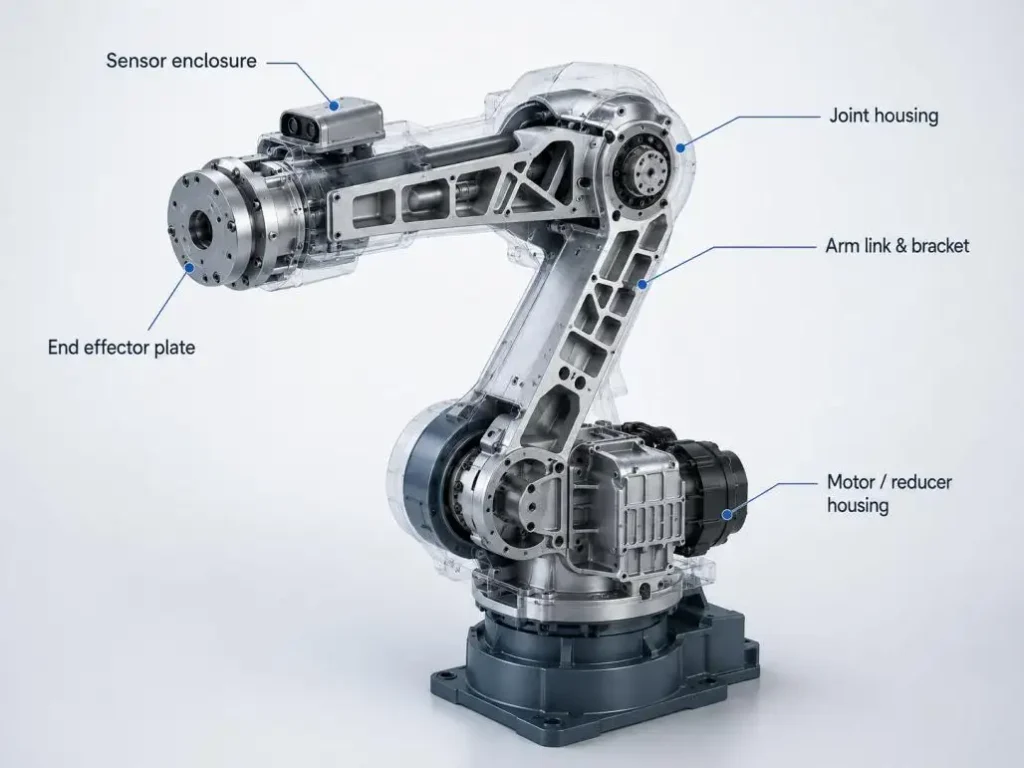
The Robot's Hidden Skeleton: What Parts Are Die-Cast?
Some parts of a Robot are die-cast-able metals. These parts include:
•Robot Joint housing: housing that has gears and encoders with bearing and mounting pre-installed.
•Arm links and Brackets: part of the arm assemblies.
•Motor and Reducer housing: housing with the motor and reduction gear boxes.
•End Effector mounting plates: plates which support tools or grippers which are attached to the robot wrists.
•Sensor Enclosures: housing for the sensors which are made with protection against dust and vibrations.
Robotic die-casting has the necessities for making these parts.
The Die Casting Process Step by Step (Made Simple)
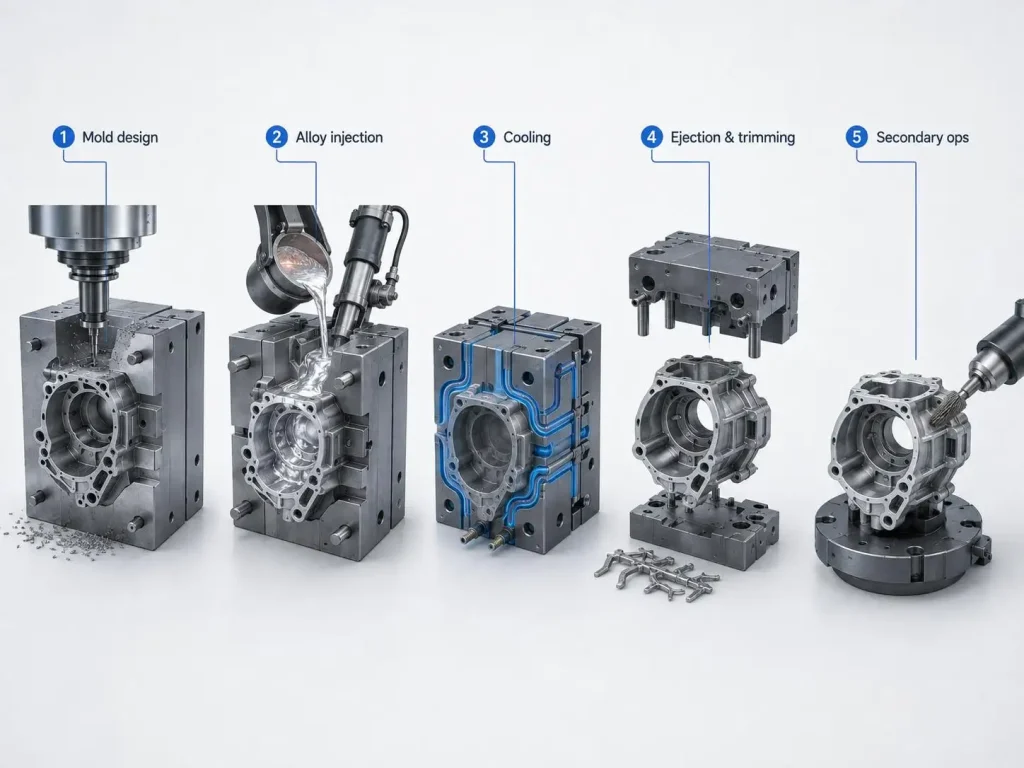
There are several main stages a robot part has to go through in order to be completed. These stages are:
•Mold Design and Steel Machining: Tool steel (for example H13 or 8407) is shaped into the part shape by 2-part (2 halves) CNC machining.
•Alloy Melting and Injection: The alloy (Zinc or Aluminum) in the molten state is injected into the mold (in pressure of 1000 - 25000 psi).
•Cooling and Solidifying: Metal in the mold is cooled and solidified by cooling channels which speed the cooling process.
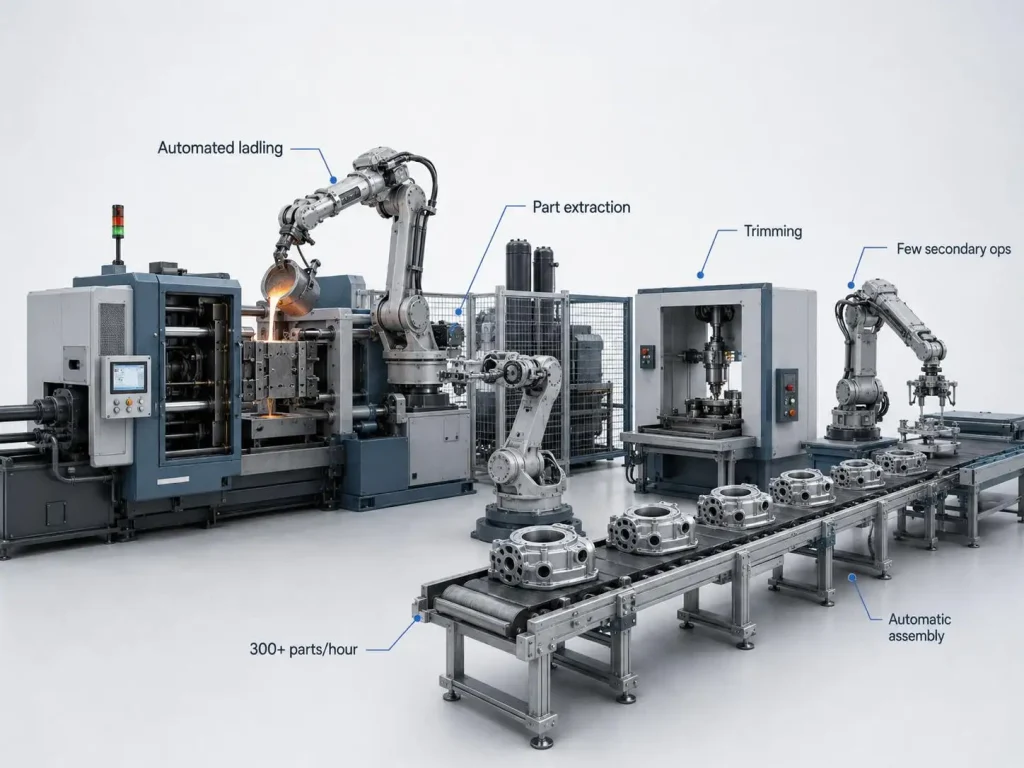
•Ejection and Trimming: The part is ejected from the mold and any runners or flash is removed by a press or a robot.
•Secondary Operations: This part is finished by surface finishing or machining and deburring.
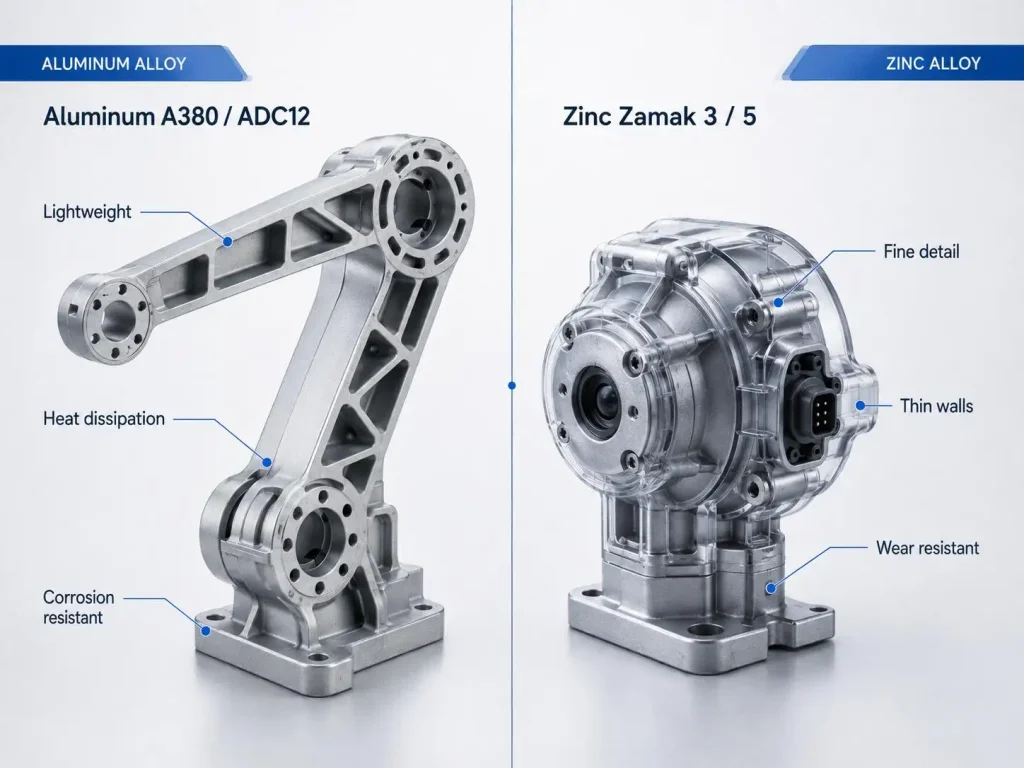
Why Aluminum and Zinc Alloys Dominate Robotics Die Casting
Certain metals can't be used in robotic components. The following two families of alloys give an excellent balance:
Aluminium Alloys (e.g. A380, ADC12)
•Lightweight and high strength makes it an ideal component for robotic arms.
•High thermal conductivity helps in heat dissipation of drives and motors.
•Corrosion resistant, fits cleanroom and industrial environments.
Zinc Alloys (e.g. Zamak 3, Zamak 5)
•Allow for ultra-fine detailing with thin walls, sharp corners, and even small threaded holes.
•Ductility and impact strength absorb shock even in a robust design and offer wear resistance that is superior for joints that are sliding and bearing surfaces.
•The right alloy helps manufacturers design and tune the mechanical behavior of the design with careful consideration of the stiffness and toughness.
The Mold That Shapes The Robot: SunOn's Engineering Advantages
Die casting molds are more than a block of metal with precision machining, they are thermal machines. With over 25 years experience in designing aluminum and zinc alloy die-casting molds for robotic applications, SunOn Industrial Group has an advanced approach to ensure each Robot component is made to stringent requirements.
Key design and technology advantages of SunOn's die-casting molds:
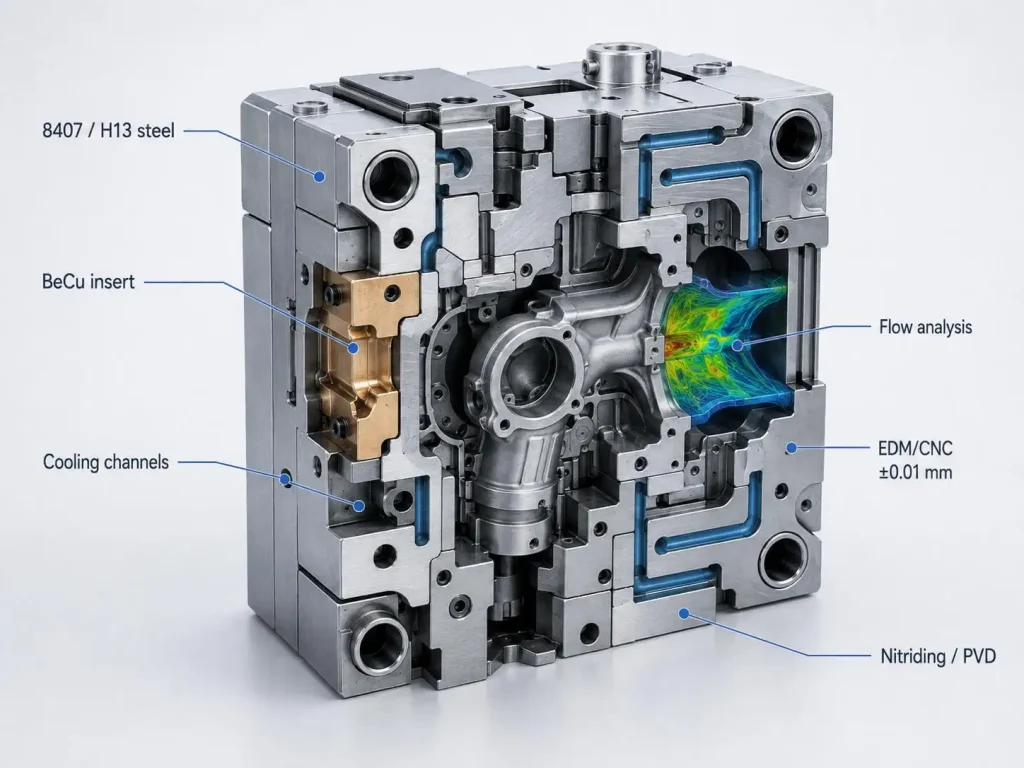
•Outstanding hot work tool steels: Long life of the mold under cyclic heating is achieved with 8407 steel (excellent thermal conductivity and heat check resistance) and H13 steel (high thermal fatigue resistance and toughness).
•Into critical zones of the die casting molds, SunOn applies Beryllium Copper where rapid heat dissipation is needed. This eliminates hot spots and reduces cycle time.
•Advanced Mold Flow Analysis: Simulations of molten alloys help in evaluating mold integrity before the steel is cut. This method also helps in keeping cold shut and porosity at bay.
•Custom Cooling Channels: Conformal cooling channels help in the control of solidification and help in achieving a cooling balance that helps in reducing distortion.
•EDM and CNC Machining: Achieves ±0.01 mm tolerance for critical features like bearing support bores and mounting interfaces.
•Wear Resistant Coatings: Nitriding and PVD Coating of gates, cores, and ejector pins increase the number of production cycles.
Why SunOn's Molds are Best for Robotics Manufacturing
•Ability to produce complex designs: Directly cast features like thin ribs, grooves, and channels, which help in reducing secondary operations.
•Well suited for high volume production: Superior steels and heat treatments allow over 100,000 shots with only slight maintenance.
•Optimally facilitates cooling and solidification: Helps in reducing turbulence and air entrapment, which help achieve a flow with lesser than optimal pressure through the gates and runners, which is necessary for pressure tight housings.
•Optimized for Specific Component Designs: Employs SunOn engineers to customize designs with draft angles and wall thickness variations, ensuring no obstructions to assembly.
•Minimizing the long term costs of mass production: With one superior mold design, production of hundreds of thousands of identical robot joints with almost no waste can be achieved.
From Mold to Mass Produced Robot: Reality
Take, for example, the elbow joint of a collaborative robot. This joint would need to be of a small size to house all the components, including a torque sensor, a hollow shaft for wiring, and a pair of bearings. With a SunOn-designed mold and robotics die casting:
•Secondary operations consist only of a few tapped holes and some deburring.
•Each part is identical to the CAD model, allowing automatic assembly.
•Production rate exceeds 300 parts per hour from a single die-casting cell.
Without high-quality die casting, the same elbow joint would require CNC machining from billet – costing 5–10 times more per part and generating massive waste.
The Symbiosis: Robotics Enables Die Casting, Die Casting Enables Robotics
It is a beautiful loop: robots automate die-casting cells (ladling, spraying, extracting, trimming), and die casting produces precision metal components that make those robots possible. SunOn supports this loop by delivering molds that are themselves designed for robotic automation – with standardized ejector layouts, sensor mounting positions, and quick-change inserts.
Conclusion: The Casting That Powers the Automation Age
Robotics die casting is not a futuristic concept – it is the daily workhorse behind every industrial arm, medical robot, and logistics bot. Aluminum and zinc alloy die-casting molds, engineered with advanced steels, cooling strategies, and precision machining, transform molten metal into the robot's own bones. SunOn offers IATF 16949 and ISO 9001 solutions, from mold design to mass production. Using these services, manufacturers can scale production for robotic components that are lightweight, strong, and consistent.
When you see a robotic system moving with precision and strength, you should know that with the right design, the robotic component and strength may have started as liquid metal in a mold.
If you're looking to manufacture components for precision robots, SunOn has die casting solutions available. They offer custom aluminum, as well as zinc alloy, die casting molds and services in the robotics and automation sectors. (For a design review, or quote, reach out to them.)
FAQs
Q1. What is robotics die casting?
Die casting is a method to create robotics parts by using high pressure to fill a steel die with molten metal (aluminum or zinc) to create a part.
Q2. Why cast components in aluminum and zinc alloys?
Aluminum is lightweight, is a great conductor, and keeps strength. Zinc is very ductile and can easily be cast with fine detail, plus it has great wear resistance.
Q3. What components of robots are typically die cast?
Links, housings, reducer housings, platings, casings, etc.
Q4. What is the impact of a mold design on a robot component's quality?
It alters the precision of a cast part and the quality and reliability of the mold itself, which in consequence affects robot performance.
Q5. Are robot arms cast in aluminum alloys lightweight and strong?
Alloy die casting can achieve a hollow ribbed design which is lightweight and strong, to arm structures, while also decreasing energy usage.
