


Single-Cycle Dual Material Mold Production | Complete Guide
Single Cycle Molding: The Future of Multi-Material Injection Molding
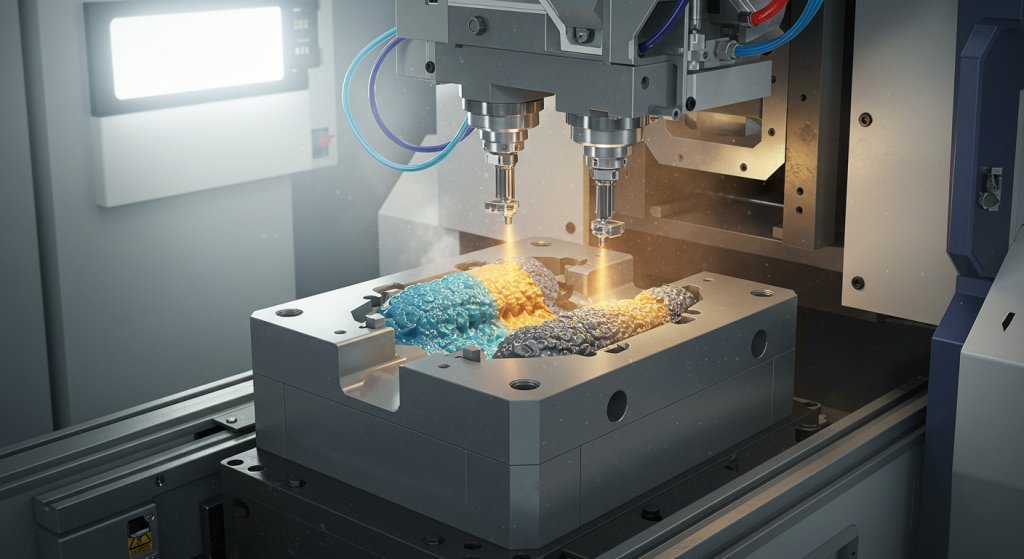
- With the dynamic nature of plastic molding technology, there are always new ways for manufacturers to increase efficiency, cut costs, and provide innovative designs of products. Single-cycle dual material mold production is one of the greatest innovations in this area. This high-tech operation enables plain injection of two disparate materials or the alternative color of the identical material in a single injection, a finished product that has a seamless bond, enhanced functionality, and high aesthetic features.
- Dual-material injection molding processes simplify production in contrast to traditional molding, which usually necessitates secondary operations. This saves time and reduces errors and assembly costs, as well as makes it a preferred option in many industries such as automotive, medical devices, consumer electronics, and industrial components.
We are focused on creating tailored dual-material mold production services through the development of CAD/CAM design, mold flow simulation, tooling precision, and high-performance polymers to produce the best results in the world.
Knowing the Single-Cycle Dual Material Mold Production
- Single-cycle dual material mold manufacture (also known as two-shot mold manufacture or dual-shot injection molding) is a process in which two dissimilar resins are injected into the same mold each cycle. This process guarantees that the materials to be bonded directly within the mold instead of being made into two distinct parts and then glued them afterward.
- The result? A long-lasting, dimensionally correct, and visually impressive part with multi-functional features. Soft-touch ergonomic grips to dual-color automotive trims: the applications are quite endless.
How Does the Process Work?
- Base Material (First Injection)- The first material is the major structure of the part; it may be a source of strength or rigidity.
- Mold Rotation / Transfer- The mold rotates or slides (by the base part) into the second cavity.
- Second Injection (Secondary Material)- The second material is a resin, usually softer or a different color, that is injected on top of or next to the first material.
- Bonding/ Cooling- The two resins develop a chemical or mechanical bond and create a single unit.
Technical and Engineering
In order to achieve success in multi-material injection molding, there should be precision engineering and the design of tools. Several technical reasons come into play.
- CAD/CAM Mold Design- Production of dual-material - Digital modeling guarantees optimal parting lines, cavity designs, and material flow.
- Mold Flow Simulation- Estimates resin behavior, bonding areas, and potential defects to ensure that it injects smoothly.
- Two-Shot Molding Hot Runner Systems- Build a better cycle time and consistency of material flow.
- Cooling Channel Optimization- Warming elimination of warping and dimensional accuracy.
- Core and Cavity Design- Customized to accommodate high-tolerance, dual-material interfaces.
- Selection of Tools- Tool steel is critical to durability, particularly when shaping abrasive or high-temperature polymers.
- Cycle Time Optimization- This is essential to cost-effective production of dual-material, with less energy use and better throughput.
These are engineering decisions that have a direct effect on the bonding strength, cycle efficiency, and the longevity of the mold used.
Quality & Performance Benefits
There are measurable advantages to investing in single-cycle dual material mold production:
- Dimensional Accuracy- Advanced mold flow analysis provides tight tolerances in each part.
- Defect-Free Production- Minimizes warpage, sink marks, and bonding failures.
- Increased Reliability- Smooth seals increase product life.
- Optimized Surface Finish- Aesthetic quality obtained that does not need secondary painting or assembly.
- Cycle Time Efficiency- Removes post-process, reducing the time of production.
- Energy Savings- Streamlined operations minimize the use of energy.
- Dual-Materials Production That is Cost-Effective- Reduction in assembly steps results in decreased costs.
- Mold Longevity- Tools can provide millions of cycles with appropriate mold maintenance and selection of steel.
We concentrate on high precision manufacturing that is dual material and balances quality and performance.
Achieving Engineering Obstacles and Ideal Practices
Although the advantages are obvious, there are difficulties with dual-shot injection molding:
- Limitations on bonding of materials- Not every polymer pair bonds with one another.
- Multitaxing Tooling Design- Dexterity in accuracy cavity engineering is needed.
- Time Balance in Cycles- Rapid cycles may be subjected to incomplete bonding or cooling problems
- Parting Line Optimization- Visible lines can only be eliminated by a sophisticated design.
Early-stage CAD/CAM validation of design, mold flow simulation, prudent polymer selection, and sound engineering of tooling are best practices. With these measures, manufacturers will be able to have a steady, flaw-free output.
Buyer-Focused Solutions
When you need to end up with custom dual-material mold production services, it is important to select the right partner. Key offerings include:
- Multi-Material Molding Tooling- Custom tooling when needed to meet special product designs.
- Turnkey Dual-Material Mold Production- Design to the final part.
- Prototyping Services- Pre-production tests.
- High-Performance and Economical Solutions- Fast and efficient cycle time and energy consumption
- Professional Advice- Advice on polymer compatibility, mold design, and bonding strength.
At SunOn Mould
We boast of being the pioneers of two-shot molding solutions, and as a result, our dual-material injection molding is highly regarded by industries worldwide.
The Future of Hybrid Injection Mold Processes
The single-cycle dual material molding next generation will be concerned with:
- Mold Flow Simulation, AIs to predict defects
- State-of-the-Art Hot Runner Systems to reduce cycle times.
- To scale production, High-Cavitation Dual-Shot Mold Systems.
- Sustainable Materials to keep in line with sustainable progress.
- Uninterrupted Co-Injection Molding to achieve better bonding.
With industries driving to lighten, strengthen, and smarten the design, hybrid injection mold processes will continue to redefine the potential of manufacturing plastic components.
Conclusion
Single-cycle dual material mold production is a breakthrough in injection molding technology. Manufacturers can create high-performing, cost-efficient, and flexible designs by combining two materials or hues in the same process. The uses are infinite, whether it is in automotive dashboards or medical devices, or electronic enclosures. At SunOn Mould, we integrate engineering know-how, sophisticated mold technology, and premium materials to provide tailored, high-precision dual-material mold solutions.
