


Types of Springs: Comprehensive Guide for Manufacturing and Engineering
Springs are also necessary mechanical elements that are commonly applied in engineering and manufacturing sectors. They are used to store energy, control loads and absorb shocks, which underlie the work of many devices. The knowledge of the types of springs assists engineers and manufacturers in the selection of an appropriate component based on longevity, operating capabilities, and effectiveness. Correct selection of springs is used to guarantee optimum functioning in automotive, industrial, electronic, and consumer products.
Compression Springs
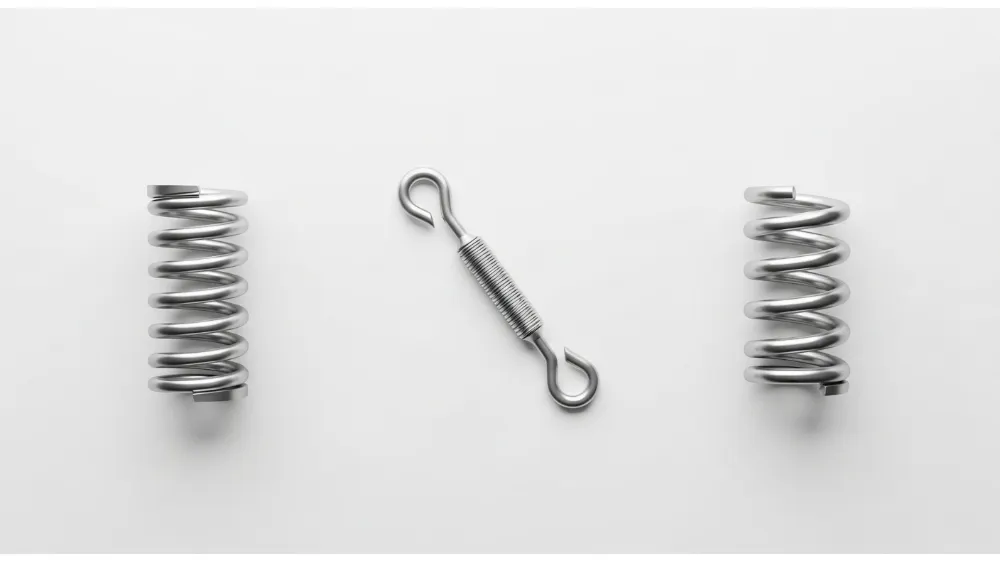
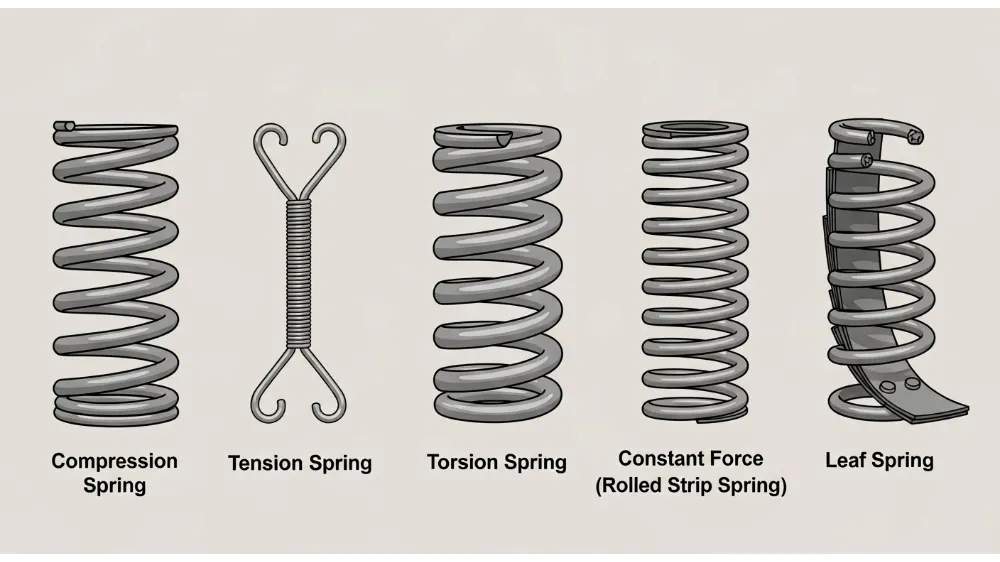
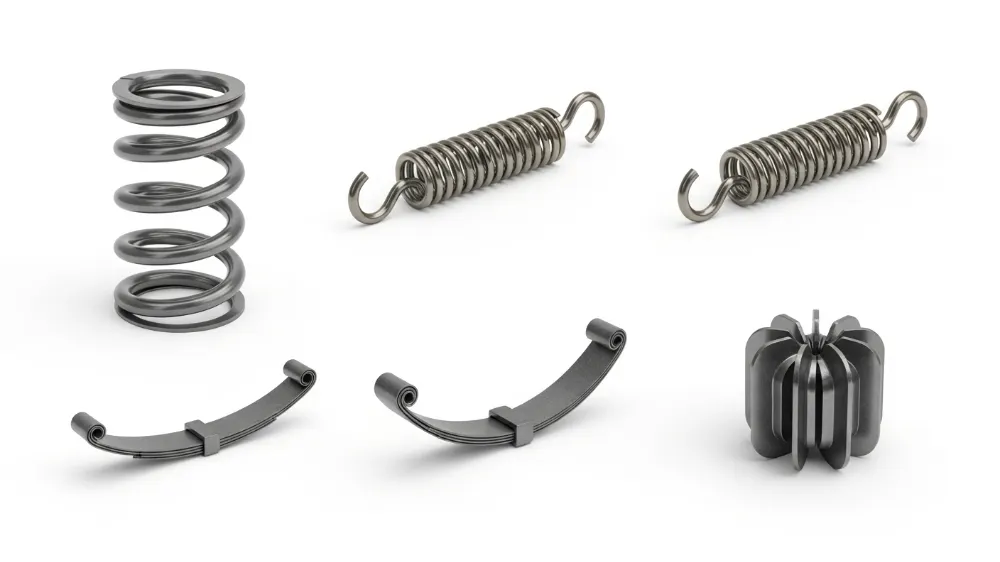
The compression springs are made in such a way that they resist the compression axial loads by compressing under load and springing to their initial height after the load is removed. These springs have wide uses as they are used as vehicle suspension, industrial valves and in medical machinery. The load-bearing capacity and the fatigue life of a spring depends on the stiffness, coil diameter and material. Permanent deformation is caused by only material strength and operating environment, and engineers should take this into account.
Extension Springs
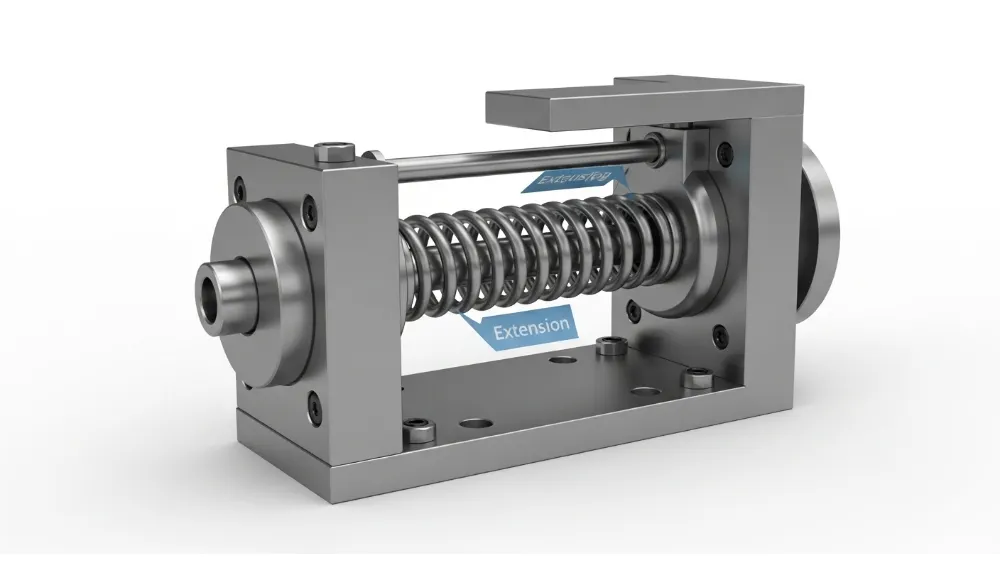
Extension springs are tensioned springs that are created to withstand the effect of stretching. They also have hooks or loops in their ends where they can be hooked to the components and also reconnect to their original length after being stretched out. Their common uses are garage doors, trampolines and exercise equipment. Tension calibration is important in order to prevent overextension that will lead to premature failure. The choice of material is also a key factor, impacting on fatigue resistance and life cycle.
Torsion Springs
Torsion springs are springs that accumulate energy by twisting them round their axis. These springs exert torque or rotational force when a force is applied to one end to rotate relative to the other. Clothespins, hinges, automotive gears and industrial machinery are some of the applications of the torsion springs. Diameter of spring, thinness of wire used and number of coils determine the features of torque and deflection. The choice of torsion spring allows maintaining the constant mechanical performance and eliminates the unbalanced loads.
Flat Springs
Flat springs or leaf springs or strip springs are constructed of flat metal strips that are bent to store mechanical energy. They are widely used in suspension systems, in clip mechanisms and in industrial assemblies. Their load capacity is determined by the strip thickness, the type of material and geometry. Leaf springs are valued due to their capacity to offer a smooth force dispersion and structural integrity at the repeated loading circumstances.
Constant Force Springs
Constant length springs offer a constant force in the direction of its movements. They come in the form of already stressed flat strips that are wound into coils. Applications It is used in retractable tape measurements, counterbalances, and industrial door mechanisms. The springs provide a constant force and thus are perfect in those situations when the movement and force need to be controlled accurately without the use of deflection variation.
Gas Springs
Gas springs or gas struts involve the use of compressed gas in a cylinder to generate both linear and damping motion. They are applied in automotive hoods, office seats and industrial equipment that needs smooth actuation. Gas springs have been appreciated due to their capability to offer controlled motion and adjustable force. The size of the cylinder, the pressure of gas and the diameter of the rod are all considered during the design in order to attain performance desired without affecting the safety.
Specialty Springs
Specialty springs are designed to meet special purposes that need non-standard shapes or purposes. They could be wave springs, clock springs and conical springs. The wave springs can conserve space in small assemblies whereas clock springs can store rotational energy in an accurate mechanism. The specialty springs can be developed in cooperation with the engineers to satisfy the load, deflection, and material needs of high-performance purposes.
Materials Used in Springs
There are many types of materials used to manufacture springs which are chosen due to mechanical properties and environmental factors. Common materials include:
Carbon steel: It is highly strong and durable and can be used in general.
Stainless steel: It has good tensile strength and good corrosion resistance.
Alloy steel: Strengthens toughness and fatigue resistance to extreme conditions.
Copper alloys: The alloys find application in electrical work, owing to their good conductiveness.
Titanium: Corrosion-resistant, lightweight aerospace and specialized.
The choice of material influences the fatigue life, spring stiffness and the overall performance in service.
Industrial Applications
In almost all industries, there is the use of springs. Automobile uses are in the form of suspensions, brakes, and transmission components. Industrial machinery uses springs to control loads, vibration damping as well as actuate precision. Micro-springs are utilized in electronics as switches, connectors and circuit protection. Even things used by consumers like pens, toys and exercise equipment are dependent on properly drawn springs. The choice of the appropriate type of spring guarantees functionality, safety and durability to these various uses.
Design Considerations
In designing springs, there are several aspects that have to be balanced; load requirements, operating environment, fatigue life and space constraints. It is through calculations and simulations that engineers can predict deflection, distribution of stress and what kind of failure mode might occur. Adequate consideration is made of the spring rate, coil diameter, wire thickness, and surface treatment to enhance the performance and increase service life. There are also other aspects of corrosion resistance, temperature stability and compatibility with the surrounding components.
The Typical Fallacies of Spring Choice
A number of mistakes may destroy spring performance:
- Installation of an incorrect spring type with the load or motion needed.
- Disregarding impacts on the environment like corrosion or temperature.
- Exceeding the fatigue limit of the spring.
- Failure to take care with deflection range and allow it to become permanent.
Design, material selection and testing are of great importance in preventing premature collapse and ensuring reliable working.
Frequently Asked Questions (FAQ)
Q1: What are the most common forms of springs in manufacturing?
A: This is compression, extension, torsion, flat, constant force, gas and specialty springs.
Q2: What is the correct type of spring to select?
A: Take into account load requirements, deflection, environment, size constraints and expected fatigue life.
Q3: Which materials are springs made out of?
A: Commonly used ones are carbon steel, stainless steel, alloy steel, copper alloys and titanium.
Q4: What is the importance of spring design?
A: The right design guarantees the correct delivery of force, durability and safety of mechanical assemblies.
Q5: Can springs be customized?
A: Yes, specialty springs are designed to suit given performance, size and environmental needs.
Q6: What are the industries that springs are dependent on?
A: The automotive, aerospace, industrial machinery, electronics and consumer products are some of the common usages of springs.
Q7: What is the effect of fatigue on springs?
A: Repeated loading may result in long-term permanent deformation or breaking when the material and design of the spring is not appropriate to the task.
Conclusion
Knowledge on the spring types and their use is crucial to the manufacturing today. The selection of the right spring depending on the load, movement, material, and surroundings promotes maximum performance, wear, and the cost effectiveness. High-tech materials, design and testing solutions assist the engineers to come up with dependable components across all industries, including automotive programmes as well as electronics and machinery tools. The correct choice of springs ensures the reliability of mechanical operation, minimizes the maintenance expenses, and improves the reliability of the products throughout the entire spectrum of application.
