


Comprehensive Guide to Steel CNC Machining: Properties and Parameters from Low-Carbon to Tool Steel
Steel is foundational to most industries today, from automobiles to medicine. Steel behaves differently when machined. It is important for engineers to understand the grade, mechanical properties, and cutting parameters when dealing with Steel CNC Machining. This guide has characterized major steel families and presents technical challenges for Steel CNC Machining.
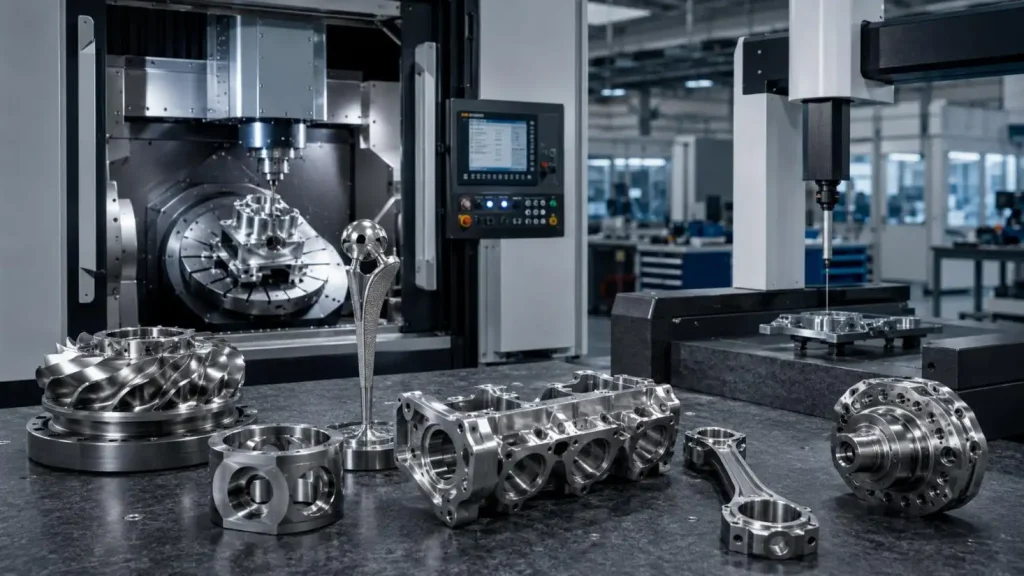
Effects of Steel Grades on CNC Machining
Heat treatment and chemical properties of the steel grade have direct effects on the tool, the surface finish of the machined part, and the cutting parameters. Using the wrong grade can cause excessive tool vibration and can result the part being scrapped rather than machined. A good understanding of the material can ensure better results when dealing with Steel CNC Machining.
1. Low-Carbon (mild) Steel
Used extensively in manufacturing, this steel contains less than 0.25% carbon content. Some examples of low-carbon steel are A36, 1018, and 1020.
•Machinability: Due to ductility of low-carbon steel, the grade has excellent machinability, however, severe tool vibration can be encountered if chip breakers are not used since the chips break continuously.
•Challenges: A cutting tool can have a built-up edge, which can affect the surface finish and the overall accuracy of the part.
•Cutting parameters: Using coolant to decrease the built-up edge, while using sharp carbide inserts can be done.
Those steel grades are used for steel bases of machines and assemblies. For lower carbon steel grades, we apply dynamic milling strategies to achieve tighter tolerances with minimal edge and distortion.
2. Medium-Carbon Steel – Best Strength and Hardness
Medium-carbon steels (such as 1045 and 1050) have a carbon content ranging from 0.30% to 0.60%. Generally, "medium-carbon" implies higher strength; these steels exhibit increased hardness after heat treatment and possess greater strength than low-carbon steels.
•Machinability: Intermediate-carbon steels after annealing are medium to good in machinability, while hardened by quenching and tempering significantly lose their machinability.
•Main difficulty: High cutting forces and high temperatures; can be prone to work-harden if cuts are too light.
•What to apply: SFM of 200–400 and use carbide tools with TiAlN coatings to generate adequate cutting speeds while withstanding the cutting temperature.
•Surface finish: A rigid setup can allow an average surface finish of Ra 0.8 μm after the final machining pass.
•Common usages: Shafts, gears, hydraulic rods, and automotive axles.
When a design is sent to SunOn, its skilled engineers examine the design and provide a manufacturability (DFM). Their recommendations typically favor the use of a pre-hardened or annealed state of the steel to provide a design that optimizes the cutting tool's longevity while reducing machining cycle time and costs.
3. Alloy Steel–Meet Tough Standards with Custom Properties
Some steels like 4140, 4340, and 8620 have alloying elements like chromium, molybdenum, and nickel. They assist with toughness, hardenability, and fatigue strength.
•Machinability: Moderate to difficult, more so when in the hardened state (30-45 HRC).
•Main difficulty: Rapid loss of cutting edge due to abrasion and the propensity to form long, continuous stringy chips.
•What to apply: A cutting speed of 150–300 SFM coupled with a high-pressure coolant to assist in the evacuation of a chip and provide thermal control.
•Surface finish: An Ra 0.8 μm finish is standard and using a polish post machining can create a mirror finish.
•Common usages: Landing gear components, heavy-duty gears, and power transmission shafts.
SunOn uses 5-axis CNC technology to manufacture complex geometries. This technology allows SunOn to reduce the number of setups needed to manufacture geometries with high tolerances, and to maintain a positional tolerance of ±0.005 mm.
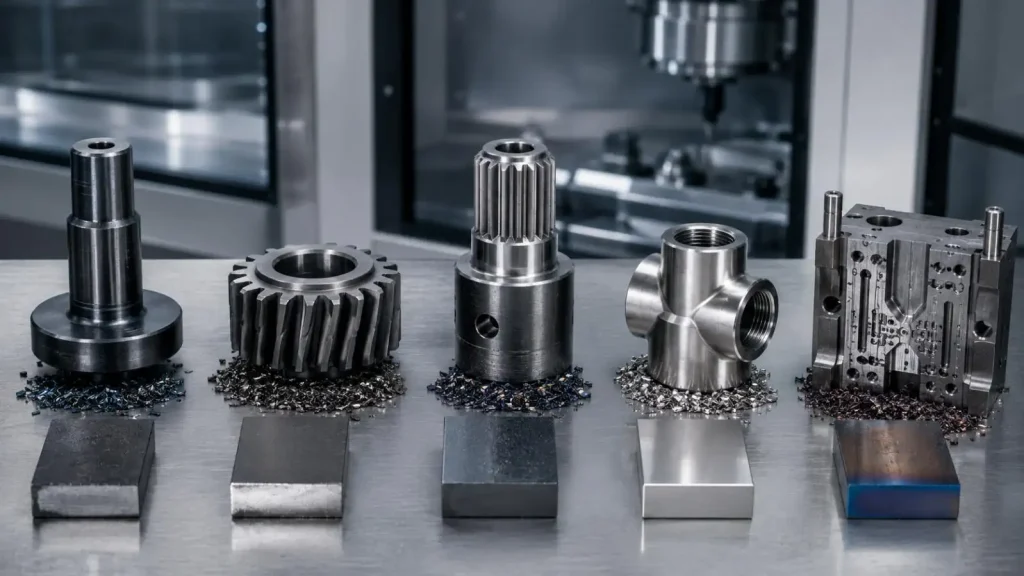
4. Stainless Steel – The Corrosion-Resistant Challenge
Stainless steels (304, 316, 17-4 PH) contain at least 10.5% chromium. They are valued for corrosion resistance but are known for work hardening and low thermal conductivity.
•Machinability: Poor to fair; austenitic grades (304/316) work harden rapidly if cuts are too shallow.
•Key challenge: Built-up edge occurs with rapid wear of the machining tool with increased friction at the cutting edge.
•Recommended parameters: Sharp tools with geometries that produce positive rake with feed rates of 0.10–0.25 mm/rev.
•Surface finish potential: With improved rigidity of the setup, Ra 0.8 μm can be achieved.
•Typical applications: Equipment used in food processing, marine hardware, and medical tools.
Trochoidal milling is used in SunOn's Steel CNC Machining for stainless steel to enable heat management, maintaining tolerances of ±0.002 mm.
5. Tool Steel – High Hardness for Molds and Dies
High carbon tool steels (D2, A2, O1, H13) have tougher alloys added to them to have better toughness and resistance to heat and wear. These steels are usually machined when they are in the annealed state, and then are heat treated.
•Machinability: Poor in the hardened state (>50 HRC). Fair in the annealed state (<25 HRC).
•Main concern: Chipping and severe abrasive wear of cutting edges.
•Recommendations: Use of a rigid setup is a must to eliminate chatter. Use CBN or ceramic inserts at a low speed (80-150 SFM) for hardened steels.
•Surface Finish: Due to the final dimensions which are determined by grinding or Wire-EDM, a surface finish may be required after heat treatment.
•Typical applications: Tools for hot forming, stamping dies, and injection molds.
To deliver hardened tool steel parts with the required geometric tolerances, SunOn provides in-house wire EDM and heat treatment.
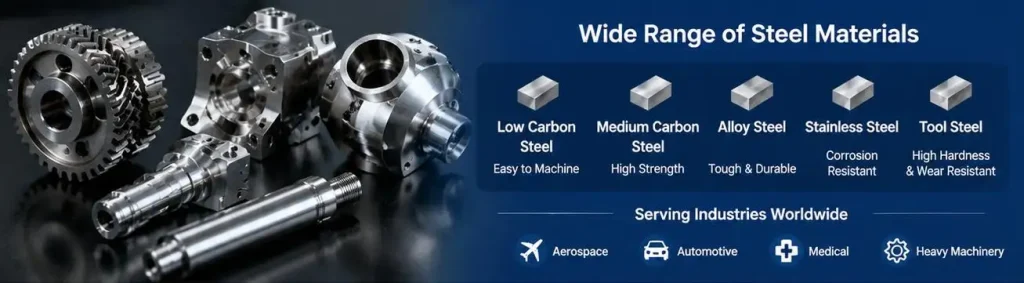
Key Factors When CNC Machining Steel
SunOn's custom steel machining services depend on the following factors being correctly controlled:
•Cutting speed (SFM): Low speeds for hardened steels. High speeds for low carbon and free machining steels.
•Feed rate: Chip load that is too little or too much causes work piece damage like enlarged holes, an uneven surface, and a poor finish.
•Depth of cut: 2 – 4 mm is a typical range for the amount of material removed in a roughing cut. This reduces the surplus material to around 0.1 – 0.3 mm for the finishing cut to achieve a surface roughness of Ra = 0.8 μm.
•Tool material: Steels especially require advanced coated carbides such as TiAlN, AlTiN and TiSiN.
•Coolant strategy: For deep pockets and holes, the pressure of the coolant needs to be over 1000 psi.
SunOn's Design and Technology Innovation for Steel CNC Machining
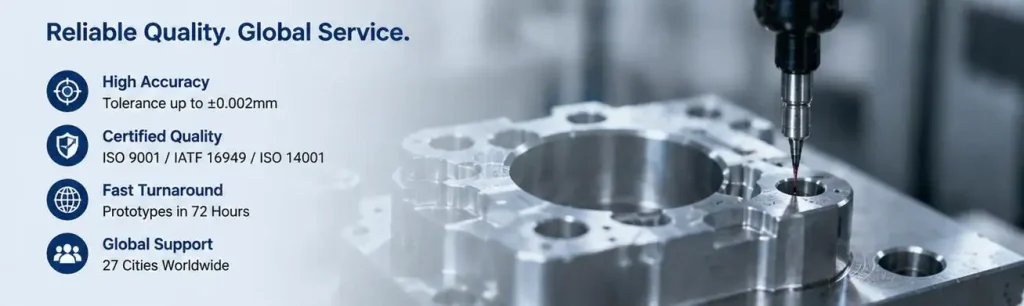
SunOn Industrial Group Limited has more than 25 years experience and provides a wide variety of steel machining solutions from design all the way through to mass production. The following capabilities provide constant, reliable, and cost-effective solutions.
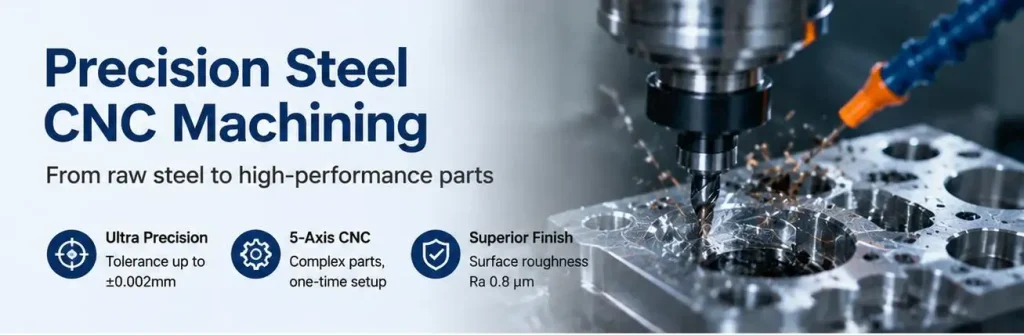
✅ Integrated service (3D design → DFM → prototyping → production): Integrated service avoids long lead times due to the need to coordinate multiple services.
•No tooling cost for CNC Machined steel parts: Prototyping for low quantities (1 – 100 pcs) is achieved within 72 hours.
•Ultra-precision tolerances (±0.1 mm,..., ±0.002 mm): Result of advanced CMM services and skilled programming.
•5-Axis CNC for Steel Parts with Complex Geometries: With modern CNC technology, additional setups aren't necessary.
•Typical surface roughness Ra 0.8 μm: Enables black oxide, powder coating, plating and polishing.
•ISO 9001, IATF 16949, and ISO 14001 Certifications: Almost all automotive and medical industry standards covered.
•Presence in 27 cities worldwide: Logistics and engineering support guaranteed in the covered and uncovered locations.
Whether you need a single low carbon steel prototype or a thousand hardened tool steel components, SunOn's Steel CNC Machining services offer the combination of material knowledge and process control.
Applicable Solutions Across Fields
•Aerospace: traceable alloy steel landing gear components and stainless steel hydraulic fittings.
•Medical: implant-grade stainless steel devices and instruments with required passivation and Ra 0.8 μm finish.
•Automotive: medium carbon steel shafts and 5-axis machined turbocharger housings.
•Heavy machinery: tool steel wear-resistant inserts and large alloy steel gear blanks.
Conclusion
Mastering Steel CNC Machining starts with the knowledge of the behavior of the various families of steel from free cutting low carbon steel to abrasive tool steels. Knowing the properties of the material and the correct cutting, tooling, and cooling parameters, is the factor which defines the cost, quality, and speed of a job.
SunOn Industrial Group Limited offers this expertise through their knowledge, 5-axis machining, and thorough quality control. For projects requiring precision steel components—whether one piece or one thousand—contact SunOn to discuss your design and receive a fast, competitive quote.
Get your precision steel CNC parts today – no mold cost, fast turnaround, and global quality standards.
FAQs
Q1: What is the standard of steel CNC machining tolerance?
A: Standard machining tolerance is around ±0.01 mm to ±0.05 mm. For ultra-precision machining tolerances, we refer to a measure of ±0.002 mm.
Q2: What do steel parts have as the average roughness after a machining operation?
A: Parts have an average surface roughness of about Ra 0.8 μm. Parts may also be covered with a layer of polish, plating, or black oxide.
Q3: Which steel is regarded as the easiest to machine?
A: The easiest grades of steel to machine of the steel families include 1018 low-carbon steel, and 12L14.
Q4: What is the advantage of 5-axis CNC machining for machining steel parts?
A: 5-axis CNC machining operates fewer setups, which saves time, and it works with a higher level of complexity.
Q5: What are some of the industries that utilize steel CNC machining?
A: Industries that integrate steel CNC machining include aerospace, automotive, medical, and heavy machinery along with energy sectors.
