


Thread Taps Make Important Equipment in Metalworking and Manufacturing
Thread taps make important equipment in the metalworking and manufacturing industry, making the component of creating internal screw threads in holes. Such tools are common in the automotive, aerospace, machinery and electronics sectors and used to guarantee accurate fastening and assembly. Knowing the types of thread taps, their use, and differences in their operation is important to engineers, machinists, and production teams to maximize their efficiency, precision, and tool life.
The guide is a comprehensive description of the types of thread taps, the operation principle, the recommended usage, and some practical guidelines of the correct choice of the tap according to the machining situation.
What Is a Thread Tap?
A thread tap is a cutting tool that shapes internal threads on to an already bored hole. Taps enable the use of fasteners to fit smoothly in parts unlike dies that cut external threads. There are a variety of thread taps in styles, sizes, and materials that should suit the thread profiles and the materials of work-pieces.
The major peculiarities of thread taps are:
- Thread profile compatibility: Metric or UNC/UNF or special threads.
- Taper and flute structure: Decides upon chip evacuation and cutting load.
- Material: High-speed steel (HSS), cobalt or carbide to different levels of hardness and wear resistance.
These attributes can be understood to make appropriate tap selection and minimize the chances of damaged taps, low-quality thread, or damaged workpieces.
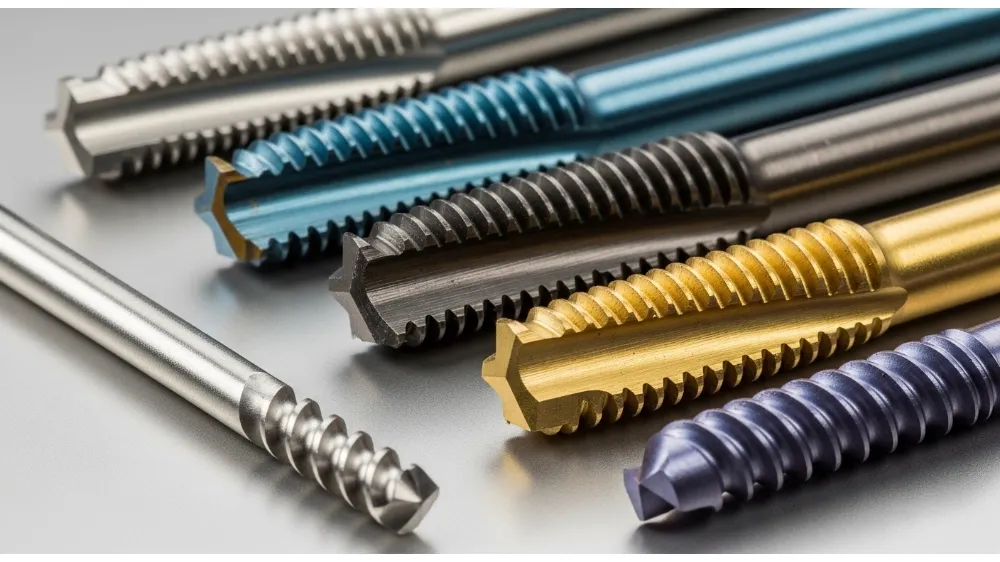
Simplistic Thread Tap Categorization
Thread taps may be separated by functionality, cutting style and geometry. This categorization assists operators to choose tools that are fast, precise and durable.
1. Taper Tap
The cutting edge of the tapers is angled; there is a typical internal profile starting with 8-10 threads gradually increasing in size. They can be used to thread a deep hole easily and they can also be used to do general-purpose threading.
Uses: Assembly of machinery, automotive engines, metal panels.
Pros: Simple aligning and less chances of breaking the tap.
2. Plug Tap
Plug taps are designed with a medium taper having fewer lead threads, which is acceptable to finish threads started off. They can be used both through holes and blindly.
Applications: Maintenance, repair and medium-depth threading.
Benefits: Both cutting action; may traverse tapers or bottoming taps to deep thread.
3. Bottoming Tap
Bottoming taps contain practically no taper in the tip, and are threaded right to the bottom of blind holes. They are suitable in holes where the greatest thread depth is needed.
Uses: Aerospace parts, hydraulic fittings, low tolerance assemblies.
Benefits: All threads are fully engaged; taper or plug taps must be pre-started.
4. Spiral Point Tap
The spiral point taps, also called gun taps, drive the chips forward into the hole, which lowers the clogging of through holes. They are very efficient in terms of production settings.
Uses: Metallic machining of large volumes of steel and aluminum.
Attributes: Rapid cutting, less chip jamming, less tool wear.
5. Spiral Flute Tap
Spiral flute taps are used to pull chips out of blind holes so that chips are not packed and the quality of the thread is enhanced. They fit perfectly in the deep holes or hard to machine materials.
Uses: Deep blind holes in tough alloys or stainless steel.
Pros: Fastener-cleaner, less tap tear, uniform action.
6. Forming Tap (Roll Tap)
Forming taps are used to displace material in order to form internal threads. They need ductile materials and are commonly applied in the case of aluminum and soft steel.
Uses: Automotive components, light metal cases, electronics cases.
Benefits: No chips formed, work-hardened threads, increased tap life.
7. Pipe Tap
Pipe taps are developed to insert cylindrical holes to fit the standard pipes. They are normally tapered or straight based on the need to ensure that the pipe joint is tightly sealed.
Uses: Hydraulics, plumbing, gas pipelines.
Merits: Standardized fitting threads; acceptable when used in sealing.
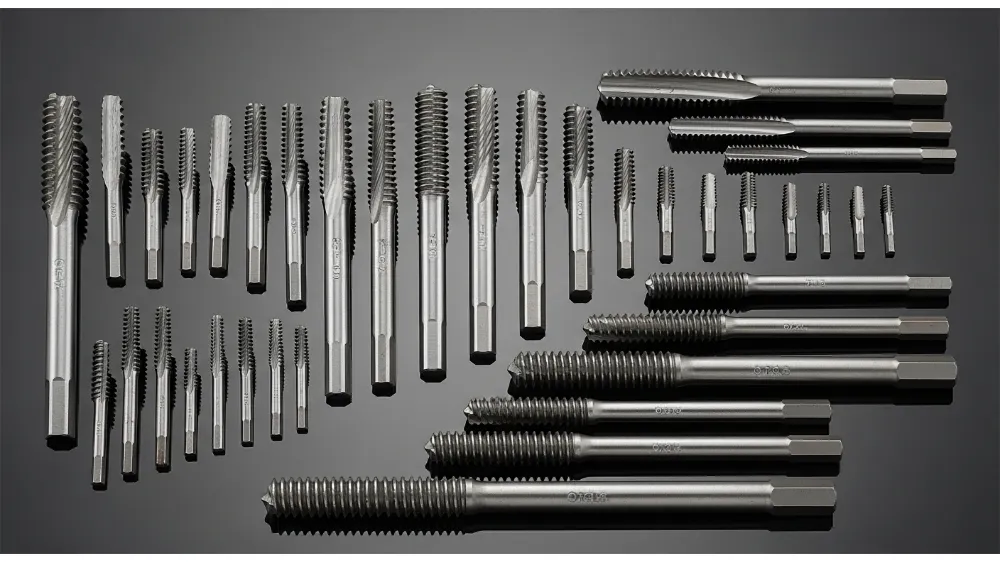
Thread Tap Materials
The correct tap material is dependent on both the work piece and working conditions:
- High-Speed Steel (HSS): General purpose threading; moderate heat.
- Cobalt Taps: Additional hardness and wear resistance; excellent in stainless steel or high-temperature alloys.
- Carbide Taps: Hardest and most wear resistant; optimal for abrasive and high-speed industrial applications.
Tool coatings such as TiN (titanium nitride) or TiCN (titanium tricalcium nitride) are sometimes applied to enhance wear resistance and reduce friction.
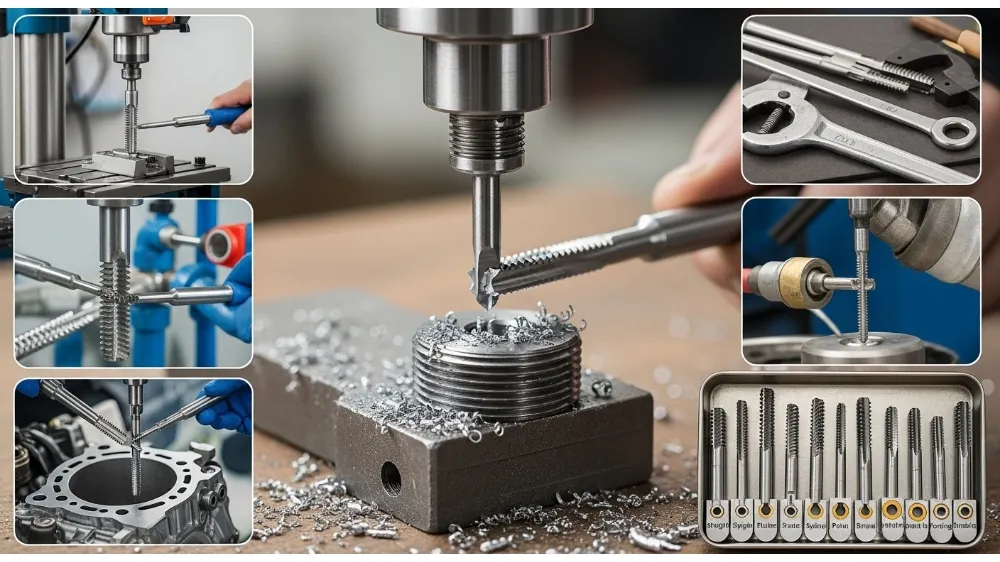
Threading Tap Geometry Scale
Proper geometry guarantees clean threads and long tool life:
- Flute design: Straight, spiral, or custom for chip control.
- Thread angle: Standard 60° for metric or UNC/UNF threads.
- Tolerance: 2B or 3B depending on fit and precision requirements.
Optimizing geometry according to material and hole type prevents tap breakage and ensures reproducible results.
Influencing Factors of Tap Performance
- Hole preparation: Correct drill size ensures proper depth and engagement.
- Lubrication: Reduces friction, heat, and tool wear, especially in metals like stainless steel or titanium.
- Machine type: CNC tapping requires rigid machines with precise spindle control; manual tapping depends on operator skill.
- Feed and speed: Correct feed ensures steady thread formation without overloading or breaking the tap.
Common Mistakes in Thread Tapping
- Using inappropriate tap types for blind or through holes.
- Ignoring chip removal, causing clogging or breakage.
- Applying excessive force or speed, damaging threads.
- Skipping lubrication for hard materials, causing accelerated wear.
Applications of Thread Taps
Thread taps are widely used across industries:
- Automotive: Brackets, engine blocks, transmission housings.
- Aerospace: Aircraft assembly, hydraulic fittings, precision components.
- Industrial Machinery: Gearboxes, pumps, valves.
- Electronics: Enclosures, heat sinks, small assemblies.
- Plumbing & Pipes: Threaded joints and fittings.
Correct tap selection ensures thread integrity, component reliability, and consistent production quality.
Frequently Asked Questions (FAQ)
Q1: What is the primary distinction between thread tap types?
Each type differs in lead thread design, chip management, and suitability for blind or through holes.
Q2: Can a taper tap be used in a blind hole?
Yes, taper taps are ideal for blind holes due to their gradual lead-in.
Q3: How do I choose between a cutting tap and a forming tap?
Cutting taps remove material, suitable for hard metals; forming taps displace material, ideal for soft metals.
Q4: Why is lubrication important during tapping?
Lubrication reduces friction and heat, prolonging tool life and ensuring high-quality threads.
Q5: Are spiral flute taps better than straight flutes?
Spiral flute taps remove chips efficiently in blind holes, preventing clogging and improving thread quality.
Q6: What materials are thread taps made from?
Commonly HSS, cobalt, or carbide, sometimes with coatings like TiN to enhance durability.
Q7: Can the same tap be used for stainless steel and aluminum?
No, harder metals require specialized taps, while aluminum can use general-purpose or forming taps.
Conclusion
Mastering thread tap types is essential for accurate, efficient, and high-quality threading operations. Understanding variations in function, geometry, material, and application helps engineers and machinists optimize production, reduce tool wear, and maintain thread integrity. Selecting the correct tap for each operation ensures superior performance, longer tool life, and consistent thread quality across materials and industries.
