


Vacuum Casting Vs Injection Molding Comparison: A Complete Guide
What Process is Right for Your Need?
It is no longer a one-size game when it comes to manufacturing plastic parts. In the current day, engineers, designers, and product developers have an up-and-down choice between vacuum casting vs injection molding comparison. The two processes both provide a quality plastic component, but they have very dissimilar requirements in terms of quantity, expense, velocity, and material selection.
What is Vacuum Casting?
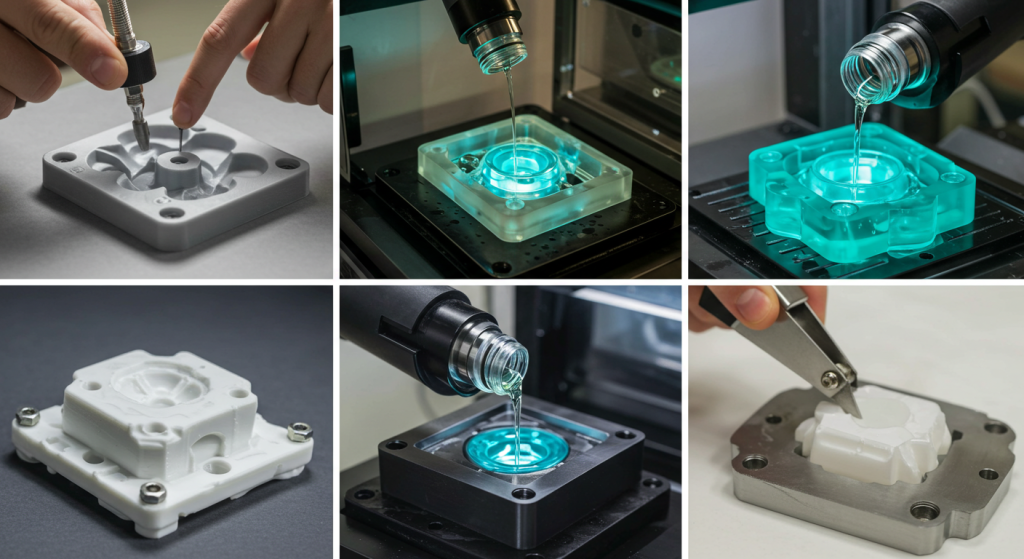
Vacuum casting is a low-volume manufacturing system that fulfills the role of prototyping and small-scale production. The process begins with a master model (typically CNC machined or 3D printed). An epoxy mold is made on the master. Then, liquid polyurethane resin- or ABS-like material- is injected into the mold in a vacuum. Air bubbles are eliminated by the vacuum to provide a smooth surface finish and dimensional accuracy.
Vacuum Casting Has the Following Key Features
- Ideal for 10 to 200 parts.
- Tolerances within +-0.2 mm to +-0.5 mm.
- Works with ABS-like, PP-like, PC-like, TPU, and PMMA-like materials.
- Lead time: as quick as 5-7 days.
- Less tooling than injection molding.
Get to know more about SunOn vacuum casting.
What is Injection Molding?
The most popular kind of plastic production is injection molding with high volume. It is done by pouring molten thermoplastic into a hardened steel or aluminum mold. When the mold is cooled down, a part is released that has extremely high dimensional accuracy and repeatability.
The salient characteristics of Injection Molding.
- Best for 10,000+ parts.
- Tolerances within +-0.05 mm.
- Works on a wide range.
- Lead Time: 3-8 weeks (because of tooling).
- Expensive up-front molding, but extremely low part cost at volume.
Vacuum Casting Vs Injection Molding: Side-By-Side Compared
Both injection molding and vacuum casting have their individual merits as far as plastic manufacturing is concerned. The correct decision will hinge on volume, cost, quality, and schedule. Below is a direct comparison:
Production Volume
Vacuum Casting: It is suitable for low-volume (10-200 parts) runs.
Injection Molding: Suited to mass-manufacturing (10,000 or more components).
Tooling & Setup Cost
Vacuum Casting: Low tooling price ($500 - 2000).
Injection Molding: This method is highly expensive to tool (10,000-100,000).
Lead Time
Vacuum Casting: Rapid turnaround, typically 5-7 days.
Injection Molding: Longer lead time, 3-8 weeks, because of building the mould.
Accuracy & Tolerances
Vacuum Casting: +-0.2 mm to +-0.5 mm.
Injection Molding: Extremely accurate, to +-0.05 mm.
Material Options
Vacuum Casting: Polyurethane resins that replicate ABS, PC, TPU, and PMMA.
Injection Molding: Thermoplastics of engineering quality (ABS, Nylon, PP, PC, etc.).
Mold Durability
Vacuum Casting: Each silicone mold requires 20-25 shots.
Injection Molding: steel/aluminum moulds have a lifetime of 100,000 plus cycles.
Select vacuum casting, short runs, and flexibility. Decide on injection molding, repeatability, and the cost effectiveness at scale.
Comparison of Cost: Vacuum Casting or Injection Molding
Cost is one of the largest determinants of the selection of a process.
Vacuum Casting Cost
Tooling: $500-$2,000 (silicone molds).
Part Cost: $30-$150 per part.
Small batches or prototyping.
Injection Molding Cost
Tooling: 10,000-100,000 (steel/aluminum molds).
Part Cost: <$1 at high volumes.
Most suitable for high-volume production.
Uses in Other Industries
Vacuum casting and injection molding are used in different industries with different purposes:
Automotive
Vacuum Casting: Concept parts, dashboard prototypes, and lighting housings.
Injection Molding: Bumpers, interior trim, engine parts.
Medical Devices
Vacuum Casting: Trials, casing test models in a short run.
Injection Molding: Surgery tools (in massive quantities).
Consumer Electronics
Vacuum Casting: The initial versions of phone cases, remote casings.
Injection Molding: Finished goods, production in large quantities of plastic shells.
Aerospace
Vacuum Casting: Aero generic tests.
Injection Molding: Structural plastic lightweight.
Pros of Vacuum Casting
- Lower upfront tooling cost.
- Quick turnaround.
- Great for prototypes.
- Good surface finish.
Pros of Injection Molding
- Perfect for mass production.
- Extremely low mass-price.
- Great repeatability and accuracy.
- Wide material range.
What to Use: Vacuum Casting or Injection Molding?
Vacuum casting and injection molding are used in the development of the product in different ways. The awareness of when to employ which process saves money and saves lead time. Select Vacuum Casting when you require:
Design Validation Prototypes
Early-stage product testing is best achieved by vacuum casting. It creates ABS-like components that replicate actual plastics and assist engineers in testing design, assembly, and behavior.
Small-Batch Production
It is best suited to a quantity of 10-200 parts and is commonly used in pilot production, marketing samples, or functional tests. Before mass production, cost-effective bridge tooling was present.
Unless you are willing to invest in costly steel molds, silicone molds can be used to provide a cost-effective, flexible solution to pre-production.
Select Injection Molding When You Require
Large-Scale Production
Coupled with the ability to manufacture thousands to millions of the same part, injection molding is the gold standard of mass production.
Uniformity of Thousands of Parts
It maintains a standard quality and dimensional precision of each part.
Close Tolerances and New Materials
Injection molding assists engineering-grade thermoplastics and can achieve the very fine tolerances required in such sectors as automotive, aerospace, and medical.
Succinctly, Vacuum casting is suitable for prototypes, low volume, and injection molding is superior in supporting large volumes and high precision productions.
Conclusion
The vacuum casting vs injection molding comparison will depend on the level of your project, funding, and time. Use vacuum casting on prototypes, low quantity, and high turnover. Use injection molding to produce in large numbers, with consistency and cost-effectiveness. We provide our clients with professional advice on this decision at SunOn Industrial Group, making sure that the solutions are cost-effective, high-quality, and delivered on time. Our team guarantees you are ahead of the competition, whether you require ABS-like vacuum casting prototypes or large-scale injection molding production.
