


Vapor Polishing of Plastics: Techniques, Benefits, and Applications
One common finishing process on plastic components is vapor polishing which enhances the surface smoothness, optical clarity and also appeals. Controlled chemical vapors allow their manufacturers to eliminate surface roughness and machining marks in thermoplastic component parts. The process of vapor polishing techniques should be understood by the engineers and designers who wish to achieve the improved quality of the products and retain the structural integrity.
The process is used in electronics, medical devices, automotive components, and consumer products industries. The method minimizes the requirement of the post-processing, visual look, and enables components to be attained to very tough performance and cosmetic criteria.
What Is Vapor Polishing?
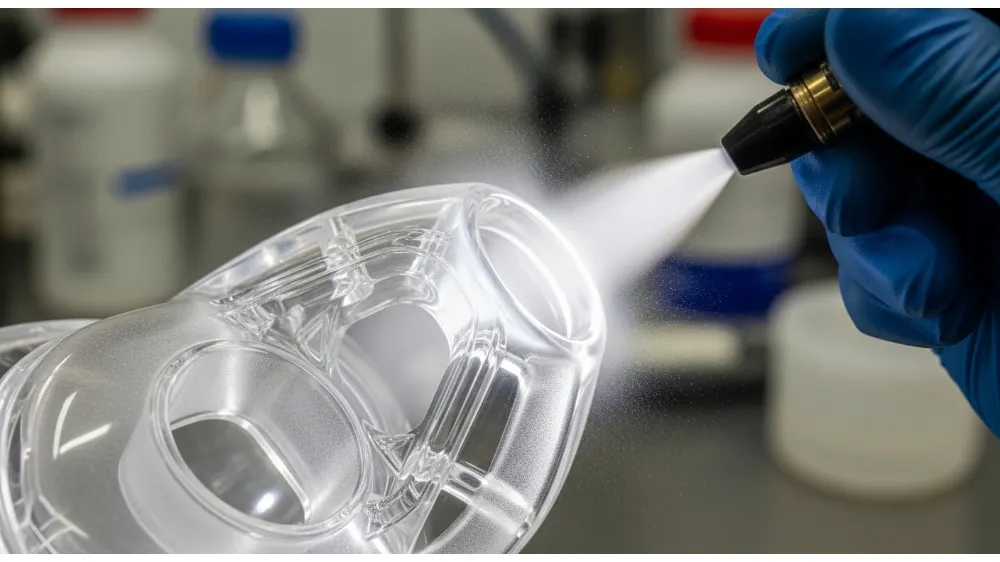
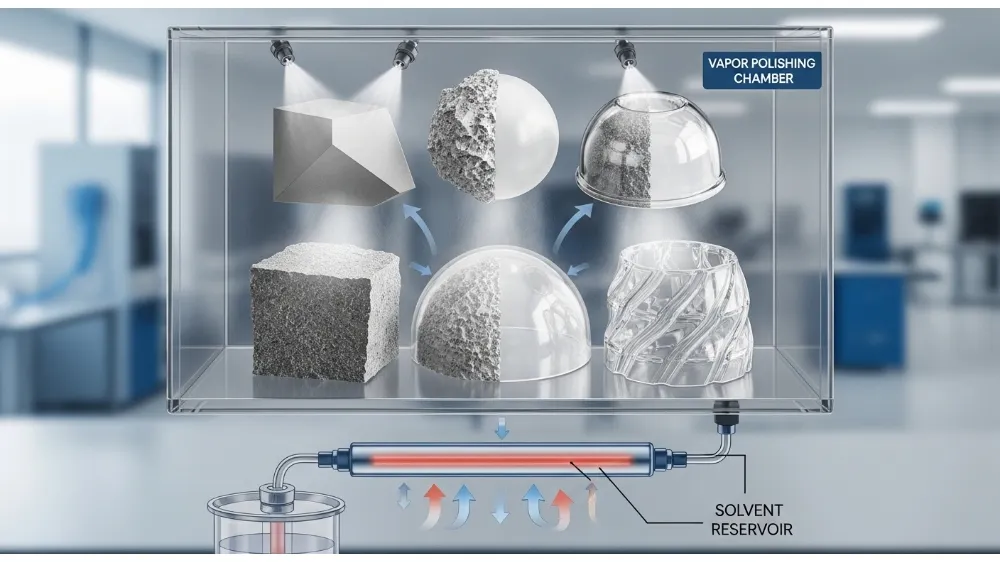
The vapor polishing is a chemical based finishing process which uses solvents to expose plastic components to their vapor. These vapors harden the outer layer of the thermoplastic substance, which enhances the movement and blending of microscopic defects. The surface hardens after cooling into a smooth glossy surface.
Vapor polishing will not abrasively wear material away like mechanical polishing. It is rather dependent on the regulated contact between the solvent vapor and the plastic surface. The method works particularly well with transparent plastics, in which optical clarity is of the essence.
Suitable Materials to Use in Vapor Polishing
Vapor polishing can not be done on all plastics. The thermoplastics like acrylic (PMMA), polycarbonate (PC) and some of the ABS plastics are good respondents of this process. The choice of material is based on the compatibility with solvents and required finish. Certain plastics could be soluble, and thus deformation of the surface could occur without appropriate regulation.
Chemical resistance, thermal properties, and dimensional stability are the criteria that engineers must look into when choosing materials used in vapor polishing. The correct choice of materials will guarantee that the process will enhance aesthetics without losing the mechanical performance.
The Vapor Polishing Process
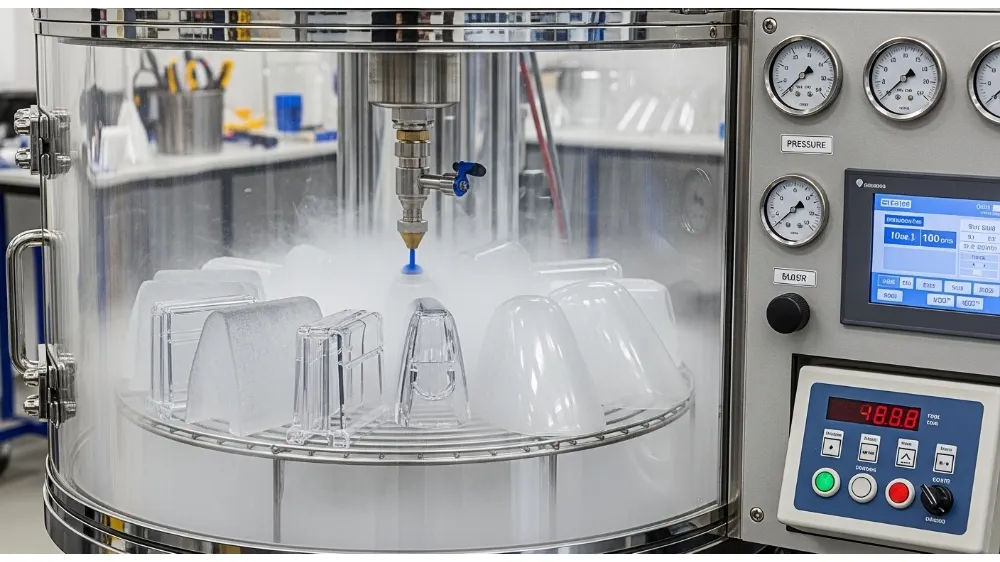
The vapor polishing procedure normally entails the insertion of the plastic part into a hypersaline enclosure. The solvent vapours are added in a controlled way usually under vacuum or regulated temperatures and exposure times. The plastic surface becomes soft, and the micro-roughness and surface irregularities are smoothed. Once enough exposure has taken place, the part is pulled off and allowed to cool the finish.
The most important conditions that can be used to identify success are the concentration of vapor, time of exposure, and temperature control. An excessive exposure may result in distortion or surface melting whereas an inadequate exposure may fail to give the intended smoothness.
The Benefits of Vapor Polishing
Vapor polishing has a number of important benefits over mechanical finishing:
- Brings a very smooth and shiny surface.
- Improves optical clarity of clear components.
- Removes small scratches and marks on machining.
- Cuts down on after processing work and time.
- Enhances esthetic quality and does not coating.
The method is particularly handy in components which are hard to manipulate physically, like a complex housing or an internally detailed component.
Uses of Vapor Polishing
Vapor polishing finds application in the industries where precision and aesthetic quality are needed:
- Medical Devices: Housing of syringes, lenses and diagnostic equipment enjoy the advantage of having a smooth and contaminant free surface.
- Consumer Electronics: The transparent covers, smartphone cases, and display panels are very visually appealing.
- Automotive: The instrument clusters and lighting components are polished to enhance clarity and look.
- Industrial Equipment: Tubing, panels and protective housings are improved to make them more efficient, with improved surface properties.
Vapor polishing is the finishing choice of both large volume and specialized production runs because of this versatility.
Comparison to Other Polishing Methods
Vapor polishing is an opposition to mechanical polishing, flame polishing, and chemical etching:
- Mechanical Polishing: Abrasive based, is capable of producing material unevenness as well as creating micro-scratches.
- Flame Polishing: Flame is applied to smooth surfaces using heat; it is made mostly appropriate in acrylic.
- Chemical Etching: This is a method to change the surface on a chemical basis and is not optically advantageous compared to vapor polishing.
Vapor polishing is a combination of surface smoothing with uniformity at a minimum dimensional change, and is thus suitable in precision parts.
Process Optimization Reflections
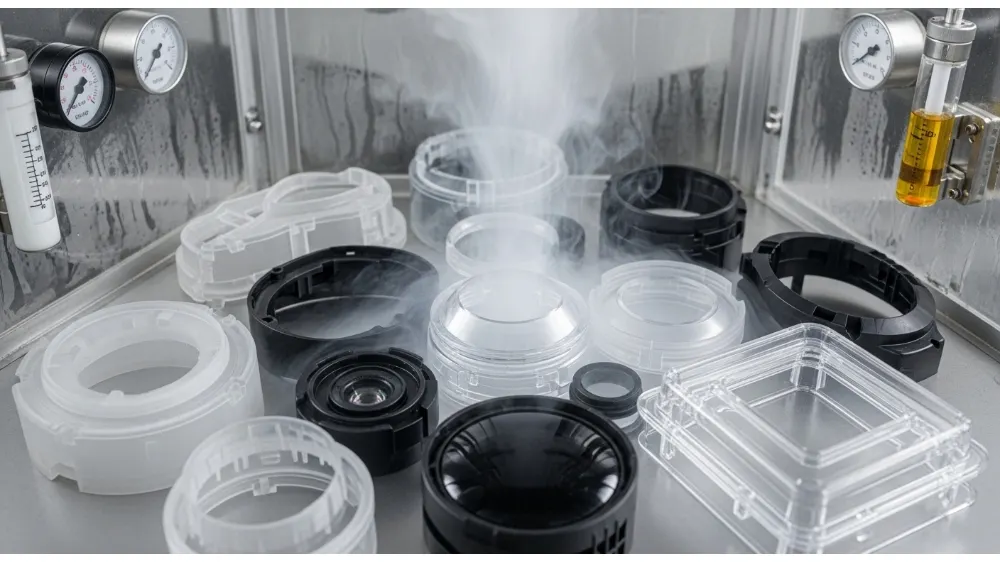
Maximization of vapor polishing incorporates many factors:
- Solvent Selection: Solvent should be selected based on the plastic and give desired effect of surface.
- Exposure Time: Timed to prevent distortion and tolerances.
- Temperature Control: Provides stable surface softness without excessive melting.
- Ventilation and Safety: The correct management of volatile solvents safeguards the employees and avoids contamination.
When these factors are observed, the occurrence of similar, high quality output will be realized across standard production batches.
Vapor Polishing Common Mishaps
Any failure in the vapor polishing may affect the beauty and the functionality of the parts:
- Covering with solvents which are incompatible that cause surface pitting.
- Blasting on components to vapor that warps or shrinks them.
- Poor cooling that has caused surface defects.
- Disregard of the geometry of parts that might need special fixturing.
These risks are alleviated through proper training, process control and quality inspection.
Safety and Environmental Issues
Solvents vapors in vapor polishing are flammable and may be dangerous. In the industrial systems, ventilation systems, fume extraction as well as solvent recycling mechanisms are commonly incorporated.
It should be in agreement with the health and environmental risks of safety standards. The controlled chambers with automated vapor delivery improve the safety of workers and the consistency of the processes.
Quality Inspection and Control
Quality inspection on parts should follow after vapor polishing to determine the surface smoothness, clarity and dimensional stability. These methods are visual inspection, optical inspection and testing of surface roughness. Close tolerances are important when dealing with medical equipment or optical parts.
Frequently Asked Questions (FAQ)
Q1: What is the purpose of vapor polishing?
Vapor polishing enhances the smoothness of surfaces, optical, and aesthetics of thermoplastics components.
Q2: Which plastics vapor polish?
Vapor polishing is applicable to acrylic (PMMA), polycarbonate (PC), and some types of ABS plastics.
Q3: Are the fine features safe in vapor polishing?
Yes, when carefully managed, it may flatten complex geometries without ruining the fine details.
Q4: What is the difference between vapor polishing and flame polishing?
Flame polishing involves heat, and vapor polishing involves chemical vapors in order to produce smooth surfaces.
Q5: Does vapor polishing have an impact on mechanical strength?
When properly used, it mostly affects the surface, and does not impair the total mechanical integrity.
Q6: Is vapor polishing automatable?
Indeed, industrial vapor polishing systems enable the automated and uniform processing of high volume production.
Q7: What are the necessary safety measures?
During vapor polishing, proper ventilation, removal of fumes, recycling of solvents, and personal protection equipment are necessary.
Conclusion
Vapor polishing is another important finishing in the contemporary plastic production. Its capacity to improve the smoothness, clarity on surface and appearance of the surface causes it to be an indispensable material in medical equipment, electronics, automotive components and any other precision parts. Knowing the process, material compatibility, and safety requirements, manufacturers are in a position to manufacture high quality parts that are aesthetically pleasing and reduced waste and post processing labor. The knowledge on vapor polishing methods enables engineers to produce the best products in an efficient and safe manner.
