


Brass CNC Machining
Our CNC machining support helps buyers review the part design before production. This includes material grade, CNC turning or milling method, tolerance requirements, surface finish, plating needs, threaded features, inserts, burr control, inspection expectations, and RFQ documents.
If your project includes brass fittings, connectors, terminals, bushings, inserts, valve parts, decorative hardware, or precision mechanical components, SunOn can review your 2D drawings and 3D CAD files to help confirm a practical manufacturing route.
Custom Brass CNC Machining for Buyer-Ready Parts
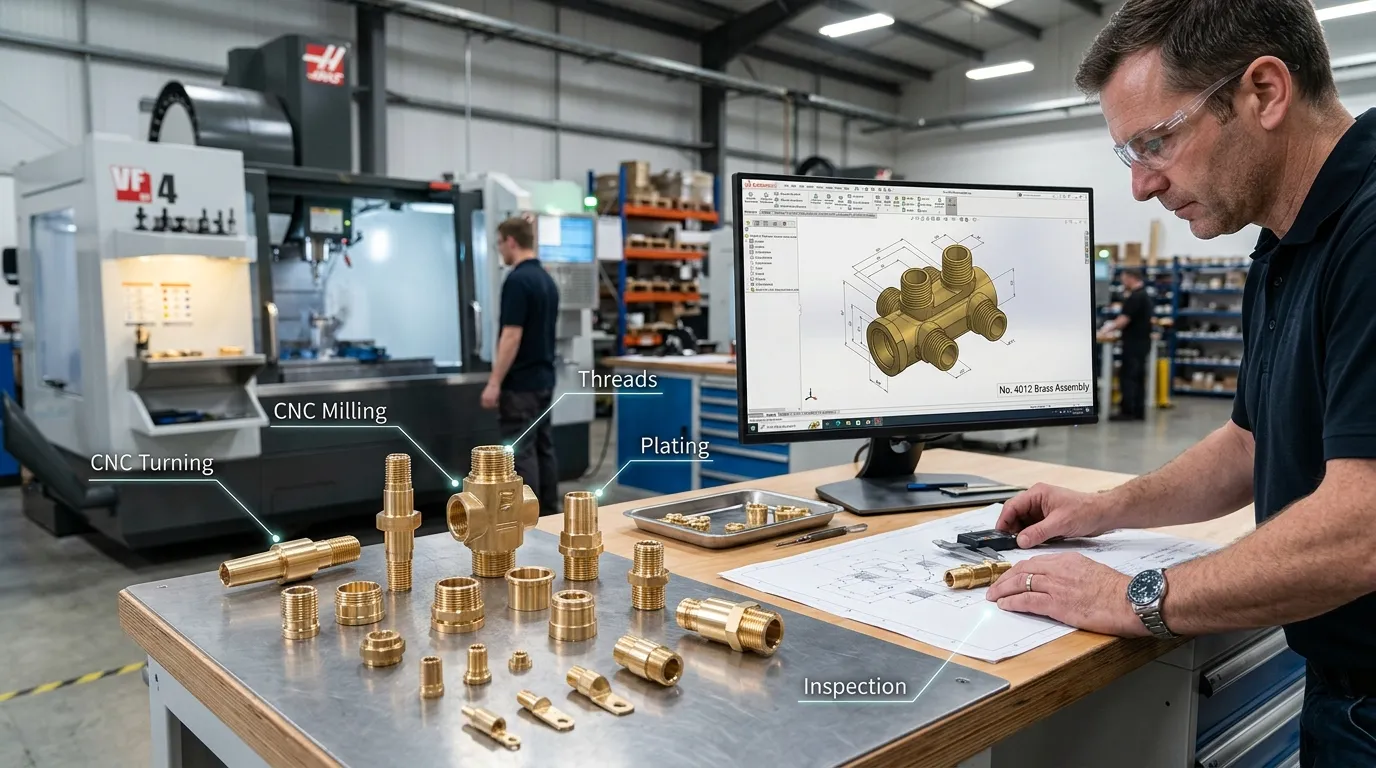
Brass is one of the most machinable metal materials, but the final part still depends on design details. A simple round brass bushing may need CNC turning. A connector block with pockets, holes, and side features may need CNC milling or turning plus milling. A threaded fitting may need extra review for thread accuracy, burr control, and plating buildup.
SunOn supports custom CNC machining for metal and plastic parts, including CNC milling, CNC turning, 5-axis machining, CNC prototype machining, low-volume production, post-processing, surface finishing, assembly, and OEM/ODM manufacturing support.
For related custom CNC capability, buyers can also review SunOn’s CNC machining parts manufacturer page.
When Should Buyers Choose Brass for CNC Machined Parts?
Brass is a strong option when the part needs a balance of machinability, durability, conductivity, and appearance. It is commonly used for components that must assemble smoothly, resist corrosion, or carry electrical current.
Buyers often choose brass for:
- Threaded fittings and connectors
- Electrical terminals and contact parts
- Bushings, sleeves, and low-friction components
- Valve parts, nozzles, and fluid fittings
- Inserts for plastic or metal assemblies
- Precision hardware and decorative parts
- Automotive, industrial, and electronics components
Brass can also be polished or plated for cosmetic and functional needs. However, the correct grade, finish, and tolerance should be confirmed before machining.
Brass Grade and Use-Case Matrix
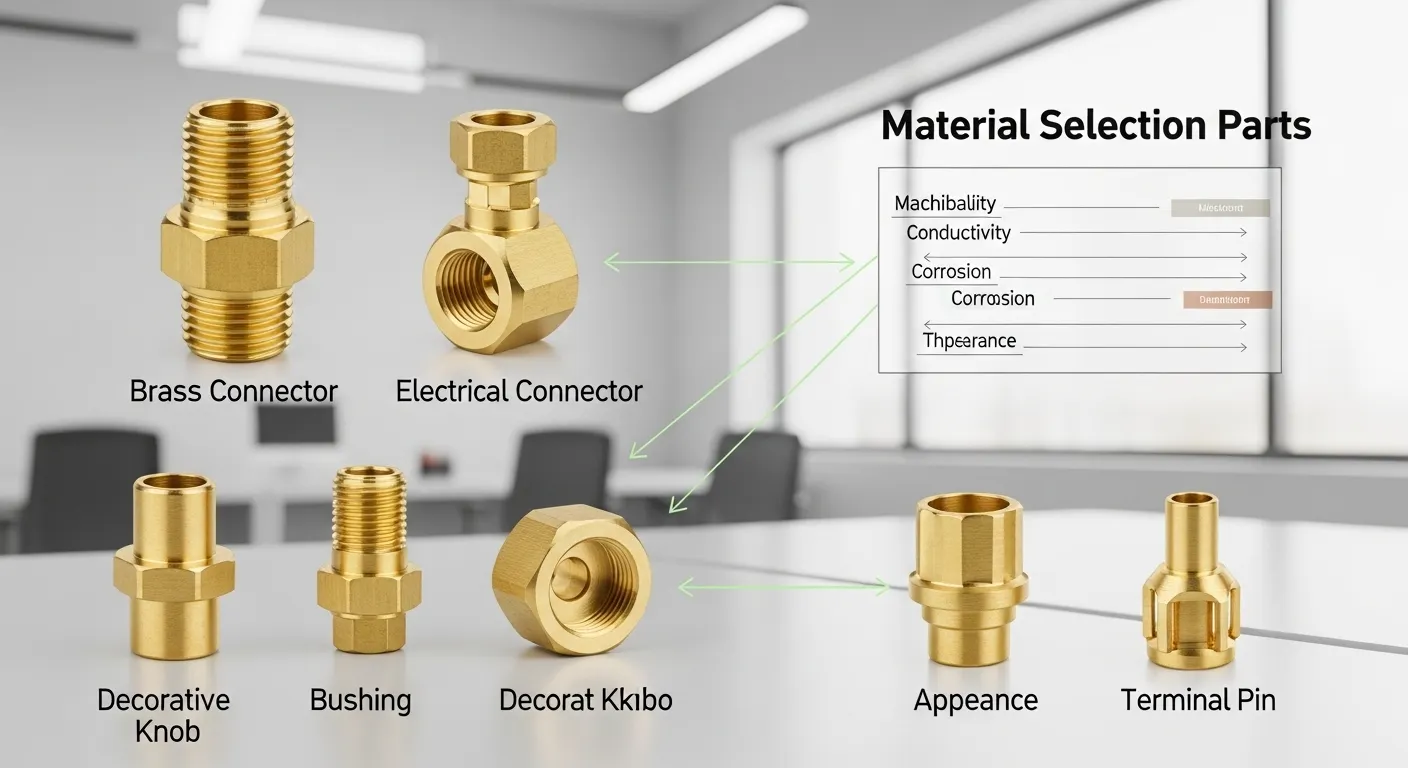
Different brass grades behave differently during machining, forming, threading, and finishing. Buyers may already have a required grade on the drawing. If not, the grade should be selected based on function, machinability, corrosion exposure, conductivity, and finish needs.
| Brass requirement | Common buyer use case | CNC/RFQ notes to confirm |
|---|---|---|
| High machinability | Turned fittings, bushings, inserts, threaded parts | Confirm grade, thread standard, burr-free edges, and inspection needs |
| Good ductility | Formed or lightly machined parts, decorative hardware | Confirm whether the part needs machining only or additional forming |
| Conductivity | Electrical connectors, terminals, contact components | Confirm contact surface, plating, conductivity needs, and assembly method |
| Corrosion resistance | Plumbing, valve, fluid, marine-related hardware | Confirm exposure environment, sealing face, plating, and material grade |
| Cosmetic appearance | Knobs, handles, visible hardware, decorative components | Confirm polishing, brushing, plating, color, and surface defect limits |
| Buyer-specified brass grade | OEM/ODM production or replacement components | Send material standard, drawing note, BOM, or project specification |
SunOn can review project requirements and discuss suitable material options during RFQ. The exact grade, availability, and equivalent material should be confirmed before production.
CNC Turning or CNC Milling for Brass Parts?
The machining method depends on part geometry. Brass machines well, but the wrong process can increase cost, setup time, or dimensional risk.
CNC turning is often suitable for round or cylindrical brass parts, such as:
- Bushings
- Sleeves
- Shafts
- Threaded inserts
- Nuts and fittings
- Pins and round connectors
- Valve and nozzle components
CNC milling is often used for parts with flat faces, pockets, slots, holes, or multi-side features, such as:
- Connector blocks
- Brass housings
- Brackets
- Plates
- Mounting parts
- Small mechanical blocks
- Milled electrical components
Turning plus milling may be needed when a part has both round features and complex side features. For example, a brass connector body may need turned outer geometry, internal threading, cross holes, and milled flats.
For complex geometry, our team can review the CAD model and drawing to check whether CNC milling, CNC turning, or a combined process is more suitable.
Threads, Inserts, Holes, and Burr Control
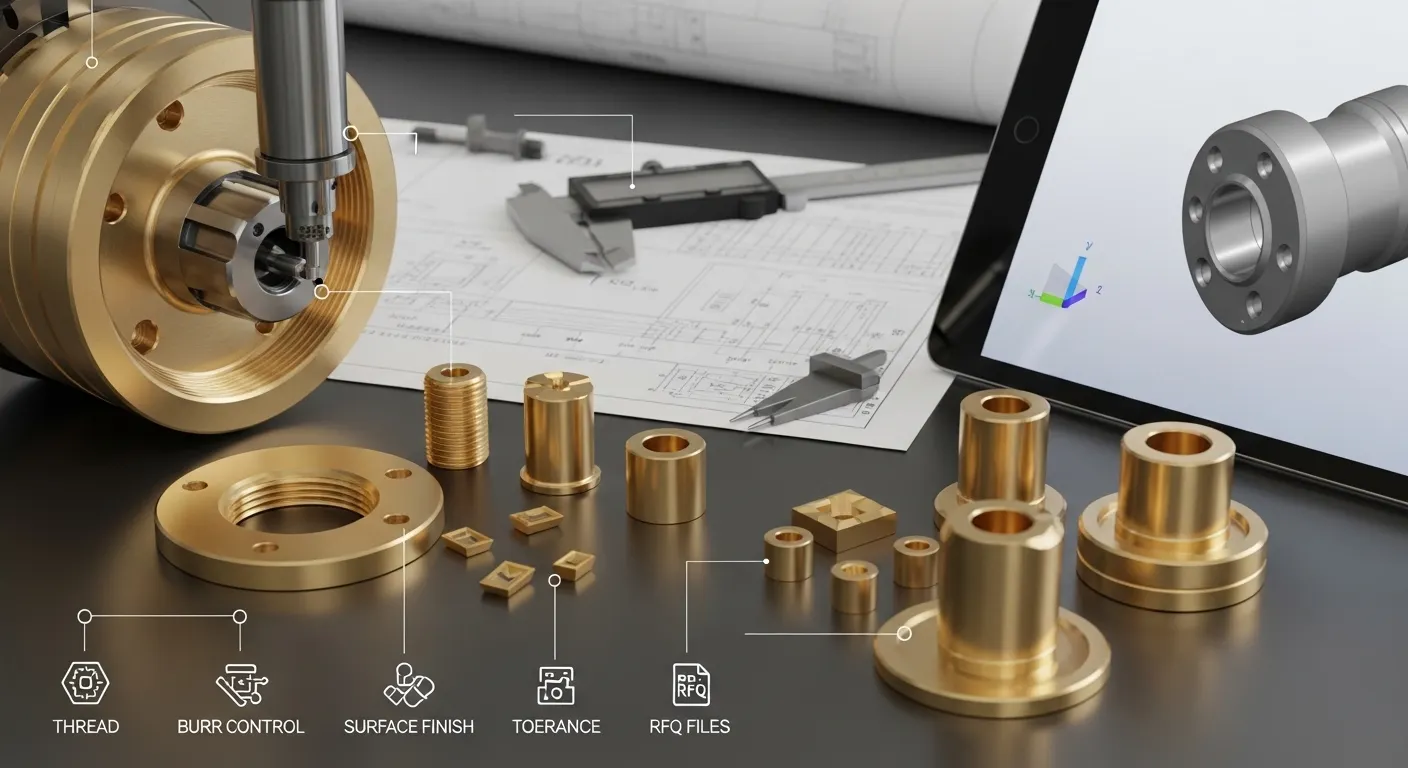
Many brass CNC parts include functional details that affect assembly. These details should not be treated as secondary features.
Threaded brass parts need clear specifications, such as:
- Internal or external thread type
- Metric, UNC, UNF, BSP, NPT, or other standard
- Thread depth
- Fit requirement
- Plating or coating after threading
- Thread gauge or inspection requirement
Burr control is also important. Small burrs around threaded holes, cross holes, slots, sealing faces, and connector edges can affect assembly or performance.
Buyers should mark critical burr-free areas on the drawing. If the part will contact a seal, carry current, rotate, or fit into another assembly, the drawing should clearly show critical edges, chamfers, and surface requirements.
Surface Finish and Plating for Brass CNC Parts
Brass can be used as-machined, polished, brushed, plated, or coated depending on the application. Surface finish affects appearance, corrosion resistance, electrical contact, assembly fit, and cost.
Common finish discussions for brass parts include:
- As-machined finish for functional internal parts
- Polishing or brushing for visible hardware
- Nickel plating for wear or corrosion needs
- Chrome plating for appearance or protection
- Zinc plating or other protective coating where suitable
- Local finish control on sealing, contact, or threaded areas
If the part needs plating, buyers should confirm whether threads, holes, and tight-fitting areas require masking or special control. Plating can change dimensions, especially on threads and small holes.
Tolerance, Inspection, and Quality Details to Confirm
Brass is machinable, but tolerance still depends on the part size, geometry, wall thickness, feature depth, material grade, and finishing process. Buyers should avoid applying tight tolerances to every dimension unless the function requires it.
Before quotation, identify:
- Critical-to-function dimensions
- Thread and hole requirements
- Flatness, concentricity, or perpendicularity needs
- Surface roughness requirements
- Burr-free or edge-break requirements
- Plating thickness or finish notes
- Inspection report requirements
- Assembly or functional testing expectations
A clear 2D drawing helps reduce uncertainty. A 3D CAD file shows geometry, but the 2D drawing should define tolerances, threads, finish, and inspection priorities.
Brass CNC Machining Applications
Brass CNC parts appear in many industries because the material combines machinability, corrosion resistance, and conductivity.
In electrical and electronics projects, brass may be used for terminals, pins, connectors, contact parts, and small housings. These parts often need conductivity review, plating control, and clean edges.
In fluid and plumbing-related assemblies, brass can be used for fittings, couplings, valve parts, nozzles, and sealing components. These parts may need thread accuracy, sealing face control, and corrosion review.
In industrial equipment, brass is often used for bushings, sleeves, gears, low-friction parts, and precision hardware. These projects usually require fit, wear, and assembly checks.
In automotive-related projects, brass may be used for fittings, terminals, bushings, and small mechanical components. For related application support, visit SunOn’s page on CNC machined automotive parts.
Prototype, Small-Batch, and Production Support
A brass part may begin as a prototype and later move into batch production. The RFQ should make this stage clear.
For prototypes, the focus is usually fit, function, material behavior, assembly, and design validation. Buyers may still be adjusting geometry, thread depth, wall thickness, or finish.
For small batches, the focus shifts to repeatability, cost control, fixture planning, inspection, and delivery planning.
For production, buyers should confirm material grade, surface finish, inspection method, packaging needs, assembly requirements, and whether related manufacturing support is needed.
SunOn’s wider service scope includes CNC machining, rapid prototyping, mold making, injection molding, die casting, finishing, assembly, and OEM/ODM manufacturing support. This helps buyers who need more than one manufacturing process across a product lifecycle.
What Should Buyers Send for a Brass CNC Machining Quote?
A complete RFQ helps the manufacturing team review cost, process, tolerance, finish, and risk more accurately. Before contacting SunOn, prepare as many of these details as possible:
- Product or part name
- Application or industry
- Quantity required
- Prototype, small-batch, or production stage
- 3D CAD file
- 2D technical drawing
- Brass grade or material standard
- Critical dimensions and tolerances
- Thread type, depth, and fit requirement
- Holes, slots, undercuts, inserts, or assembly features
- Surface finish, polishing, coating, or plating requirement
- Burr-free or edge-break requirements
- Inspection report requirement
- Functional testing requirement if relevant
- Delivery destination
- Target schedule
- NDA, BOM, or project specification if required
If the grade or finish is not finalized, send the application details. SunOn can review the drawing and discuss practical machining and finishing options.
Why Work With SunOn for Custom Brass Parts?
SunOn Mould supports buyers who need practical engineering communication, not only a price. Brass parts often look simple, but issues can appear in threads, plating, small holes, burrs, sealing faces, and assembly fits.
Our team can help review:
- Whether the part is better suited for CNC turning, milling, or combined machining
- Whether the design may create burr, tool access, or tolerance challenges
- Whether the selected brass grade matches the part function
- Whether the finish or plating may affect assembly
- Whether prototype, small-batch, or production planning should change the machining approach
- Whether additional finishing, assembly, or OEM/ODM support is needed
This makes the page useful for engineers preparing drawings and procurement teams comparing suppliers.
Frequently Asked Questions
Is brass good for CNC machining?
Yes. Brass is widely used for CNC machined parts because it cuts cleanly, supports threads well, resists corrosion, and offers good conductivity. The best grade depends on the part function, finish requirement, and application.
Which brass grade should I choose?
The grade should match the application. Some grades focus on machinability, while others support ductility, corrosion resistance, or appearance. Send your drawing, material standard, or application details so the grade can be reviewed before quotation.
Can SunOn machine threaded brass fittings?
Yes, SunOn can review threaded brass fittings, inserts, connectors, and similar parts for CNC machining. Buyers should provide thread standard, thread depth, fit requirement, plating notes, and inspection needs.
Can brass CNC parts be plated or polished?
Brass parts can often be polished, brushed, plated, or used as-machined. The best finish depends on appearance, corrosion resistance, conductivity, and assembly fit. Plating should be reviewed carefully for threaded or tight-fitting features.
What files are needed for a quote?
Send a 3D CAD file and a 2D drawing when possible. The drawing should include material grade, tolerance, thread details, finish, plating, burr-free areas, inspection requirements, quantity, and application notes.
Can SunOn support prototype and production brass parts?
SunOn can support custom CNC machining projects from prototype review to small-batch and production planning. Buyers should share the project stage, target quantity, technical drawings, finish needs, and inspection expectations.
Request a Brass CNC Machining Quote
Send SunOn your brass part drawings for quote review and DFM discussion. Include the part type, quantity, application, 2D drawing, 3D CAD model, brass grade if known, tolerance requirements, surface finish or plating needs, threading or insert details, burr-control notes, inspection requirements, delivery destination, and target schedule.
SunOn can review your brass CNC machined part and discuss machining method, material selection, finishing, prototype support, production planning, assembly needs, and OEM/ODM manufacturing support before you move forward.
