


Painting vs Pad Printing: Which Finishing Solution is Best?
Choosing between painting and pad printing depends primarily on whether you need to cover a full surface area or apply specific, high-detail graphics. Painting is the process of applying a liquid or powder coating over the entire exterior of a part to provide protection and a uniform color. Pad printing is a versatile printing process that transfers a 2D image—such as a logo, warning label, or instructional text—onto a 3D object using a silicone pad. While painting excels at broad environmental protection and aesthetic uniformity, pad printing is the gold standard for adding branding and fine details to complex, irregular geometries.
Comparison Table: Painting vs. Pad Printing
| Feature | Industrial Painting | Pad Printing |
| Primary Purpose | Full surface protection/color | High-detail branding/graphics |
| Surface Coverage | Complete (100%) | Localized (Icons, Logos) |
| Geometry Fit | Best for large, flat, or simple curves | Best for complex, recessed, or curved surfaces |
| Durability | High (Chemical/UV resistance) | Moderate (Requires specific inks) |
| Tooling Cost | Low (Fixtures/Masking) | Moderate (Clichés and Silicone pads) |
| Setup Time | Fast (Spray booth setup) | Longer (Art alignment/Plate etching) |
The Strategic Importance of Surface Finishing in B2B
In modern manufacturing, the finish is rarely just "cosmetic." For procurement managers and product designers, the choice between painting and pad printing impacts everything from the Design for Manufacturing (DFM) phase to final assembly reliability. A poorly chosen finish can lead to adhesion failure, dimensional interference, or non-compliance with industry safety standards.
At SunOn Industrial Group, we treat finishing as an integral part of the prototype-to-production workflow. Whether you are developing a medical device or a high-performance automotive component, the finishing method must align with the mechanical requirements of the part. This guide helps you navigate these trade-offs to ensure your RFQ leads to a successful, scale-ready production run.
Understanding Industrial Painting Processes
Industrial painting involves the application of a pigmented liquid or powder to a substrate. This provides a protective barrier against moisture, UV radiation, and chemical exposure. In the context of sheet metal fabrication, painting is often the primary defense against oxidation and rust.
Spray Painting vs. Powder Coating
Most B2B applications use spray painting for plastic components and powder coating for metallic parts. Spray painting offers an incredible range of finishes, including matte, high-gloss, and metallic textures. For plastic parts, we often use EMI/RFI shielding paint on the interior surfaces to prevent electronic interference. This is a critical step for hardware founders moving from a functional prototype to a market-ready housing.
When to Prioritize Painting
You should choose painting when the primary goal is to change the base color of the material or provide a specific tactile experience, such as a "soft-touch" finish. It is also the preferred choice for large-scale components where a uniform, durable coat is required across the entire visible surface. If your part is destined for harsh environments, a high-quality polyurethane or epoxy paint provides the necessary resilience.
Decoding the Pad Printing Process
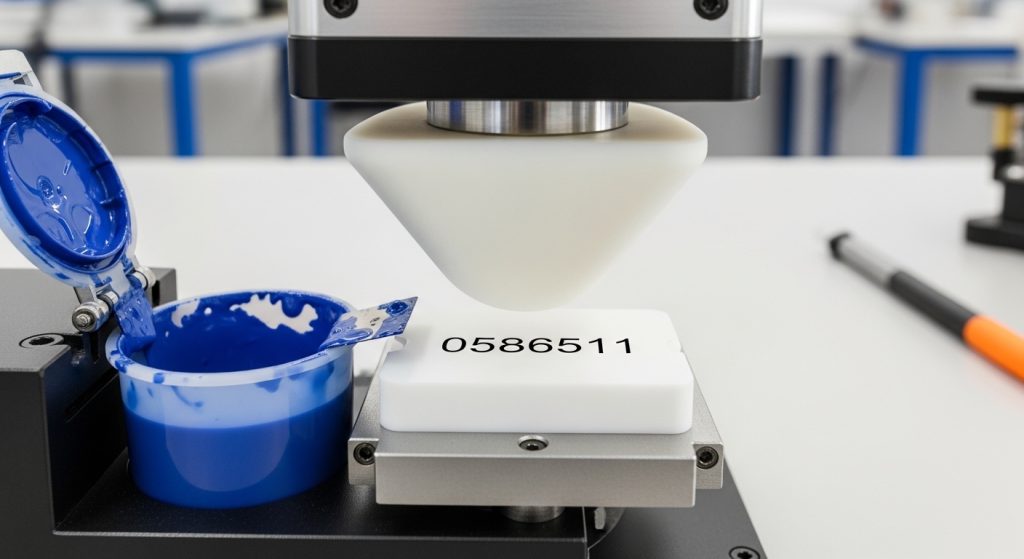
Pad printing (also called tampography) is a unique process because it can transfer images onto surfaces that are not flat. The silicone pad is soft and flexible, allowing it to "wrap" around curves, textures, and even recessed areas that traditional screen printing cannot reach.
The Printing Cycle
The process begins with an etched plate (cliché) that holds the ink in the shape of the desired graphic. The silicone pad presses onto the plate to pick up the ink and then moves to the part to transfer the image. Because the silicone pad is highly adaptable, it can print onto spheres, cylinders, and compound curves with high precision. This is why pad printing is the preferred method for medical dials, keyboard keys, and medical silicone compression molding components.
Graphic Detail and Color Matching
One of the biggest advantages of pad printing is the ability to maintain fine detail. Small text, intricate logos, and multi-colored graphics can be applied with high repeatability. For B2B buyers, this means consistent branding across thousands of units, ensuring that regulatory symbols or safety instructions remain legible forthe life of the product.

Key Decision Factors for Engineering and Procurement
When deciding between painting vs pad printing, you must evaluate several technical and financial factors. Your manufacturing partner should assist in this DFM review to avoid late-stage production hurdles.
1. Geometry and Surface Complexity
If your part has deep recesses or complex 3D contours, pad printing is likely the only way to apply a logo or text. Painting, on the other hand, requires line-of-sight or specific fixture angles to ensure even coverage. If the part has many "blind spots," an automated painting line might struggle to achieve the desired thickness in corners.
2. Tolerance and Material Compatibility
Painting adds a measurable layer of thickness to the part, often between 25 to 100 microns. If your assembly has tight tolerances, you must account for this "growth" in the design phase. Pad printing adds negligible thickness, making it ideal for precision parts. At our injection mould manufacturer California support center, we frequently advise clients on masking strategies to prevent paint build-up on critical mating surfaces.
3. Durability and Environmental Resistance
Industrial paints are specifically formulated for durability. They can withstand salt spray, high humidity, and repeated cleaning. While pad printing inks are also durable, they are more susceptible to abrasion over time if not protected by a clear overcoat. For high-wear items like handheld tools, we often recommend a combination: paint the part for overall protection, then pad print the branding on top of the cured paint.
4. Unit Cost vs. Tooling Investment
Painting usually has a lower initial tooling cost but a higher per-unit cost due to labor and material waste (overspray). Pad printing requires the creation of etched clichés and custom fixtures to hold the part during the printing cycle. However, for high-volume production, the per-unit cost of pad printing is exceptionally low, making it a very efficient choice for large batches.
Integrating Finishing into the DFM Workflow
A successful project starts with a DFM-led quoting process. When you submit an RFQ to SunOn, our engineers look for potential finishing conflicts. For example, if you are using dual material tooling, the paint must adhere to both materials equally well. Different plastics have different surface energies; some require a primer or flame treatment before they can be painted or printed.
We also consider "masking" in the DFM phase. If a part needs to be painted but has threaded holes or grounding points that must remain bare, we design custom masking fixtures. This reduces manual labor and improves lead time reliability. High-quality documentation of these masking zones ensures that every part in the mass-production phase is identical to the approved prototype.
Quality Assurance and Testing Standards

In B2B manufacturing, "looking good" is not enough. The finish must pass rigorous Quality Assurance (QA) testing. We utilize several standardized tests to verify the integrity of both painting and pad printing:
- Cross-Hatch Adhesion Test: We use a specialized cutting tool to create a grid on the surface, then apply and remove tape to see if any paint or ink peels off.
- Chemical Resistance Test: Parts are exposed to common chemicals (like alcohol or cleaning agents) to ensure the graphics or coatings do not degrade.
- Color Matching (Spectrophotometry): We use digital color-matching tools to ensure that the "Brand Blue" on your painted part exactly matches the "Brand Blue" on your pad-printed logo.
- Abrasion Testing: Using a "Crockmeter" or similar device, we simulate years of user handling to see how the finish holds up under friction.
Providing these testing results is part of our commitment to transparency and supplier communication. We believe that hardware founders and procurement leads should have full confidence in the durability of their parts before they ever reach the end-user.
Lead Time and Scale-Up Readiness
When moving from prototype to mass production, finishing can become a bottleneck if not planned correctly. Painting usually requires drying or curing time in an oven, which adds hours to the production cycle. Pad printing is much faster, with inks that often dry almost instantly.
To ensure lead time reliability, we maintain state-of-the-art spray booths and multi-color pad printing machines in-house. This vertical integration allows us to control the schedule and avoid the delays associated with outsourcing to third-party finishing shops. When we provide a quote, we include the estimated time for finishing so your product launch stays on track.
Frequently Asked Questions
Can you pad print on a painted surface?
Yes, this is a common industrial practice. We often apply a base coat of paint for color and protection, then pad print logos or instructions on top. It is crucial to ensure that the pad printing ink is chemically compatible with the base paint to prevent peeling or "bleeding."
Which is better for small, high-precision text?
Pad printing is significantly better for small text. While you can use stencils for painting, they cannot achieve the sharpness or fine resolution of a silicone pad and an etched cliché. Pad printing can clearly render text as small as 4pt or 5pt, which is essential for compliance labels on medical or electronic devices.
Does the material of my part affect the choice of finish?
Absolutely. Metals like aluminum or zinc require different primers than plastics like ABS or Polypropylene. Some "low-energy" plastics like PE or PP may require corona or flame treatment before painting or pad printing to ensure the ink or paint bonds to the surface. We always evaluate material compatibility during the RFQ stage.
Is powder coating a type of painting?
Technically, powder coating is a dry finishing process where a thermoplastic or thermoset polymer powder is applied electrostatically and then cured under heat. It is much more durable than liquid paint and is the preferred finish for aluminum or zinc die-casting mould parts used in industrial settings.
How do I provide my artwork for pad printing?
For the best results, we require vector files (such as .AI, .EPS, or .PDF). Vector files allow us to scale the graphic without losing any detail and are used to create the high-resolution etched clichés needed for the printing process.
Conclusion: Optimizing Your Finish for Market Success
The choice between painting vs pad printing is ultimately about matching the finishing technique to the functional and aesthetic needs of your product. If you need total surface protection and a professional color change, painting is the way to go. If you need high-detail branding, instructions, or logos on a complex part, pad printing is the superior tool.
At SunOn Industrial Group Limited, we help global B2B buyers navigate these complexities every day. From the first DFM review to the final QA inspection, our goal is to deliver parts that exceed your expectations for quality and durability.
Ready to select the perfect finish for your next project?
Contact SunOn today for a technical DFM review or to request a competitive RFQ. Let our engineering team help you bridge the gap from prototype to mass production with the right finishing solution.
